Cocoa price forecast for 2026-2027
Uncertainty rises over El Niño's impact on cocoa supply
Published by Pasquale Marzano. .
Food Cocoa ForecastSince February 2026, international cocoa quotations have risen by more than 70%, averaging over 5500 dollars per tonne in the first two weeks of September. The rally is mainly attributable to a deterioration in expectations for global supply and, in particular, to the growing probability of an intense El Niño event developing[1].
El Niño is a climate phenomenon associated with the anomalous warming of surface waters in the central-eastern Pacific Ocean. Depending on its intensity, it can alter temperatures and rainfall patterns on a global scale. In West Africa, it can lead to drought conditions, penalizing production in Ghana and Côte d'Ivoire, which together account for roughly 60% of global cocoa supply. In Ecuador, the world's third-largest producer, it can instead trigger particularly heavy rainfall, raising the risk of flooding and disruptions to harvesting and drying operations.
In recent weeks, the US Climate Prediction Center, the US government agency specializing in climate forecasting, updated its assessment, putting the probability of El Niño reaching very high intensity during the autumn and winter of 2026-2027 at over 90%[2]. This revision has heightened concerns over the 2026-2027 season, which begins in October 2026, prompting market participants to price in a higher risk premium for a renewed supply shortfall.
Given the recent price dynamics, this article examines how new information has reshaped the outlook for cocoa prices. To this end, indications from several sources are compared, with the aim of identifying the most plausible price levels for the coming two years. The benchmark used is cocoa traded on the Intercontinental Exchange (ICE), the leading international financial reference.
Financial market expectations implied by futures contracts
The chart below compares the ICE cocoa futures curves recorded on April 1 and September 3, 2026. The comparison shows how the price structure for delivery over the following 24 months has changed.
Comparison of ICE cocoa futures curves, in dollars per tonne
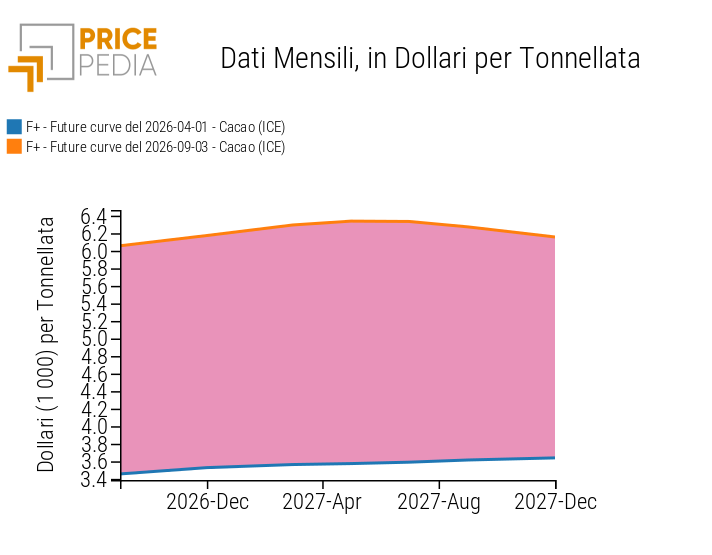
The curve recorded on September 3 sits well above the one from early April, pointing to a substantial upward revision of the prices implied by futures contracts. For the end of 2026, the new curve points to quotations above 6000 dollars per tonne, compared with roughly 3400 dollars priced in at the start of April.
The revision also extends into 2027: the September curve stays above 6200 dollars for most of the year, coinciding with the final stretch of the 2026-2027 season, compared with levels close to 3600 dollars embedded in the April curve.
Consensus Economics forecast
A second source considered is Consensus Economics, which collects forecasts from a panel of analysts specializing in commodities. The spread of responses makes it possible to build a forecast range and gauge the degree of uncertainty surrounding the outlook. Comparing successive surveys also shows how analysts' expectations shift over time.
The chart below shows the distribution of forecasts for the ICE cocoa price in December 2027, comparing the April and August 2026 surveys.
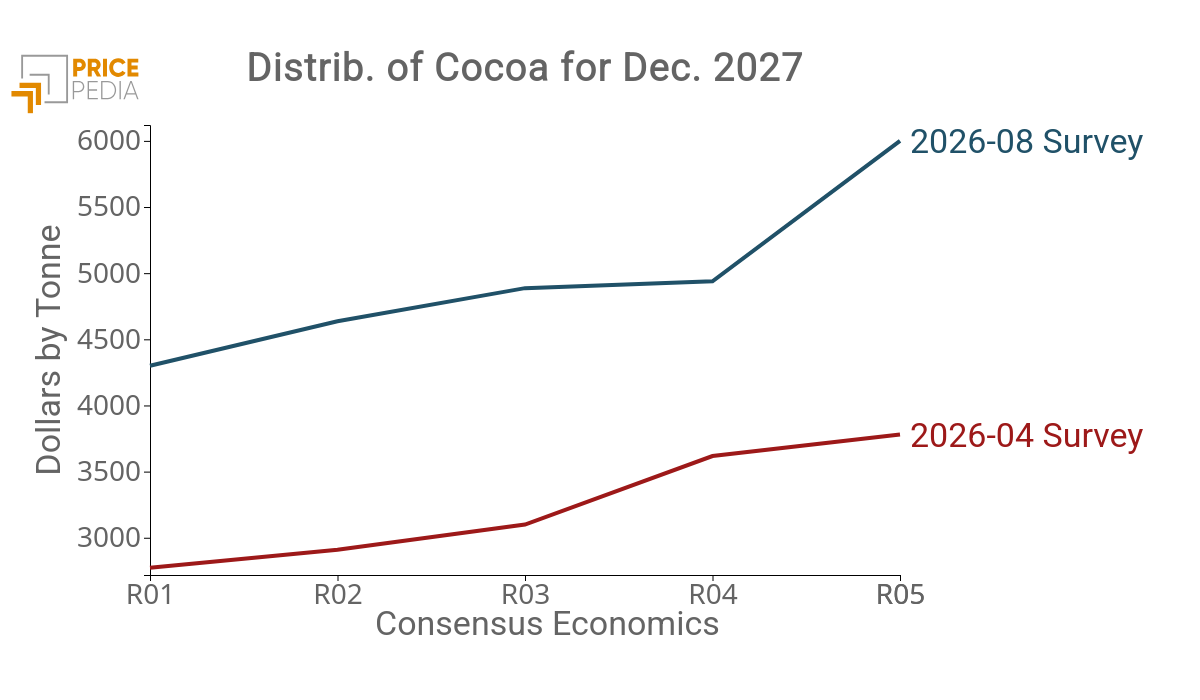
The chart shows that analysts' forecasts have been revised sharply higher. In the August survey, the range for December 2027 runs between 4300 and 6000 dollars per tonne, compared with roughly 2800 to 3800 dollars in April.
The average forecast recorded in August for December 2027 sits just under 5000 dollars per tonne, around 19% below the average quotations for the first two weeks of September 2026.
On an annual basis, however, the Consensus points to a roughly 12% price increase in 2027 versus the 2026 average, consistent with a heightened risk of a supply squeeze. That expected increase remains more moderate than what is implied by the futures curve, which factors in a higher risk premium.
PricePedia forecast
PricePedia's forecast for ICE cocoa takes into account the shift in scenario implied by both financial market expectations and the Consensus Economics forecasts outlined above.
The chart below presents the outlook for the ICE cocoa spot price, updated with the information available as of early September 2026.
PricePedia forecast for the ICE cocoa price, in dollars per tonne
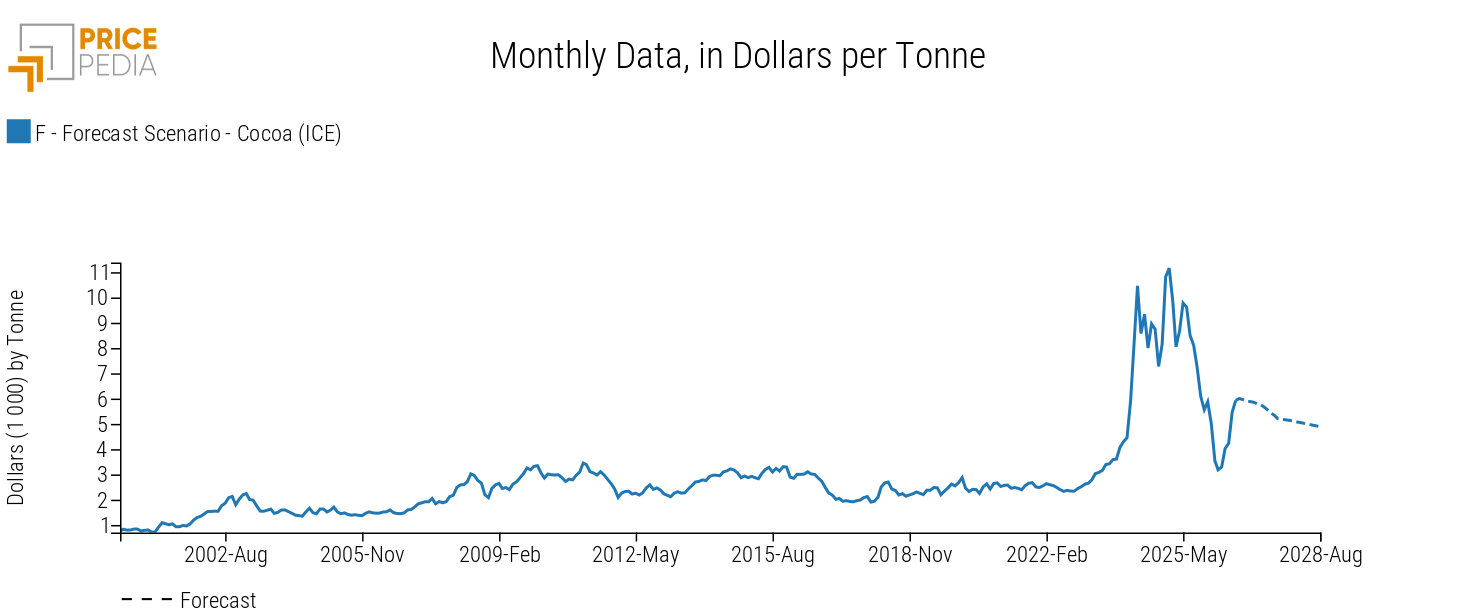
The PricePedia scenario points to a gradual decline in quotations from the levels reached in September 2026, down to a value close to 5000 dollars per tonne by August 2028. By December 2027, the price is expected to sit just above that threshold, broadly in line with the average assessment from Consensus Economics.
In terms of annual averages, 2026 is expected to see a decline of more than 40% from the exceptional levels of 2025, which exceeded 8200 dollars per tonne. In 2027, by contrast, prices are expected to rise by around 12% versus the 2026 average, in line with Consensus Economics and with the greater supply risk tied to the 2026-2027 season.
In summary
The sharp rise in cocoa prices seen since February 2026 is mainly driven by a revision in supply expectations. The growing probability of a very intense El Niño event has raised the risk of adverse weather conditions in the main producing regions, supporting both spot prices and forward delivery contracts.
All the sources considered point to average prices in 2027 above those of 2026, consistent with the greater supply risks tied to the 2026-2027 season.
The main source of uncertainty lies in the scale of the expected increase, with the various sources placing it in a range between 12% and 29%.
1. For further details, see El Niño.
2. See US forecaster says more than 90% risk of a very strong El Nino - Reuters.
You may be interested in:
Flexible packaging tailored to technical requirements: the PET/ALU/PE coffee pouch case
Published by Pasquale Marzano. .
Food Should CostStarting from the PET/PE stand-up pouch, how preservation requirements reshape the Should Cost structure [ Read all ]

Hormuz Strait crisis and food packaging: from price dynamics to cost structure
Published by Pasquale Marzano. .
Food Packaging Paper Basic thermoplastics Should CostAn example of integrating non-material costs into the Should Cost for two stand-up pouch configurations [ Read all ]

Hormuz Crisis and Food Packaging
Published by Pasquale Marzano. .
Food Packaging Paper Basic thermoplastics Should CostHow material composition drives different cost impacts [ Read all ]