Hormuz Crisis and Food Packaging
How material composition drives different cost impacts
Published by Pasquale Marzano. .
Food Packaging Paper Basic thermoplastics Should CostIn the article Increasing raw material prices for food packaging, it was explained how the Strait of Hormuz crisis has triggered ripple effects across multiple industrial supply chains, including food processing, through rising prices of packaging materials. In particular, in May 2026, food packaging material prices increased by more than 14% compared with February of the same year, the last month before the outbreak of the conflict in the Persian Gulf.
However, this percentage represents an average across heterogeneous situations and can vary significantly depending on the mix of materials purchased by packaging converters and the specific production requirements of different packaging solutions.
To assess more accurately the impact of the Hormuz crisis on different types of packaging, it is useful to compare two specific cases. The analysis focuses on flexible packaging solutions used for the same finished product, such as granola and muesli, ensuring that both packaging types are subject to identical functional requirements and can therefore be considered substitutes.
In this regard, stand-up pouches (doypacks) provide an illustrative example. They consist of one or more layers of materials such as paper, plastic, or aluminium, designed to contain and protect food products. Unlike traditional flat pouches, stand-up pouches feature a bottom gusset that allows them to remain upright on store shelves. Thanks to their combination of lightweight design, excellent printability, and barrier properties against moisture and oxygen, they are widely used for products such as snacks, dried fruit, coffee, and, indeed, granola and muesli.
To analyse the cost dynamics of the two packaging solutions, we use the Should Cost tool available on PricePedia, which enables the construction of synthetic technical cost indices based on the breakdown of a product into its main raw materials.
The analysis considers two different stand-up pouch configurations: one paper-based and one plastic-based (PET/PE).
Building Should Cost Indices for Flexible Packaging
To construct the respective Should Cost indices for the two granola and muesli pouches, the individual components were identified and a corresponding technical coefficient was assigned to each, expressed in kilograms per tonne of finished product.
| Technical coefficients (kg) per tonne of finished product | |||
|---|---|---|---|
| Material | PricePedia EU customs price series | Paper pouch | PET/PE pouch |
| Kraft paper | Kraft paper (weight ≤ 150 g/m²) | 780 | - |
| Polyethylene | LDPE polyethylene | 220 | 700 |
| PET | Polyethylene terephthalate (PET) | - | 280 |
| Adhesives and coatings | Isocyanates | 20 | 20 |
| Printing inks | Ethyl acetate | 10 | 10 |
| Total | 1030 | 1010 | |
In both cases, the sum of the technical coefficients exceeds one tonne. This reflects the fact that the coefficients implicitly incorporate the production scrap associated with each packaging solution.
In addition, for illustrative purposes, a number of simplifying assumptions have been introduced that do not affect the conclusions of the comparison:
- only raw-material cost drivers are considered, excluding labour, energy, and other non-material inputs;
- for secondary materials such as inks, adhesives, and coatings, identical technical coefficients are assumed for both packaging types.
The chart below compares the two Should Cost indices, highlighting how alternative packaging structures, while meeting the same functional requirements, can follow significantly different cost trajectories in response to the same market shock.
Food Packaging: Comparison of Stand-Up Pouch Should Cost, Euro-Based Indices (2022-01 = 100)
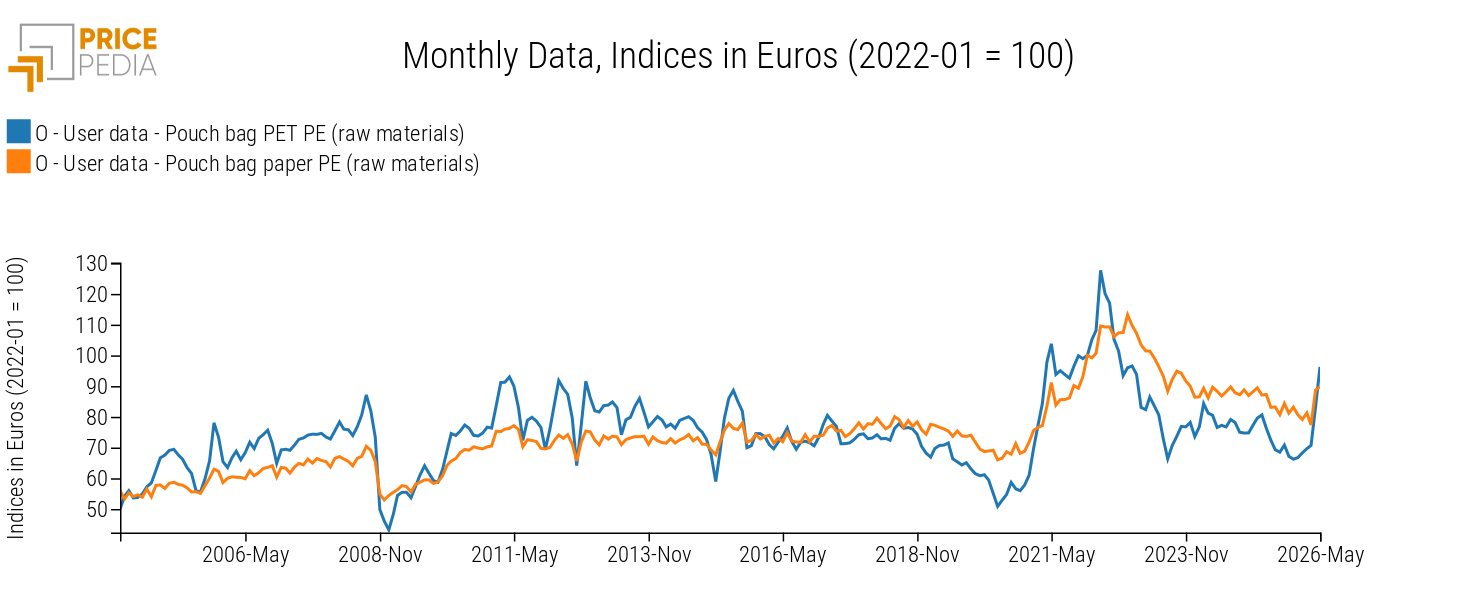
The chart highlights the different dynamics of the two stand-up pouch Should Cost indices. Historically, the PET/PE solution has exhibited greater volatility than the paper-based alternative, reflecting its higher exposure to fluctuations in petrochemical prices.
This pattern is also evident in the most recent period: since February, the technical cost of the plastic pouch has increased by more than 38%, while the paper-based pouch has recorded a more moderate rise of approximately 10%.
The stronger increase in PET/PE packaging is primarily attributable to the sharp rise in polyethylene prices, which have increased by nearly 50% over the period considered, reflecting the supply chain's direct exposure to the Strait of Hormuz crisis. By contrast, paper-based packaging is less exposed to these dynamics due to the lower weight of plastic materials in its overall cost structure.
Conclusions
The analysis shows that the Strait of Hormuz crisis is generating highly differentiated effects across the food packaging industry, depending on the material composition of packaging solutions.
The higher share of petrochemical-based polymers in PET/PE stand-up pouches results in a more direct and amplified transmission of the cost shock, whereas the greater use of paper in the alternative pouch helps mitigate overall exposure to the market dynamics associated with disruptions in the Strait.
Do you want to stay up-to-date on commodity market trends?
Sign up for PricePedia newsletter: it's free!
You may be interested in:
Flexible packaging tailored to technical requirements: the PET/ALU/PE coffee pouch case
Published by Pasquale Marzano. .
Food Should CostStarting from the PET/PE stand-up pouch, how preservation requirements reshape the Should Cost structure [ Read all ]
Hormuz Strait crisis and food packaging: from price dynamics to cost structure
Published by Pasquale Marzano. .
Food Packaging Paper Basic thermoplastics Should CostAn example of integrating non-material costs into the Should Cost for two stand-up pouch configurations [ Read all ]
Polyethylene: the rise of Chinese exports in a market marked by supply shortages
Published by Luca Sazzini. .
Plastics and Elastomers Basic thermoplastics China in global commodity marketsChina eases global tensions over polyethylene [ Read all ]