PricePedia Scenario for September 2026
Purchase material prices amid geopolitical tensions and supply shortages
Published by Pasquale Marzano. .
Forecast ForecastThe PricePedia Forecasting Scenario, based on the information available as of September 3, 2026, continues to be affected by the high degree of uncertainty surrounding the geopolitical landscape. In recent weeks, the diplomatic stalemate between the United States and Iran has been accompanied by a renewed escalation on the ground, with both sides launching attacks against vessels transiting the Strait of Hormuz, a strategic chokepoint for global hydrocarbon trade. These developments have heightened market concerns over the availability of oil and, above all, natural gas, as discussed in the latest weekly update.
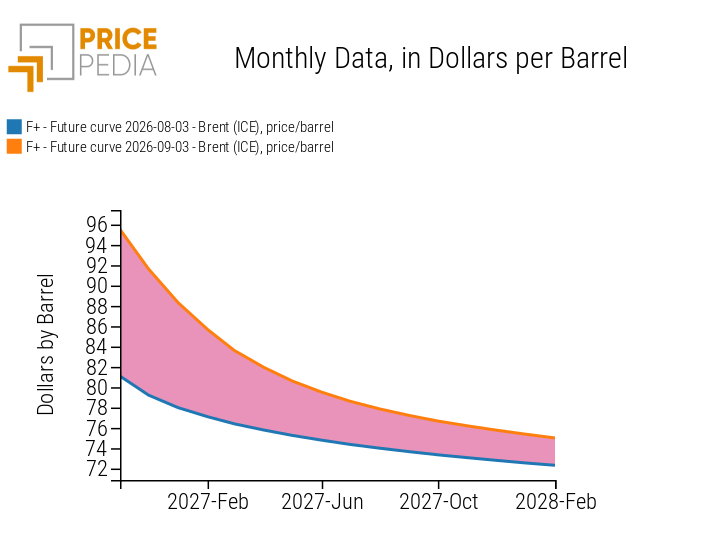
The following charts illustrate how financial market expectations for Brent crude oil and TTF natural gas prices have changed, comparing the futures curves recorded on September 3, 2026, with those observed on August 3, 2026. Prices are expressed in dollars per barrel and euros per megawatt-hour (MWh), respectively.
Energy Commodity Futures Curves
Brent Crude Oil, USD/barrel
TTF Natural Gas, EUR/MWh
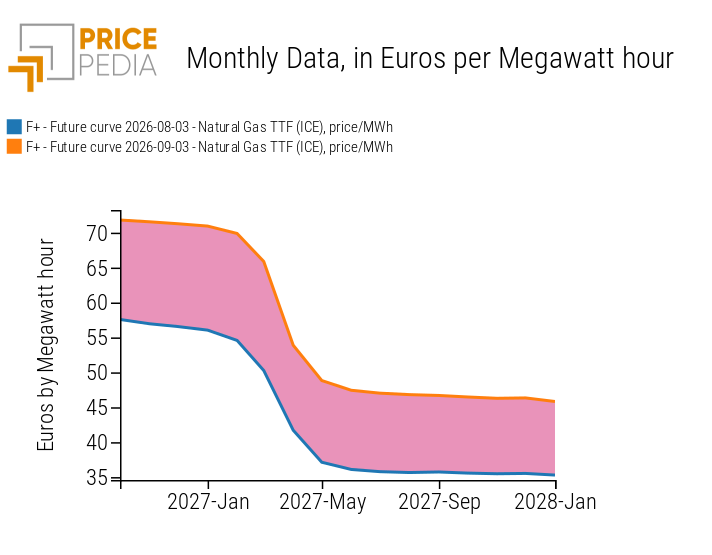
Extending the movement observed in the previous scenario, the September futures curves for both oil and natural gas stand above their levels of one month earlier. This points to a further upward revision in market price expectations over the next 24 months.
For Brent crude oil, the latest curve implies prices above $90 per barrel through the end of the year, compared with approximately $80 per barrel in the August 3 curve. For 2027, the September 3 curve incorporates a price of around $80 per barrel, against $75 per barrel one month earlier.
The most pronounced upward revision, however, concerns TTF natural gas. Expectations reflect the European market's particular exposure to potential disruptions in supplies from the Persian Gulf, against a backdrop of lower storage levels than in the same period of previous years. The September 3 curve therefore points to a price above €70 per MWh at the end of 2026, around €15 per MWh higher than indicated by the August 3 curve. The upward adjustment also extends to 2027 maturities, for which the implied average price rises from €41 per MWh in the August curve to approximately €53 per MWh.
The September 2026 PricePedia Scenario
The shift in natural gas and oil price expectations over the next 24 months also translates into an upward revision for European energy commodities, whose prices are forecast to increase by an average of 27% in 2026. Compared with the previous scenario, the assumption of a gradual easing of geopolitical tensions and a normalization of trade flows through the Strait of Hormuz in 2027 remains unchanged. This would result in an average decline in energy commodity prices of around 10% next year.
Energy commodity trends also have a significant impact on the overall European commodity price index. Average prices are forecast to increase by 13.4% in 2026, followed by a 4.3% decline in 2027.
The following table reports the annual changes, expressed in euros, for the main commodity aggregates included in the PricePedia Scenario: Industrial Commodities[1], Total Commodities[2], Energy Commodities and Food Commodities.
Table 1: Annual Rates of Change (%) in the PricePedia Aggregate Indices, in Euros
| 2024 | 2025 | 2026f | 2027f | |
|---|---|---|---|---|
| I-Forecast Scenario, 3 Sep. 2026 Info-Commodity Index (Europe) | −4.11 | −4.90 | +13.38 | −4.33 |
| I-Forecast Scenario, 3 Sep. 2026 Info-Energy Total Index (Europe) | −6.16 | −11.66 | +27.04 | −9.91 |
| I-Forecast Scenario, 3 Sep. 2026 Info-Industrials Index (Europe) | −4.65 | −3.17 | +6.69 | +2.30 |
| I-Forecast Scenario, 3 Sep. 2026 Info-Food Total Index (Europe) | +8.83 | +17.10 | −8.20 | −3.62 |
Over the 2026-2027 period as a whole, industrial commodity prices are forecast to rise by 9%. The strongest increases are expected in supply chains most exposed to higher natural gas and petrochemical feedstock costs. This is the case for fertilizers and thermoplastic polymers, whose prices are forecast to increase by 38% and 16%, respectively.
Among the other industrial sectors, prices for non-ferrous metals are also expected to rise. In particular, quotations for copper and copper alloys, especially bronze and brass, are forecast to increase by around 30% over the two-year period. Demand generated by the twin energy and digital transitions is being compounded by concerns over the limited availability of mined supply. These same factors are also shaping the outlook for zinc, whose prices are expected to rise by almost 21% overall.
Upward pressures also extend to ferrous metals. Within this sector, hot-rolled coil prices are forecast to rise by 15% overall, supported by higher energy costs, European protectionist measures and the recent decline in steel production.
A different trend emerges for food commodities, whose prices are forecast to decline by approximately 12% overall in 2026-2027. The aggregate figure, however, conceals divergent trends within the sector. One of the main exceptions is wheat, whose price is expected to rise by almost 17% amid concerns that supply may fall short of expectations.
1. L'indice PricePedia Industriali risulta dall'aggregazione degli indici relativi alle seguenti categorie merceologiche: Ferrosi, Non Ferrosi, Legno e Carta, Chimica: Specialty, Chimici Organici, Chimici Inorganici, Plastiche ed Elastomeri e Fibre Tessili.
2. L'indice PricePedia Totale Commodity risulta dall'aggregazione degli indici relativi alle commodity industriali, alimentari ed energetiche.
You may be interested in:

Elastomer price forecasts for 2026–2027
Published by Luca Sazzini. .
Forecast Elastomers Natural Rubber ForecastWhat is the outlook for elastomer prices amid rising petrochemical costs and supply risks? [ Read all ]

PricePedia Scenario for October 2026
Published by Pasquale Marzano. .
Forecast ForecastThe new escalation renews upward pressure on industrial commodity prices [ Read all ]

Cobalt: is the price decline set to continue?
Published by Luca Sazzini. .
Forecast Cobalt ForecastPrevisioni dei prezzi del cobalto LME 2026-2027 [ Read all ]