Flexible packaging tailored to technical requirements: the PET/ALU/PE coffee pouch case
Starting from the PET/PE stand-up pouch, how preservation requirements reshape the Should Cost structure
Published by Pasquale Marzano. .
Food Should CostIn the previous articles on flexible food packaging[1], we compared the Should Cost of two stand-up pouch solutions for granola and muesli packaging: one predominantly paper-based and the other made of PET and polyethylene. The analysis showed how differences in material composition lead not only to different cost levels, but also to different exposure to raw material market dynamics.
For products with more demanding preservation requirements, such as roasted coffee beans, the plastic stand-up pouch can be used as a starting point and adapted to meet specific functional requirements.
One example is the PET/ALU/PE pouch, a multilayer laminated structure that differs from the PET/PE stand-up pouch by incorporating:
- an aluminium foil layer, which enhances barrier properties against oxygen, moisture and light, helping preserve the coffee's aroma and freshness;
- a one-way degassing valve, which allows the carbon dioxide naturally released by roasted coffee to escape while preventing outside air from entering the package.
This article presents a Should Cost configuration for this flexible packaging solution for roasted coffee beans, taking into account both material costs and non-material costs (energy, labour and manufacturing operations). The analysis is carried out using the PricePedia Should Cost tool, which makes it possible to build synthetic technical cost indices by breaking down a product into its individual cost components.
The Should Cost of a PET/ALU/PE pouch for roasted coffee beans
As discussed above, the PET/ALU/PE pouch differs from the PET/PE stand-up pouch through the addition of an aluminium foil layer and a one-way degassing valve, both introduced to meet the functional requirements of roasted coffee bean packaging.
For the one-way valve, the analysis does not use the purchase cost of the finished component. Instead, it breaks the valve down into its underlying cost elements. As a result, the overall bill of materials combines the materials and manufacturing operations required to produce the multilayer pouch with those needed to manufacture the one-way valve.
For labour and manufacturing, the average hourly costs reported in a previous article are used. Compared with the PET/PE stand-up pouch, both labour and manufacturing hours are higher, 6 and 16 hours, respectively, to account for the additional operations required for aluminium lamination and the production of the one-way degassing valve.
The table below reports the cost breakdown per tonne of finished product. For each component, it shows:
- the price series representing its cost driver;
- the technical consumption coefficient per tonne of finished product;
- its share of total cost, calculated using January 2022 as the base period.
Table 1: Cost breakdown of a PET/ALU/PE pouch with one-way valve for roasted coffee beans
| Component | Cost driver | Technical coefficients per tonne of finished product |
Cost share (%) |
|---|---|---|---|
| PET | Polyethylene terephthalate (PET) | 137.8 kg | 5.68 |
| Aluminium foil | Aluminium alloys plates (thickness of 0,2 - 3 mm) | 180.5 kg | 21.75 |
| Polyethylene film + valve body | Polyethylene LDPE | 659.5 kg | 35.62 |
| Adhesives and coatings | Isocyanates | 28.5 kg | 2.38 |
| Printing inks | Ethyl acetate | 9.5 kg | 0.52 |
| Valve membrane and fluid | Silicones | 3.2 kg | 0.77 |
| Energy | PUN electricity (Italy) (GME) | 680 kW | 4.87 |
| Labour + manufacturing | Harmonized Index of Consumer Prices Euro Area | 902.4 euro | 28.41 |
| Total | 100 |
As with the PET/PE pouch, material costs are the largest component of the PET/ALU/PE Should Cost, accounting for more than 66% of the total. The sum of the technical material coefficients is slightly above one tonne per tonne of finished product, reflecting manufacturing scrap and process materials that are not fully incorporated into the final packaging.
As in the PET/PE configuration, polyethylene is the single largest cost component, representing more than 35% of total cost. This reflects its use both in the inner film of the pouch and in the body of the one-way degassing valve.
The second largest cost component is labour and manufacturing, accounting for approximately 28% of the Should Cost. Aluminium follows with a share close to 22%. Its significant contribution reflects not only its technical consumption coefficient but also its typically higher price level compared with the other raw materials included in the bill of materials.
Do you want to stay up-to-date on commodity market trends?
Sign up for PricePedia newsletter: it's free!
Overall, polyethylene, aluminium, and labour and manufacturing together account for more than 85% of the total packaging cost. Each of the remaining components contributes less than 6% individually, playing a comparatively smaller role in determining the overall cost.
The chart below compares the PET/ALU/PE pouch configuration with the PET/PE stand-up pouch, with both expressed in euros per tonne.
Food packaging: comparison between different configurations, euros per tonne
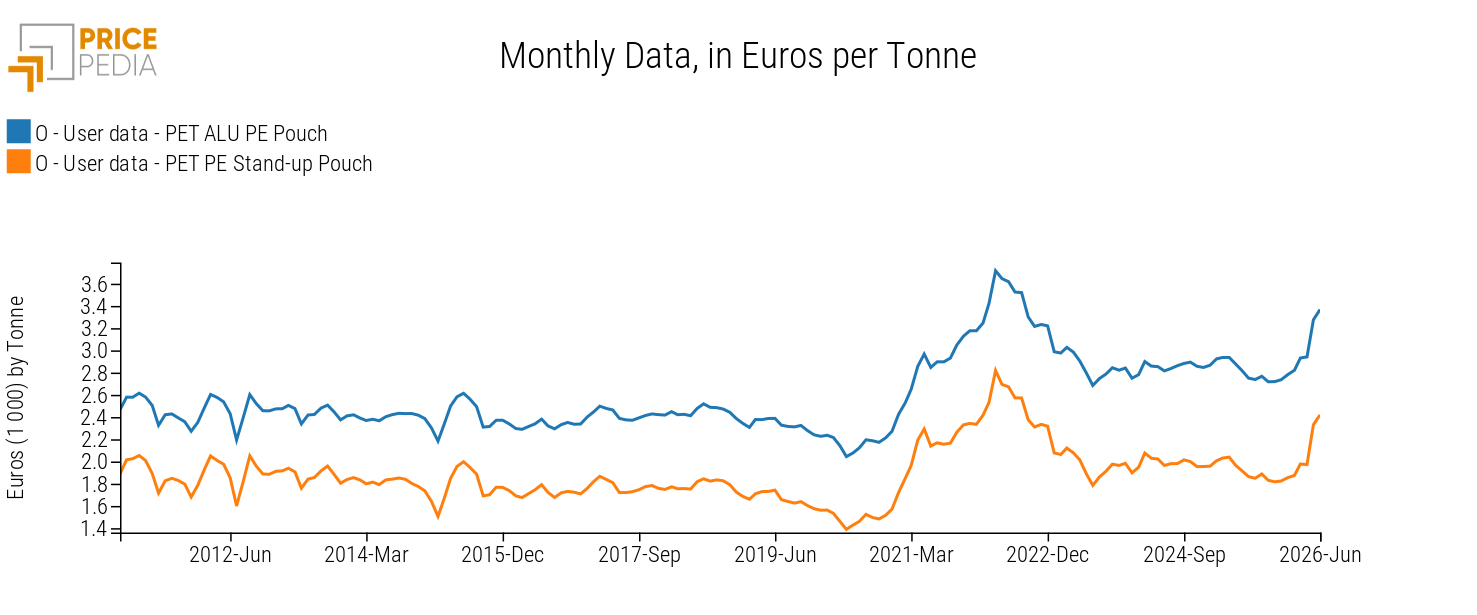
The comparison shows that the PET/ALU/PE pouch and the PET/PE stand-up pouch follow very similar cost dynamics. In both configurations, polyethylene is the dominant cost component and therefore drives most of the overall cost trend.
However, the functional requirements of roasted coffee packaging, which make the aluminium layer and the one-way degassing valve necessary, result in a higher Should Cost for the PET/ALU/PE pouch than for the PET/PE stand-up pouch. This cost premium has also widened over time, increasing from around 600 euros per tonne in early 2011 to more than 900 euros per tonne in June 2026.
Conclusions
The Should Cost analysis of the PET/ALU/PE pouch shows that adding more advanced functional features could lead to a structural increase in the technical cost of the packaging. At the same time, it demonstrates how the Should Cost model can be tailored to the specific characteristics of the purchased product, making it a valuable analytical tool for procurement teams.
By configuring the model according to the packaging's technical structure, procurement professionals can monitor its cost evolution over time through its main cost drivers and compare it with alternative packaging solutions. This makes it easier to assess suppliers' price revision requests and determine whether the proposed increases are consistent with changes in the product's underlying cost structure.
1. The previous articles are:
You may be interested in:
Cocoa price forecast for 2026-2027
Published by Pasquale Marzano. .
Food Cocoa ForecastUncertainty rises over El Niño's impact on cocoa supply [ Read all ]
Hormuz Strait crisis and food packaging: from price dynamics to cost structure
Published by Pasquale Marzano. .
Food Packaging Paper Basic thermoplastics Should CostAn example of integrating non-material costs into the Should Cost for two stand-up pouch configurations [ Read all ]
Hormuz Crisis and Food Packaging
Published by Pasquale Marzano. .
Food Packaging Paper Basic thermoplastics Should CostHow material composition drives different cost impacts [ Read all ]