Hormuz Strait crisis and food packaging: from price dynamics to cost structure
An example of integrating non-material costs into the Should Cost for two stand-up pouch configurations
Published by Pasquale Marzano. .
Food Packaging Paper Basic thermoplastics Should CostIn the article Hormuz Crisis and Food Packaging, it was observed how the crisis in the Hormuz Strait has so far generated significantly heterogeneous effects on the food packaging sector, depending on the material composition of the packaging.
In particular, the analysis considered two stand-up pouches (doypacks) configurations for granola and muesli: one paper-based and one plastic-based. By building two Should Cost indices based exclusively on raw materials, it emerged that the plastic stand-up pouch shows higher volatility and greater exposure to fluctuations in the petrochemical supply chain, while the paper-based solution exhibits a relatively more stable dynamic.
To complete the cost analysis of the two flexible packaging solutions, it is useful to also consider the other components contributing to total cost formation, namely energy consumption, labour, and industrial transformation activities. This allows an assessment not only of cost dynamics, but also of overall cost level.
Breakdown analysis
Based on the approach described in the article Building a reliable Should Cost: the importance of breakdown analysis, the cost is decomposed through a structured breakdown approach, extending the scope beyond raw materials to include energy, labour, and transformation activities.
The first step consists in defining technical coefficients, representing the unit input requirements needed to obtain one ton of finished product. In the case analysed in this article, these coefficients are expressed as follows:
- kilograms for raw materials,
- kilowatts for energy consumption,
- labour hours and machine hours, subsequently valued using the corresponding average hourly costs.
For the cost components related to labour and transformation, the assumptions reported in the table below are also applied.
Table 1: Stand-up pouches for granola and muesli, cost breakdown for labour and transformation
| Labour | Transformation | |||||
|---|---|---|---|---|---|---|
| Hourly cost (January 2022) (EUR) |
Number of hours | Technical coefficient (EUR) | Hourly cost (January 2022) (EUR) |
Number of hours | Technical coefficient (EUR) | |
| Paper PE Pouch | 30.4 | 5 | 152 | 45 | 20 | 900 |
| PET/PE Pouch | 30.4 | 4 | 122 | 45 | 10 | 450 |
For labour, the European average hourly manufacturing cost is used, equal to 30.4 euros (source Eurostat). For transformation, the same average hourly cost is assumed for both configurations.
Regarding the number of hours required, the higher value assumed for the paper-based configuration reflects the need for more conversion operations, making it more process-intensive.
This also results in higher energy usage for the paper-based doypack.
The following table reports the complete cost breakdown of the two pouches. For each component, the following are associated:
- a representative price series for the corresponding cost driver;
- the technical coefficient per ton of finished product;
- the resulting cost share, calculated using the Should Cost tool, assuming January 2022 as the base period.
Table 2: Cost breakdown of stand-up pouches for granola and muesli
| Technical coefficients per ton of finished product |
Cost share (%) | ||||
|---|---|---|---|---|---|
| Component | Cost driver | Paper pouch | PET/PE pouch | Paper pouch | PET/PE pouch |
| Kraft paper | Kraft paper (basis weight ≤ 150 g/m²) | 780 kg | - | 35.31 | - |
| Polyethylene | LDPE polyethylene | 220 kg | 700 kg | 14.82 | 51.43 |
| PET | Polyethylene terephthalate (PET) | - | 280 kg | - | 15.71 |
| Adhesives and coatings | Isocyanates | 20 kg | 20 kg | 2.08 | 2.27 |
| Inks | Ethyl acetate | 10 kg | 10 kg | 0.68 | 0.75 |
| Energy | Italian electricity PUN index | 650 kW | 550 kW | 5.80 | 5.36 |
| Labour + Transformation | Euro area consumer price index | 1052 euro | 572 euro | 41.31 | 24.48 |
| Total | 100 | 100 | |||
In both stand-up pouch solutions, raw materials represent the main cost component, accounting for more than 50% of total technical cost. This share rises to around 70% in the PET/PE configuration, reflecting its strong dependence on petrochemical-based polymers. In particular, LDPE polyethylene alone accounts for more than half of the total packaging cost.
Energy costs show a very similar incidence in both configurations, standing at around 5%, indicating that energy consumption, while relevant, is not the main differentiating factor between the two technologies.
The most significant difference emerges in labour and transformation costs. In the paper-based stand-up pouch, these two items jointly account for more than 40% of total technical cost, compared to about one quarter in the PET/PE packaging.
This gap is driven by the industrial characteristics of the two solutions. PET/PE doypacks are a well-established production standard, with high production speeds. Paper-based doypacks, by contrast, require more complex conversion processes to provide kraft paper with the properties required for food packaging.
These structural differences are reflected in both the level and dynamics of the two Should Cost indices. The chart below compares the two indices, expressed in euros per ton of finished product.
Food packaging: comparison of stand-up pouch Should Cost, EUR per ton
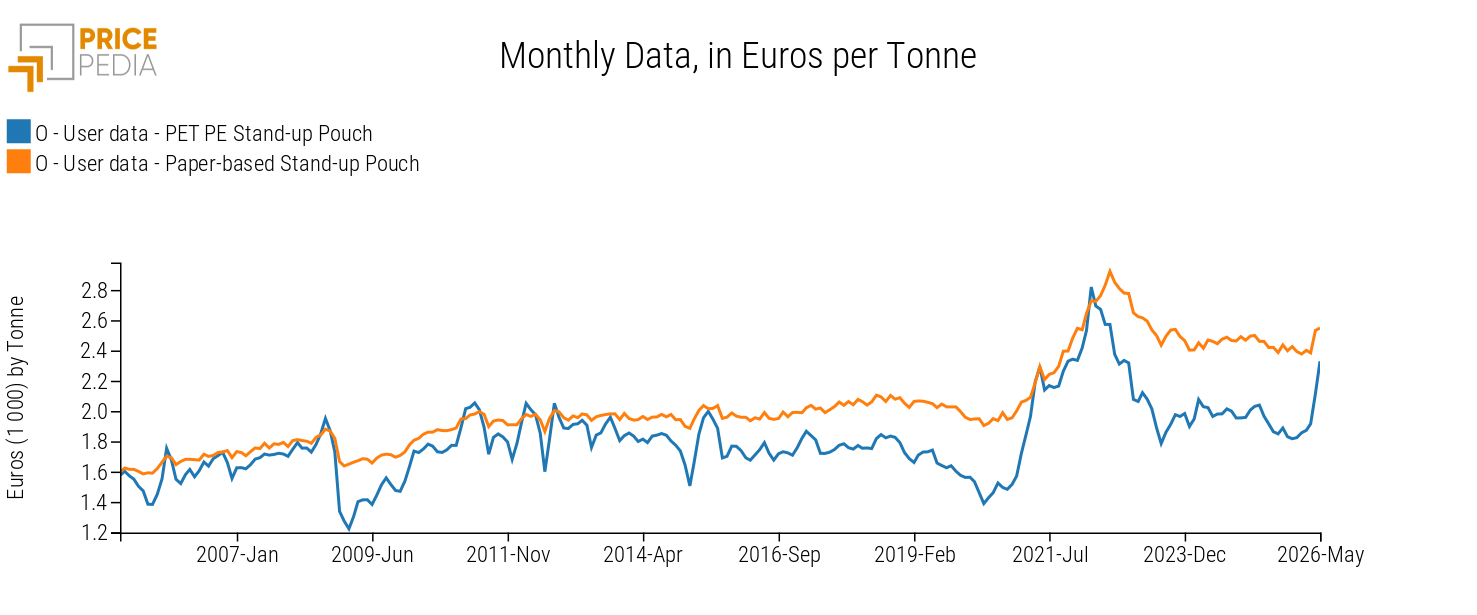
Although showing smaller fluctuations, the paper-based pouch exhibits systematically higher cost levels than the PET/PE solution, reflecting the greater incidence of transformation activities and labour.
The PET/PE pouch, on the other hand, shows lower cost levels, as it is characterised by more mature and standardised production processes. However, this advantage comes with greater exposure to fluctuations in energy and petrochemical commodities, as highlighted by recent dynamics. In recent months, in fact, the Hormuz Strait crisis has led to a significant increase in the cost of PET/PE pouch, reducing the relative advantage over the paper-based alternative.
Conclusions
The Should Cost analysis of the two stand-up pouch configurations highlights that packaging selection does not depend solely on the average cost level, but also on its stability over time and on the different exposure to key market drivers.
Over the past twenty years, the PET/PE pouch solution has recorded a significantly lower average cost compared to the paper-based alternative. This economic advantage, however, comes with higher volatility, driven by strong dependence on petrochemical raw materials and energy market dynamics.
The paper-based pouch, instead, shows higher average cost levels, mainly due to the greater incidence of labour and transformation activities. At the same time, its cost structure is less exposed to fluctuations in petrochemical commodities, ensuring greater stability over time.
For food companies, the optimal choice between the two solutions therefore depends on competitive positioning and strategic objectives. Companies primarily focused on cost minimisation may find the PET/PE solution more efficient. Conversely, for mid-to-high-end or premium products, the paper-based solution may represent a coherent choice not only in terms of greater cost stability, but also in terms of differentiation strategies that enhance perceived packaging sustainability for the end consumer.
From this perspective, the higher cost of the paper-based solution can be interpreted as the price of lower exposure to petrochemical supply chain risks and of a potential strengthening of product market positioning.
Do you want to stay up-to-date on commodity market trends?
Sign up for PricePedia newsletter: it's free!
You may be interested in:
Cocoa price forecast for 2026-2027
Published by Pasquale Marzano. .
Food Cocoa ForecastUncertainty rises over El Niño's impact on cocoa supply [ Read all ]
Flexible packaging tailored to technical requirements: the PET/ALU/PE coffee pouch case
Published by Pasquale Marzano. .
Food Should CostStarting from the PET/PE stand-up pouch, how preservation requirements reshape the Should Cost structure [ Read all ]
Hormuz Crisis and Food Packaging
Published by Pasquale Marzano. .
Food Packaging Paper Basic thermoplastics Should CostHow material composition drives different cost impacts [ Read all ]