Polymeric MDI: Prices rising across international markets
The Hormuz crisis reduces Saudi supply and strengthens China’s role as a benchmark in the global market
Published by Daniel Vito Lobasso. .
Organic Chemicals Strait of HormuzAmong the petrochemical commodities most affected by the geopolitical tensions of 2026 is polymeric methylene diphenyl diisocyanate (polymeric MDI), one of the main isocyanates used in polyurethane production. This product is primarily used in rigid PU and PIR foams for building insulation, refrigeration and insulation panels, as well as in the production of adhesives, binders for wood-based panels, and certain automotive and industrial applications.
Following the outbreak of the conflict with Iran and the resulting disruption to traffic through the Strait of Hormuz, international polymeric MDI prices recorded significant increases in the second quarter of 2026.
Given the importance of this product across industrial value chains, it is useful to understand the factors contributing to its price dynamics. To this end, the analysis first examines the evolution of MDI prices relative to the costs of the main raw materials and then considers the structure of international trade, in order to assess whether changes in product availability have also contributed to the increase.
International polymeric MDI price dynamics
The following chart compares international polymeric MDI prices, expressed in euros per tonne, based on three different sources:
- intra-EU customs price of polymeric MDI;
- FOB price of US exports;
- FOB price of Chinese exports.
To assess the role of production costs, the chart also shows the price trend of benzene, one of the main upstream raw materials in the polymeric MDI production chain.
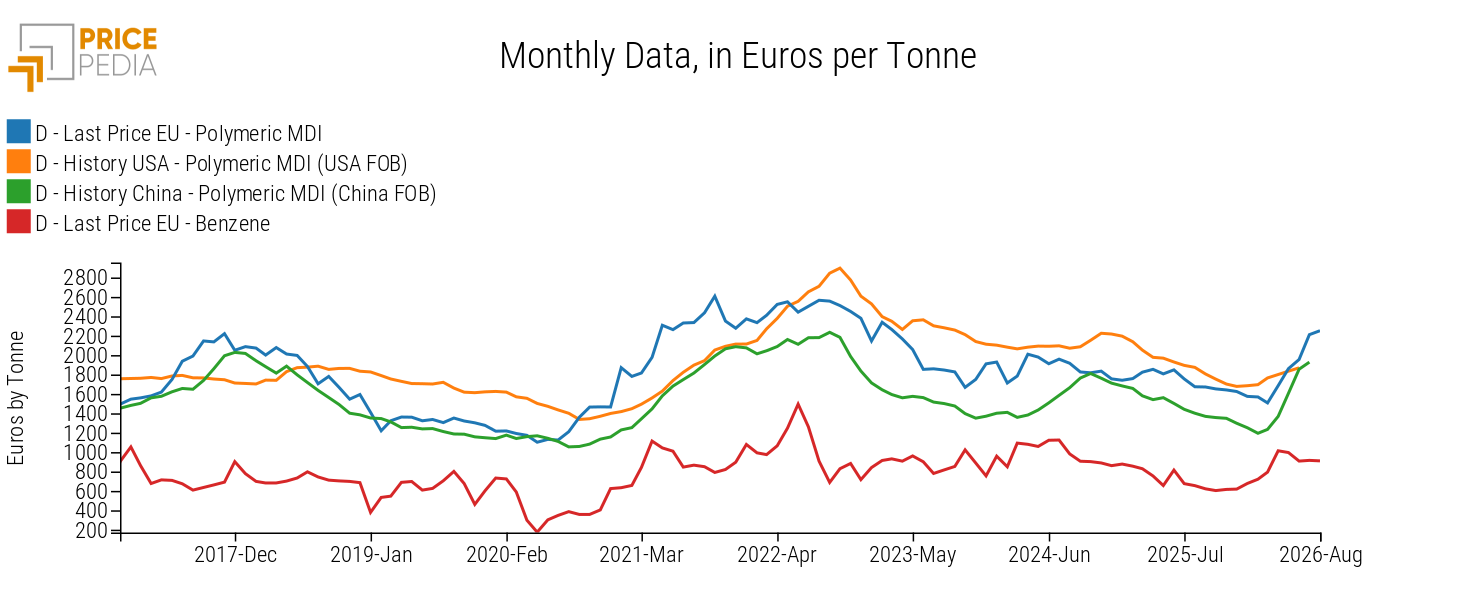
As shown in the chart, international polymeric MDI prices have increased across all the markets considered since February 2026. The strongest increase was recorded in the FOB price of Chinese exports, which rose by a cumulative 61%. Europe also recorded a significant increase of 43%, while the rise in the US FOB price was more moderate, at close to 10%.
Over the same period, benzene prices also experienced a major shock. In Europe, during the second quarter of 2026, the average price increased by approximately 30% compared with the first three months of the year. The increase was concentrated mainly in April, when the price exceeded one thousand euros per tonne, before declining in the following months while remaining above pre-conflict levels.
The rise in benzene prices therefore certainly contributed to the initial increase in polymeric MDI prices. Higher raw-material costs and, more generally, higher energy costs placed additional pressure on production costs. However, benzene price dynamics alone do not appear sufficient to explain the scale and persistence of the increase observed in polymeric MDI prices.
Global trade in polymeric MDI
To understand whether production-cost pressures were accompanied by a factor related to product availability, it is useful to examine the geographical structure of international supply. The following chart shows the main suppliers of polymeric MDI worldwide (source: ExportPlanning).
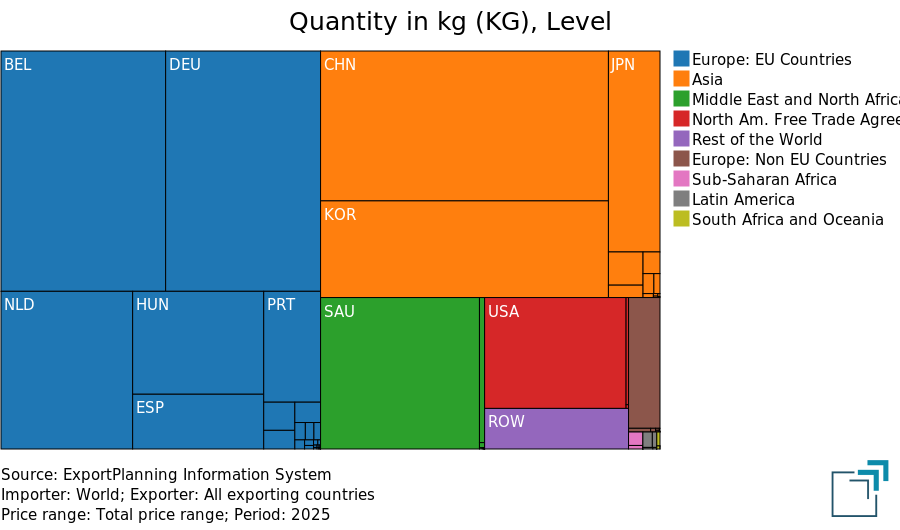
In 2025, China was the world’s largest exporter of polymeric MDI, with approximately 724 thousand tonnes and a share of more than 16% of global trade. It was followed by Belgium and Germany, with shares of around 15% and 14% respectively, and South Korea, with just over 10%.
Among Persian Gulf countries, the relevant role is concentrated almost entirely in Saudi Arabia, which exported approximately 404 thousand tonnes in 2025, equivalent to almost 10% of global trade.
Overall, however, the most important trading bloc is the European Union, whose member states together account for approximately half of global exports.
This international supply structure changed during 2026. The outbreak of the conflict between the United States and Iran and the resulting disruption of traffic through the Strait of Hormuz led to a significant reduction in flows from Saudi Arabia, one of the world’s leading suppliers of polymeric MDI.
The following chart shows quarterly global imports of polymeric MDI originating from China and Saudi Arabia (source: ExportPlanning).
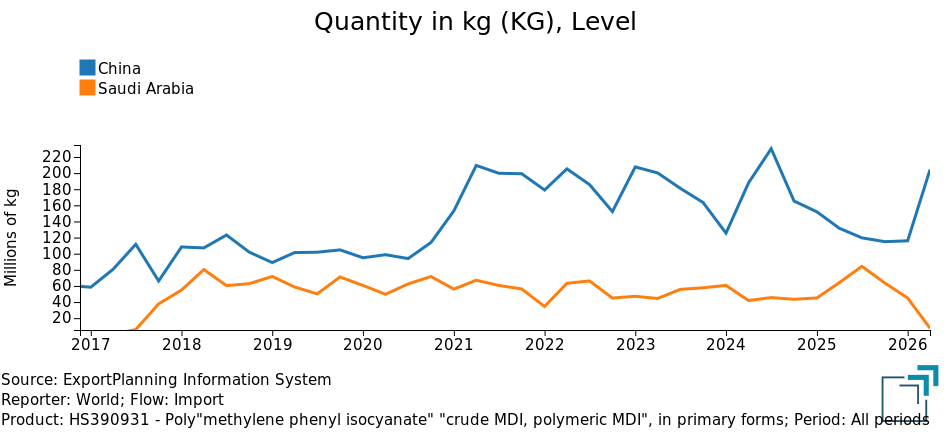
Between the first and second quarters, Saudi Arabian exports fell from approximately 45 thousand tonnes to just over 7 thousand tonnes, a contraction of more than 80%. Over the same period, Chinese exports increased from approximately 116 thousand tonnes to more than 204 thousand tonnes, representing growth of close to 76%.
The increase in chinese supply therefore more than offset, at least in the observed trade flows, the reduction in saudi exports. Although the Hormuz crisis significantly reduced the availability of MDI from the Gulf, it therefore does not appear to have resulted in an equivalent contraction in global supply.
This does not, however, rule out an impact on availability as perceived by market participants. In a period characterised by high uncertainty, the sharp reduction in Saudi supplies may have encouraged buyers to bring purchases forward or increase precautionary inventories, thereby supporting current demand. Under this scenario, even with overall global supply remaining sufficient, stronger precautionary demand may have contributed to upward pressure on international prices.
The mechanism described is consistent with the findings of a previous article, according to which, although isocyanates are produced through energy-intensive industrial processes, their prices tend to respond primarily to relative product scarcity. Raw-material costs help determine the minimum economically sustainable price level, while during periods of market tension it is mainly plant availability, logistics, inventories, and the balance between supply and demand that determine the magnitude of the price cycle.
Conclusions
The increase in polymeric MDI prices in the second quarter of 2026 therefore appears to reflect a combination of higher production costs and tensions surrounding product availability. The Hormuz crisis supported benzene and energy prices while at the same time sharply reducing saudi exports. Higher chinese supply offset the reduction in saudi flows in quantitative terms, but uncertainty regarding the continuity of supply may have encouraged an increase in precautionary purchasing, thereby contributing to sustained prices.
Do you want to stay up-to-date on commodity market trends?
Sign up for PricePedia newsletter: it's free!
You may be interested in:
Strait of Hormuz risk after more than six months of conflict in the Persian Gulf
Published by Pasquale Marzano. .
Energy Organic Chemicals Petrolchimica Strait of HormuzTrade flows and prices of the commodities most vulnerable to a Strait of Hormuz closure [ Read all ]
Cyclohexanone cost pass-through
Published by Daniel Vito Lobasso. .
Organic Chemicals Price DriversThe role of phenol and cyclohexane in the price formation and transmission of one of the most important chemical intermediates in the benzene-nylon value chain [ Read all ]
International Octanol Prices on the Rise
Published by Daniel Vito Lobasso. .
Organic Chemicals Price DriversIl ruolo del propilene e il cost pass-through nella formazione dei prezzi internazionali [ Read all ]