How are the rules governing the European steel market changing?
From the CBAM to new safeguard measures: the European response to growing competitive pressure on the steel industry
Published by Luca Sazzini. .
Ferrous Metals Forecast Energy Transition Import tariffs
Over the course of the year, the European steel market has been affected by two major changes set to alter the competitive dynamics of the supply chain: the entry into force of the Carbon Border Adjustment Mechanism (CBAM) and the new safeguard measures on steel imports.
On the one hand, the CBAM aims to support the European environmental transition by addressing the risk of carbon leakage, namely the relocation of production to countries with less stringent climate regulations or the replacement of European products with low-cost imports characterized by higher emission intensity. On the other hand, the new safeguard measures aim to protect the European steel industry from the effects of global excess production capacity and the resulting increase in competitive pressure from foreign imports following Liberation Day. The protectionist trade policies introduced by the United States have, in fact, encouraged some exporters to redirect volumes previously destined for the US market towards other markets, increasing competitive pressure on international markets already affected by global oversupply, primarily originating from China.
This article analyzes the functioning of the CBAM and the new safeguard measures that entered into force on 1 July, assessing their potential effects on the European steel market. Against this new regulatory background, the latest PricePedia forecast scenario for ferrous metal prices will be presented, with the aim of assessing how these measures may influence price developments in the coming months.
CBAM
Regulation (EU) 2023/956 introduced the CBAM, a mechanism that applies an environmental cost to the CO₂ emissions embedded in products imported from sectors characterized by high emission intensity, namely steel, cement, aluminium, fertilizers, hydrogen and electricity.
The implementation of the CBAM has been divided into two phases:
- Transitional period (from 1 October 2023 to the end of 2025): importers were required to monitor, calculate and report the embedded emissions of imported goods, without being subject to any payment obligation.
- Operational phase (from 1 January 2026): the mechanism requires importers to obtain authorization to become CBAM declarants, purchase CBAM certificates and surrender a number of certificates proportional to the CO₂ emissions embedded in imported products, net of any carbon costs already paid in the country of origin and the share of embedded emissions still covered by free allowances under the EU ETS.
The price of CBAM certificates is determined based on the average price of European ETS emission allowances, ensuring that imported products face a CO₂ cost equivalent to that borne by European producers subject to the ETS system.
The first financial compliance obligation will concern imports carried out during 2026 and must be completed by 31 May 2027, the deadline by which CBAM certificates corresponding to the declared emissions must be surrendered.
To assess the economic impact of the new mechanism on the competitiveness of imported steel products, it is useful to analyze the methodology used to determine the overall CBAM cost. The formula for this calculation is reported below:
CCBAM = (Q × EI − A − R) × PCBAM
where:
- CCBAM = total cost of CBAM certificates (€)
- Q = quantity of imported product (tonnes of product)
- EI = embedded emissions per unit of product (tCO₂ equivalent / tonne of product)
- A = reduction in embedded emissions equivalent to the free allocation of EU ETS allowances that would have been granted to EU producers for the same product, progressively phased out by 2034 (tCO₂ equivalent)
- R = reduction in embedded emissions corresponding to the carbon price already effectively paid in the country of origin (tCO₂ equivalent)
- PCBAM = CBAM certificate price (€ / tonne of CO₂ equivalent)
This overall cost will therefore have to be added to the price of the imported product, increasing the cost of goods originating from countries outside the European Union. The CBAM therefore aims to align the environmental cost of imported products with that borne by European producers under the ETS, preventing European companies from being disadvantaged by competition from foreign producers subject to less stringent environmental regulations.
New safeguard measures
As anticipated in the article “HRC futures curve: analysis of the evolution of market expectations”, from 1 July 2026 the previous European Union safeguard measures on steel imports were replaced by a new and more restrictive regulatory framework introduced by Regulation (EU) 2026/1384. The new provisions provide for a 47% reduction in available tariff-rate quotas, which will decrease to 18.3 million tonnes per year, and an increase from 25% to 50% in the duty applied to imports exceeding these quotas.
An additional new element is the introduction of the “Melt & Pour” traceability requirement, which requires documentation of the country where the steel was melted (Melt) and the country where casting took place (Pour). This requirement aims to increase transparency in trade flows and prevent potential circumvention practices intended to bypass safeguard measures.
PricePedia Ferrous Metals Scenario
Given the recent changes affecting the European Union steel market, it is useful to analyze the expected dynamics of ferrous metal prices over the next two years.
The following chart shows the PricePedia forecast scenario for the aggregate European ferrous metals index, based on the information available as of 2 July.
PricePedia forecast for the total European ferrous metals index
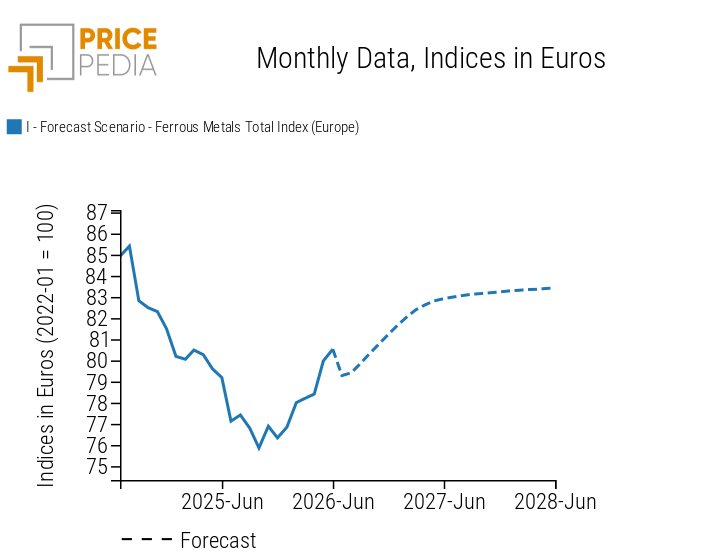
The PricePedia forecast scenario highlights an increase in ferrous metal prices over the next two years, with average annual growth rates of 1.35% in 2026 and 4.24% in 2027.
The effects of the new safeguard measures introduced to support the European steel industry, combined with the expected increase in demand linked to the energy transition, should contribute to supporting domestic market prices, mitigating competitive pressure from international markets.
Regarding the effects of the Hormuz crisis and the new escalation in the Persian Gulf, it remains difficult to determine to what extent these events will affect the future dynamics of ferrous metal prices. On the one hand, higher international energy costs should support the recovery of steel prices through increased production costs; on the other hand, a prolonged increase in energy-related inflation could lead central banks to maintain a restrictive monetary stance for longer, weakening demand growth and slowing the upward trend expected for ferrous metals.
You may be interested in:

PricePedia Scenario for October 2026
Published by Pasquale Marzano. .
Forecast ForecastThe new escalation renews upward pressure on industrial commodity prices [ Read all ]
Cobalt: is the price decline set to continue?
Published by Luca Sazzini. .
Forecast Cobalt ForecastPrevisioni dei prezzi del cobalto LME 2026-2027 [ Read all ]
Crude steel production on the decline: how are forecasts for ferrous metals changing?
Published by Luca Sazzini. .
Ferrous Metals Forecast ForecastThe decline in crude steel production and the escalation in the Middle East are affecting the PricePedia outlook for ferrous metal prices [ Read all ]