International Octanol Prices on the Rise
The Role of Propylene and Cost Pass-Through in International Price Formation
Published by Daniel Vito Lobasso. .
Organic Chemicals Price DriversSince late February 2026, the crisis in the Persian Gulf and the sharp reduction in traffic through the Strait of Hormuz have abruptly altered the balance of energy and petrochemical markets. Before the conflict, approximately 20 million barrels per day of crude oil and petroleum products passed through the Strait, equivalent to almost one-fifth of global consumption. Between March and May, flows fell to an average of approximately 2.7 million barrels per day, generating an exceptionally severe shock across all petrochemical-related supply chains.
The products affected also include octanols, which have experienced increases in international prices since February 2026, although with varying intensity across markets such as Europe, the United States and China.
One of the factors that helps explain the different pace of growth is the trend in propylene, the main petrochemical feedstock of octanol.
This article examines octanol price dynamics across the different markets and the role of propylene, as the main octanol feedstock, in price formation.
International Octanol Price Dynamics
Octanols are saturated acyclic alcohols used as intermediates in the production of plasticisers, solvents, acrylates, surfactants, lubricants, esters and additives. Among the octanol isomers, the most economically significant is 2-ethylhexanol, also known as 2-EH or isooctyl alcohol, which is widely used in the production of flexible PVC, acrylates for paints and other industrial derivatives.
The following chart shows international octanol prices obtained from three different sources:
- intra-EU customs prices;
- FOB customs prices for US exports;
- CIF customs prices for Chinese imports.
Comparison of International Octanol Prices
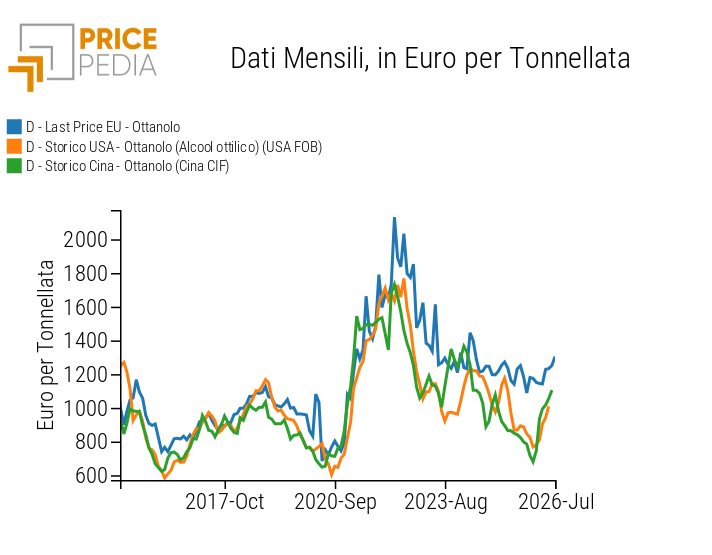
As the chart shows, international octanol prices followed similar trends until 2021. From 2022 onwards, however, price dynamics began to diverge, with a progressively widening gap between European quotations and those recorded in both the United States and China.
The greatest divergence occurred during 2025. Between January 2025 and February 2026, the European price fell by approximately 7%, while the US price declined by more than 20% and the Chinese price lost roughly one-third of its value. By February 2026, the European price was therefore approximately €330 per tonne higher than the US price and more than €200 per tonne higher than the Chinese price.
Between February and June 2026, however, the European price increased by approximately 9% and the Chinese price by 18%. In the United States, where the latest available observation refers to May, growth was close to 25%, leading to a gradual realignment of international prices.
The Role of Propylene
Octanol price dynamics are very similar to those of propylene, its main production feedstock.
The following chart shows international propylene prices, in particular:
- intra-EU customs prices;
- CIF customs prices for US imports;
- CIF customs prices for Chinese imports.
Comparison of International Propylene Prices
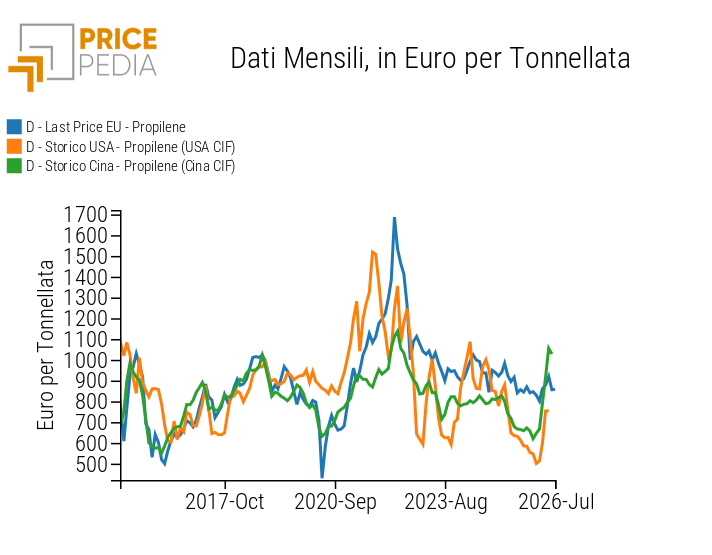
As shown in the chart, between January 2025 and February 2026 the European price fell by approximately 13%. A sharper decline affected prices in the United States and China, which decreased by 34% and 18%, respectively. In particular, by February 2026 this divergence had pushed the European propylene price to a level almost 20% higher than the Chinese price and more than 50% higher than the US price.
The Hormuz crisis rapidly changed this dynamic. Since the beginning of the conflict, Chinese propylene prices have increased by approximately 54%, rising above the European level. Growth in the United States has been similar, at 47%, while the increase in Europe has been more limited, at around 10%.
The graphical comparison highlights a relationship between propylene and octanol prices. A more precise measure of this relationship can be obtained by estimating dynamically specified models expressed in terms of the long-run elasticity[1] of the derivative’s price with respect to changes in the price of propylene. These elasticities are estimated for each octanol-propylene pair in the corresponding geographical area.
The estimated elasticities are as follows:
- 0.99 in Europe;
- 0.67 in the United States;
- 1.02 in China.
In Europe and China, the coefficient is very close to one. This means that a 10% long-run change in the price of propylene is associated with an almost equivalent change in the price of octanol. In the United States, long-run transmission is more limited: a 10% increase in the price of propylene results in an increase of approximately 6.7% in the price of octanol.
Conclusions
The analysis has shown that the different octanol price dynamics across international markets can be explained primarily by the performance of propylene, the main petrochemical input used in octanol production.
The long-run elasticities confirm that the relationship between propylene and octanol is structurally strong, particularly in Europe and China, where changes in propylene prices tend to be passed through almost entirely to octanol prices. In the United States, by contrast, propylene cost pass-through is more limited.
The sustainability of current price levels will depend primarily on the evolution of geopolitical risk, the normalisation of flows through the Strait of Hormuz and the ability of final demand to absorb further increases.
Would you like to stay up to date on commodity market trends?
Subscribe to the PricePedia newsletter free of charge!
[1] Three Engle-Granger models were estimated using the logarithms of the prices for each octanol-propylene pair. In this form, the coefficient associated with propylene can be interpreted directly as an elasticity, indicating the percentage change in the price of octanol resulting from a 1% increase in the price of propylene.
You may be interested in:
Cyclohexanone cost pass-through
Published by Daniel Vito Lobasso. .
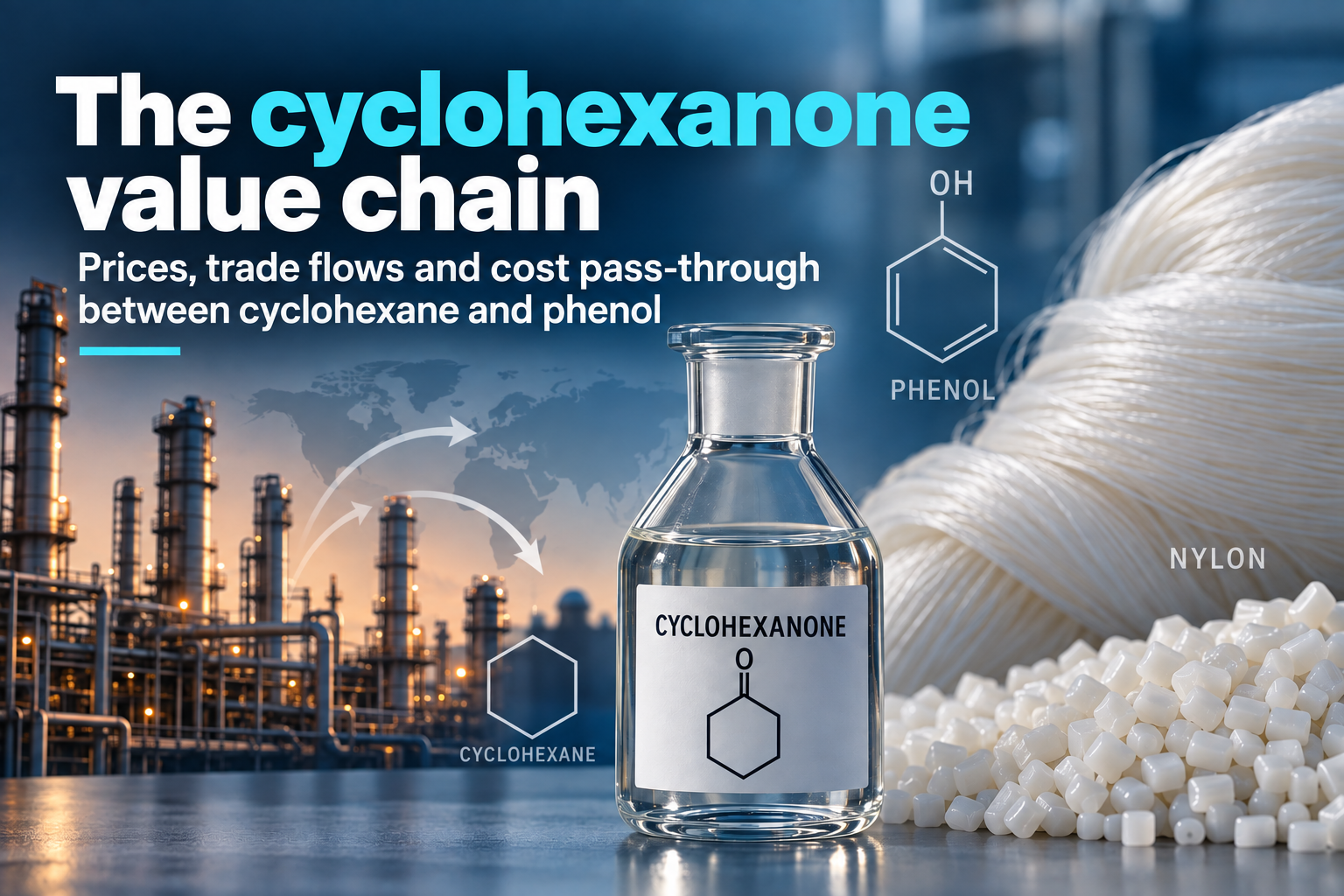
Organic Chemicals Price DriversThe role of phenol and cyclohexane in the price formation and transmission of one of the most important chemical intermediates in the benzene-nylon value chain [ Read all ]
Polymeric MDI: Prices rising across international markets
Published by Daniel Vito Lobasso. .
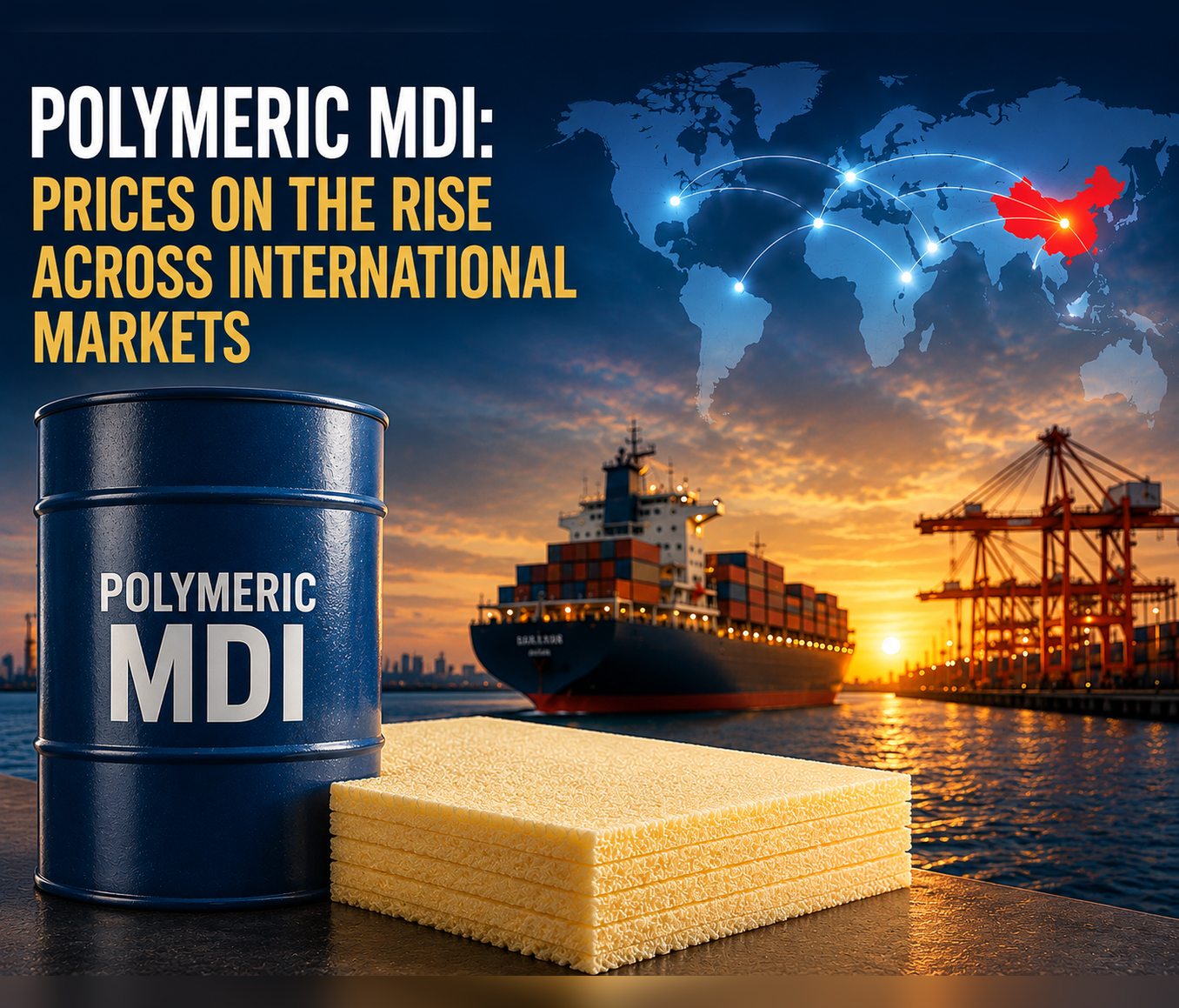
Organic Chemicals Strait of HormuzThe Hormuz crisis reduces Saudi supply and strengthens China’s role as a benchmark in the global market [ Read all ]
Xylenes: A Global Market Under Pressure
Published by Daniel Vito Lobasso. .
Organic Chemicals Petrolchimica Strait of HormuzLe tensioni geopolitiche e il rialzo del petrolio sostengono i prezzi internazionali degli xileni [ Read all ]