PricePedia Scenario for June 2026
Prices of input materials in 2026–2027 between higher energy costs and tighter supply conditions
Published by Pasquale Marzano. .
Forecast ForecastHeightened geopolitical uncertainty continues to shape the PricePedia Scenario for commodity prices, based on information available as of 4 June 2026. In light of recent developments in the Persian Gulf and ongoing diplomatic negotiations, forecasts for oil prices have been slightly revised downward.This adjustment reflects financial market expectations, which increasingly factor in a stronger willingness by the United States to reach a swift resolution of the conflict and, in particular, to secure the reopening of the Strait of Hormuz (see the latest weekly update). Crude oil futures have therefore started to incorporate these expectations, with a visible decline in the risk premium associated with tensions in the region.
In the baseline scenario, i.e. the most likely outcome, the assumption of an end to hostilities by the summer and a gradual normalization of trade flows through the Strait of Hormuz is confirmed. In this context, the energy market is expected to move towards a gradual rebalancing, with conditions progressively stabilizing over the course of 2027.
The following chart illustrates the evolution of market expectations for Brent prices over the coming months, comparing the futures curves of 4 June 2026 and 1 May 2026, expressed in US dollars per barrel.
Brent crude oil: futures curves comparison (prices in US dollars per barrel)
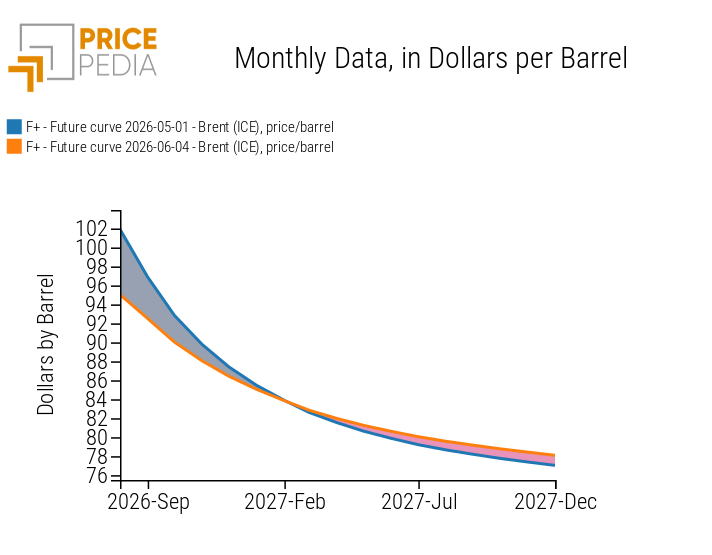
The comparison highlights a gradual downward revision in oil price expectations. In the second half of 2026, the 4 June futures curve stands below that of 1 May, with expected prices around 90 US dollars per barrel versus approximately 95 US dollars per barrel one month earlier. Moving into 2027, the gap between the two curves narrows, converging towards levels close to 80 US dollars per barrel, indicating broadly aligned medium-term expectations.
The June 2026 PricePedia Scenario
The downward revision of oil price expectations is directly reflected in the outlook for energy commodities. In the updated scenario, energy prices are expected to increase by +16% in 2026, down from +23% in the previous scenario.
At the same time, the overall PricePedia commodity index shows a more moderate upward profile: the expected increase for 2026 stands at +8%, compared with the previous scenario.
The table below reports annual percentage changes (in euro terms) for the main commodity aggregates included in the PricePedia Scenario: Industrials [1], Total Commodities[2], Energy, and Food.
Table 1: Annual percentage changes (%) of PricePedia aggregate indices, in euro terms
| 2024 | 2025 | 2026f | 2027f | |
|---|---|---|---|---|
| I-Forecast Scenario, 4 June 2026-Commodity Index (Europe) | −4.10 | −4.89 | +8.02 | −5.61 |
| I-Forecast Scenario, 4 June 2026-Energy Total Index (Europe) | −6.17 | −11.66 | +15.60 | −11.08 |
| I-Forecast Scenario, 4 June 2026-Industrials Index (Europe) | −4.61 | −3.15 | +7.51 | +2.89 |
| I-Forecast Scenario, 4 June 2026-Food Total Index (Europe) | +8.83 | +17.11 | −12.46 | −11.02 |
Overall, industrial commodity prices are expected to increase by more than +10% over the 2026–2027 period, broadly in line with the previous scenario. This stability reflects two opposing forces:
- the downward revision of energy price assumptions (as described above),
- tighter supply conditions across several commodity markets.
The latter factor is particularly relevant for products whose production is concentrated in Gulf countries and/or whose supply chains rely on transit through the Strait of Hormuz[3]. The longer disruptions or restrictions persist in the area, the higher the risk of tighter global availability, with consequent upward pressure on prices.
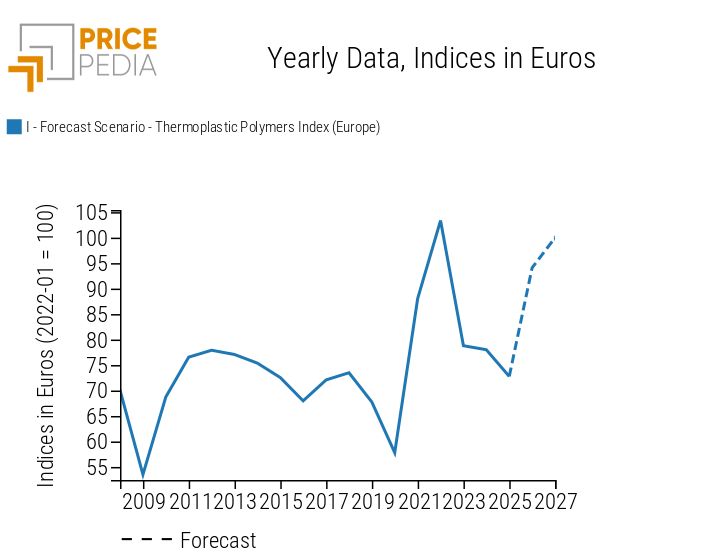
Among the segments most exposed to this dynamic are thermoplastic polymers and the chemical sector, in particular ethylene glycol[4]. For these products, supply-side constraints more than offset the downward revision in energy costs, resulting in strong price growth prospects over the next two years, as shown in the following charts.
Price forecasts, indices in euro (Jan 2022 = 100)
Thermoplastic polymers
Ethylene glycol
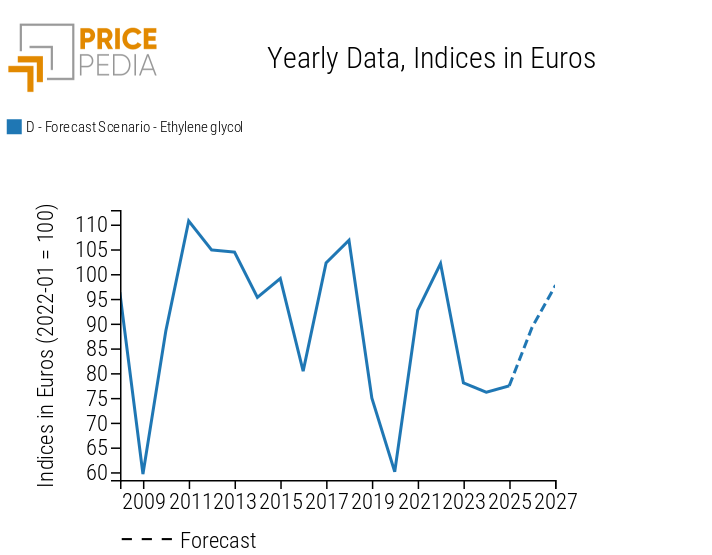
The expected trajectory over 2026–2027 points to particularly strong increases for both commodities.
In the case of thermoplastic polymers, the cumulative increase exceeds +35% over the period considered. Ethylene glycol also shows a sustained upward trend, with a cumulative increase of approximately +25%.
1. The PricePedia Industrials index results from the aggregation of the indices relating to the following product categories: Ferrous, Non-Ferrous, Wood and Paper, Chemicals: Specialty, Organic Chemicals, Inorganic Chemicals, Plastics and Elastomers and Textile Fibres.
2. The PricePedia Commodity index results from the aggregation of the indices relating to industrial, food and energy commodities.
3. See the article Supply Risk in the Event of a Closure of the Strait of Hormuz.
4. See the article PET, Ethylene Glycol and the Strait of Hormuz.
You may be interested in:

Elastomer price forecasts for 2026–2027
Published by Luca Sazzini. .
Forecast Elastomers Natural Rubber ForecastWhat is the outlook for elastomer prices amid rising petrochemical costs and supply risks? [ Read all ]

PricePedia Scenario for October 2026
Published by Pasquale Marzano. .
Forecast ForecastThe new escalation renews upward pressure on industrial commodity prices [ Read all ]
Cobalt: is the price decline set to continue?
Published by Luca Sazzini. .
Forecast Cobalt ForecastPrevisioni dei prezzi del cobalto LME 2026-2027 [ Read all ]