PET, Ethylene Glycol and the Strait of Hormuz
The European PET market is experiencing a period of strong tension due to producers' price increase requests
Published by Luigi Bidoia. .
Petrolchimica Polyethylene terephthalate (PET) Strait of HormuzThe European PET market is currently experiencing a period of strong tension following producers' requests for price increases. The underlying reasons are linked to the closure of the Strait of Hormuz and affect the market through multiple channels, both direct and indirect.
PET price increases
The table below reports the monthly rates of change in virgin PET prices during 2026, based on several sources covering both the European and Asian markets. The sources considered are:
- the PricePedia "last price", based on intra-EU customs flow prices and updated to May 2026 using nowcasting methods;
- the price set by the Chemical Products Price Commission of the Milan Chamber of Commerce;
- the FOB price of Chinese exports;
- the CIF price of Japanese imports.
International prices for polyethylene terephthalate (PET): rates of change in euros

The analysis of these data makes it possible to outline the following picture:
- Since the attack by the United States and Israel on Iran, the price of virgin PET in Europe has increased by between 14%, according to PricePedia's "last price" series, and 70%, according to the Chemical Products Price Commission of the Milan Chamber of Commerce. The divergence among the different sources is particularly significant. In this regard, it should be noted that the PricePedia "Last Price" series is updated through nowcasting procedures based on market fundamentals. However, these methods may not fully capture temporary anomalies or tensions that can emerge in specific markets during exceptional circumstances. By contrast, prices reported by the Milan Chamber of Commerce Price Commission have sometimes reflected producers' and distributors' asking prices more than prices actually accepted by the market.
- In Asia, PET price increases appear to be considerably more limited and more consistent with the European "last price" estimates. In particular, the stability of the FOB price of Chinese exports in April 2026, following an increase of "only" 9% in March, seems to indicate market conditions that are markedly different from those observed in Europe.
Do you want to stay up-to-date on commodity market trends?
Sign up for PricePedia newsletter: it's free!
The drivers behind the increase in PET prices
The share of PET supplied by the Persian Gulf countries is relatively modest: less than 5% of global trade and less than 1% of European Union imports. Recent price increases therefore cannot be attributed to a presumed global shortage of PET. Instead, the main driver behind these price hikes is the worldwide increase in ethylene glycol prices,
which, together with terephthalic acid, are the main feedstocks used in the production of PET.
In the ethylene glycol market, the Persian Gulf countries play a leading role. Among the products that, before the closure of the Strait of Hormuz, relied most heavily on this route were ethylene glycols. In particular, approximately 50% of global trade in monoethylene glycol (MEG), the most important product within the ethylene glycol family, and 32% of global trade in diethylene glycol (DEG) passed through the Strait of Hormuz. The European Union is relatively less exposed in the case of MEG, importing only about 15% of its external supply from Gulf countries. For DEG, however, the EU's dependence is broadly in line with the global average.
The strong dependence of global ethylene glycol supply on trade flows passing through the Strait of Hormuz is causing a significant reduction in product availability on international markets, with substantial effects on price dynamics, as illustrated in the chart below. The chart reports intra-EU customs prices (Last Price EU), CIF prices of Chinese imports, and prices assessed by the Chemical Products Price Commission of the Milan Chamber of Commerce.
International prices for ethylene glycol (MEG)
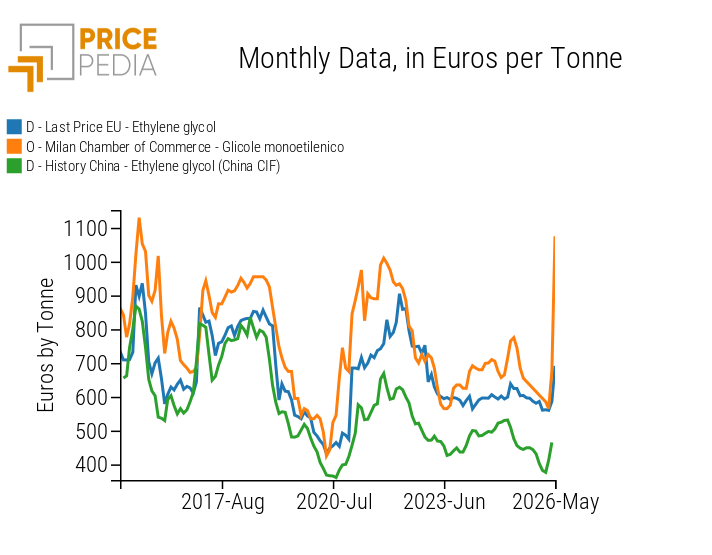
The analysis of the different price series clearly highlights a sharp increase following the closure of the Strait of Hormuz. Price gains are close to 25% for both intra-EU customs prices and CIF prices of Chinese imports. Even more pronounced is the increase recorded by the Milan Chamber of Commerce Price Commission, where prices have risen by more than 80%, pushing May 2026 quotations to very high levels, even exceeding the peaks reached during the 2022 crisis.
Conclusions
The closure of the Strait of Hormuz has created global shortages not only of crude oil and natural gas, but also of several key petrochemical products. Among these, ethylene glycols stand out because a particularly large share of global trade in these products previously passed through the Strait of Hormuz. The reduction in product availability has had a significant impact on international markets, leading to sharp price increases.
The rise in ethylene glycol prices is now progressively being transmitted downstream along the value chain, affecting PET prices and, more broadly, polyester markets. This process appears to be particularly pronounced in Europe, where concerns about material availability are more acute.
The current market environment is characterized by a high degree of uncertainty. Different sources report price increases of significantly different magnitudes. On the one hand, the price increases requested by producers and distributors, especially in Europe, are particularly substantial; on the other hand, market fundamentals appear to support more moderate increases.
In this context, the key factor is the intensity of precautionary purchasing and inventory-building activities undertaken by downstream users.
In the short term, price rises will only be curbed when they reach levels that discourage further purchases.
However, it is extremely difficult to estimate where this threshold lies, both for ethylene glycol and for PET.
The crucial variable therefore remains the duration of the closure of the Strait of Hormuz. The longer trade flows remain disrupted, the longer prices of ethylene glycols and PET are likely to remain under pressure. Conversely, the reopening of the Strait and the subsequent recovery of supply flows could rapidly ease market tensions, triggering a decline in ethylene glycol and PET prices that could be just as rapid as the current phase of price escalation.
You may be interested in:
Strait of Hormuz risk after more than six months of conflict in the Persian Gulf
Published by Pasquale Marzano. .
Energy Organic Chemicals Petrolchimica Strait of HormuzTrade flows and prices of the commodities most vulnerable to a Strait of Hormuz closure [ Read all ]
Xylenes: A Global Market Under Pressure
Published by Daniel Vito Lobasso. .
Organic Chemicals Petrolchimica Strait of HormuzLe tensioni geopolitiche e il rialzo del petrolio sostengono i prezzi internazionali degli xileni [ Read all ]
How thermoplastic polymer prices are transmitted along synthetic fibre value chains
Published by Pasquale Marzano. .
Polypropylene Textile Fibers Polyamide Polyethylene terephthalate (PET) Price DriversThe case of nylon, polypropylene and polyester [ Read all ]