Iron ore price forecast for 2026 - 2027
What are analysts' forecasts for iron ore prices?
Published by Luca Sazzini. .
Ferrous Metals Forecast ForecastIron ores play a central role within the steel supply chain, as they represent a fundamental input in the blast furnace steel production process. Consequently, their price dynamics directly affect steel production costs, in turn influencing the prices of steel products along the entire value chain.
For this reason, forecasting iron ore prices is of strategic importance. Having robust forecasts enables steel companies to optimize cost management, inventories, and production processes across the entire supply chain.
In this analysis, we present iron ore price forecasts produced by various industry analysts, in order to identify the most likely price evolution scenario based on currently available information.
Implicit forecasts in futures contracts
The first forecasting source analyzed is represented by the expectations embedded in futures contracts, which reflect the current price at which sellers are willing to commit to delivering a given product at a future date.
Within financial markets, iron ore is always quoted in the form of “fines”, i.e. raw ores that have not yet undergone any agglomeration process.
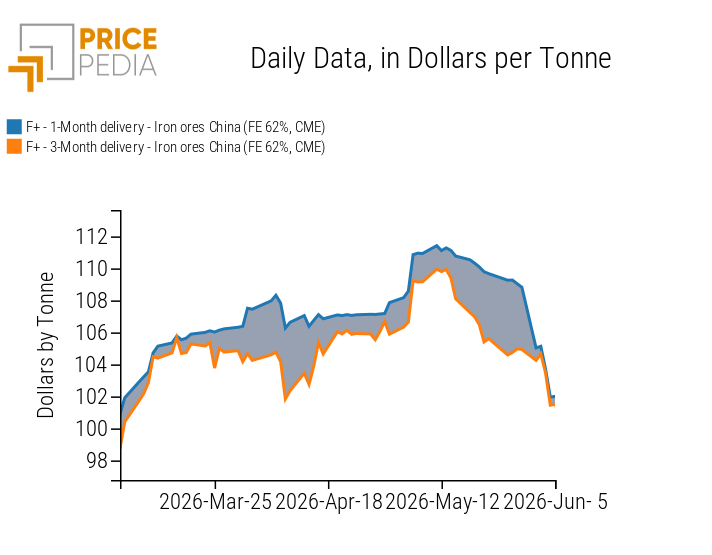
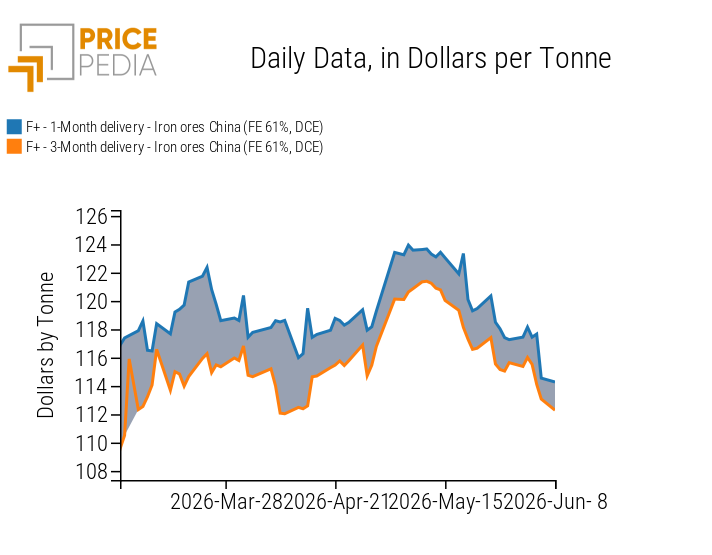
The table below shows the comparison between spot and futures prices of Chinese iron ore, listed on the CME and DCE.
| Comparison between spot and futures prices of Chinese iron ore, expressed in $/tonne | |
| CME prices (Iron 62%) | DCE prices (Iron 61%) |
|
|
From the graphs above, it can be seen that Chinese iron ore financial prices are currently in backwardation, particularly on the DCE market, meaning that futures prices are lower than spot prices. These findings indicate that market participants are incorporating expectations of a future decline in iron ore prices. Otherwise, sellers would have no incentive to commit today to deliver iron ore at a future date at a lower price than the current one, while bearing storage and related financial costs in the meantime.
World Bank forecast
The second forecasting source considered in this analysis is the World Bank, which provides a useful benchmark for assessing the potential equilibrium price between supply and demand.
The chart below shows the latest World Bank forecast scenario for annual Chinese iron ore prices (62% Fe), updated as of April 2026.
World Bank forecasts of Chinese iron ore prices (62% Fe)
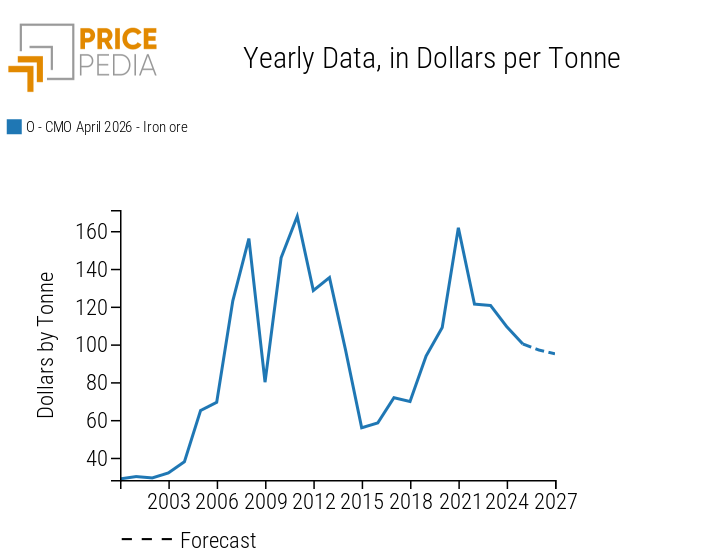
World Bank analysts expect the supply surplus that has characterized the iron ore market in recent years to persist, with annual average prices projected to decline by 3% in 2026 and a further 2% in 2027, reaching levels of $97 and $95 per tonne respectively.
Demand growth prospects for iron ore remain weak, due to limited expansion potential in steel production and high inventory levels at Chinese ports. At the same time, the continued expansion of production in major exporting countries, including Australia and Brazil, together with the gradual commissioning of new low-cost capacity in West Africa, is expected to further increase an already abundant global supply.
Consensus Economics forecast
Expectations of declining iron ore prices are also confirmed by surveys conducted by Consensus Economics among numerous institutions and international organizations specializing in commodities.
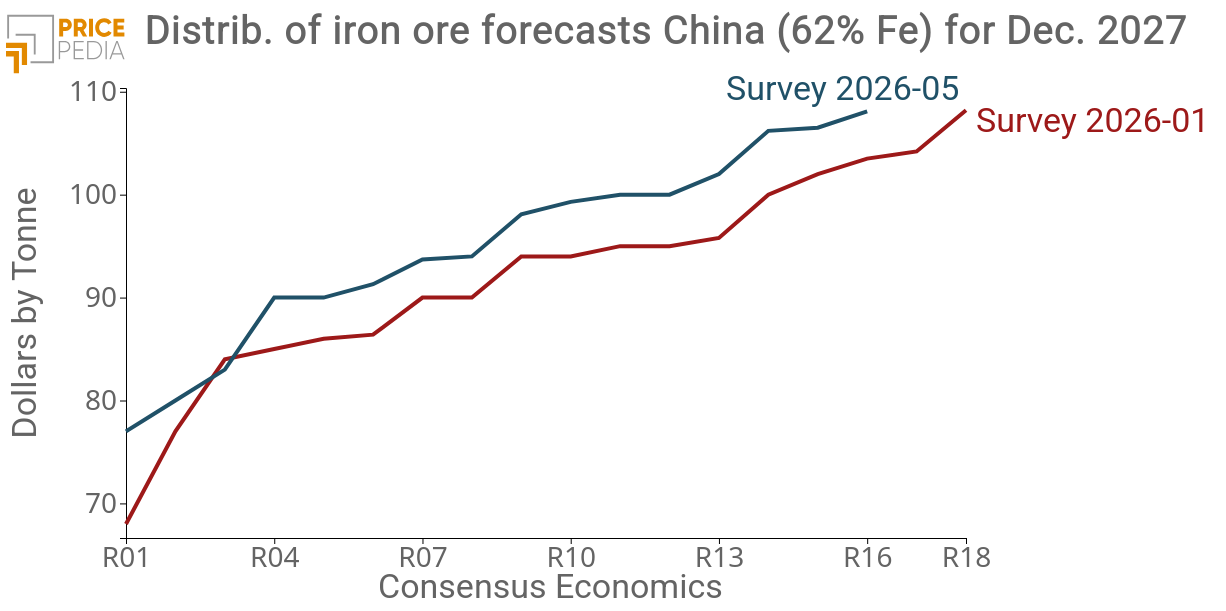
For December 2027, the May survey indicates a forecast range for CME iron ore prices between $77 and $108 per tonne, with an average of $95 per tonne, below current spot reference prices of $102 per tonne. This pattern is consistent with both World Bank estimates and expectations expressed by financial markets.
However, between January and May 2025, forecasts for December 2027 iron ore prices show a slight increase, while still remaining on average below current spot prices. This modest upward adjustment in expected end-2027 prices is evident in the chart below, which shows the forecast ranges from the January and May 2026 Consensus Economics surveys for Chinese iron ore (62% Fe) prices for December 2027.
PricePedia forecast
The PricePedia forecast for Chinese iron ore (62% Fe) listed on the Chicago Mercantile Exchange has been developed as a synthesis of the forecasts described above, giving priority to financial market expectations, then to Consensus Economics forecasts, and finally to those of the World Bank.
The chart below shows the PricePedia forecast scenario for CME iron ore prices, expressed in $/tonne.
PricePedia forecast scenario for Chinese CME iron ore prices, expressed in $/tonne
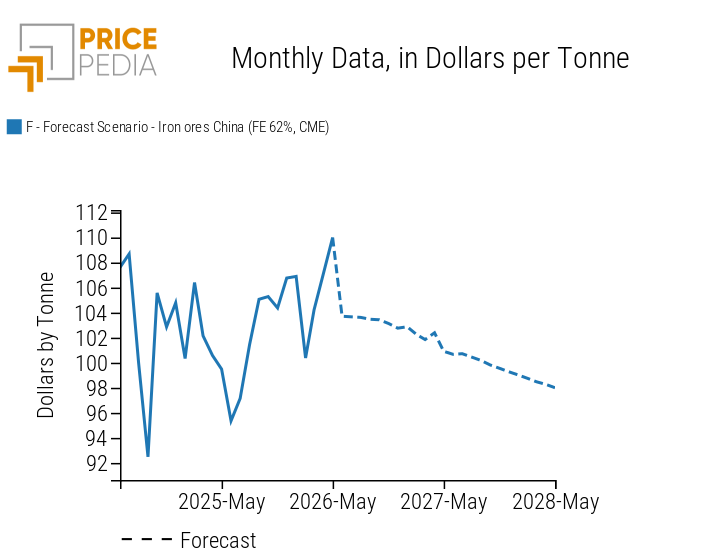
The PricePedia scenario foresees a downward trend in iron ore prices, in line with the dynamics projected by all other forecasters. By May 2028, the last forecast period, the PricePedia projection stands at $98 per tonne, approximately 11% below the May 2026 average of $110 per tonne.
Conclusions
All forecasters analyzed agree in predicting a continued downward trend in iron ore prices, attributable to the gradual widening of the current supply surplus in the market.
The PricePedia forecast, developed as a synthesis of the various projections, estimates that by May 2028, the final period of the forecast horizon, iron ore prices will reach $98 per tonne, 11% lower than the May 2026 average.
The price range from the latest Consensus Economics survey for December 2027 shows values between $77 and $108 per tonne, with an expected average of $95 per tonne.
The expected decline in iron ore prices should help contain the growth of steel product prices, whose demand is expected to increase significantly due to the development of green technologies, the construction of infrastructure required for the energy transition, and rising demand from the defense sector.
You may be interested in:

Elastomer price forecasts for 2026–2027
Published by Luca Sazzini. .
Forecast Elastomers Natural Rubber ForecastWhat is the outlook for elastomer prices amid rising petrochemical costs and supply risks? [ Read all ]

PricePedia Scenario for October 2026
Published by Pasquale Marzano. .
Forecast ForecastThe new escalation renews upward pressure on industrial commodity prices [ Read all ]

Cobalt: is the price decline set to continue?
Published by Luca Sazzini. .
Forecast Cobalt ForecastPrevisioni dei prezzi del cobalto LME 2026-2027 [ Read all ]