Elastomer price forecasts for 2026–2027
What is the outlook for elastomer prices amid rising petrochemical costs and supply risks?
Published by Luca Sazzini. .
Forecast Elastomers Natural Rubber Forecast
The escalation of the conflict in the Middle East and the resulting restrictions on transit through the Strait of Hormuz and the Bab el-Mandeb Strait have increased supply risks for commodities that are particularly dependent on supplies from the Persian Gulf. These developments have contributed to rising international prices for energy and industrial products that rely heavily on petrochemical and natural gas supply chains. These products include synthetic elastomers, whose market is affected both by logistical risks and by changes in production costs linked to the prices of petrochemical feedstocks.
Price pressures on synthetic elastomers also tend to spill over into natural rubber prices through substitution effects, as some demand shifts towards the latter. Since the beginning of the year, financial prices for the two varieties of natural rubber traded on the Shanghai Futures Exchange (SHFE) have indeed recorded substantial increases.
The following chart shows SHFE financial prices for the RSS3 and TSR 20 varieties of natural rubber, expressed in euros per tonne.
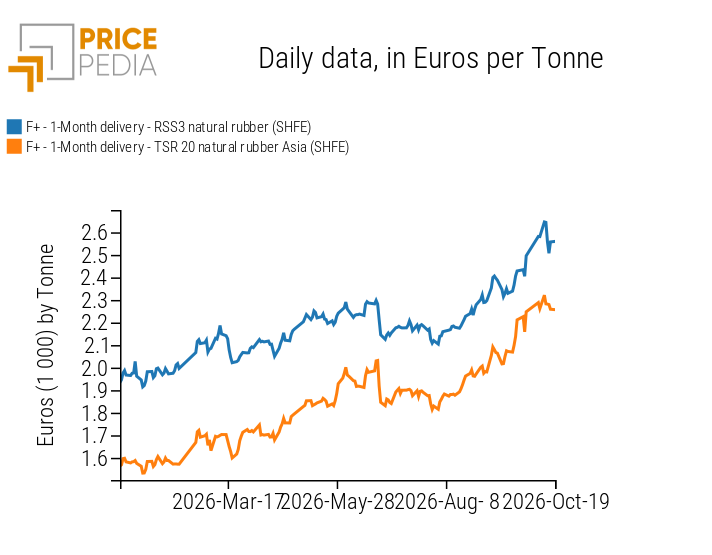
Since the beginning of the year, SHFE financial prices for RSS3 and TSR 20 natural rubber, expressed in euros, have risen by 32% and 44%, respectively.
As discussed in the italian article "L'effetto calmieratore dei prezzi della gomma naturale", financial prices for natural rubber tend to influence international synthetic rubber prices through substitution effects.
To assess the impact of these pressures on the European market, we will analyse price trends for the main elastomers traded in the EU and the forecasts developed by PricePedia in its latest Scenario for 2026-2027.
PricePedia Forecasts
The following chart shows PricePedia's forecasts for the aggregate European elastomer price index, based on the information available as of 1 October 2026.
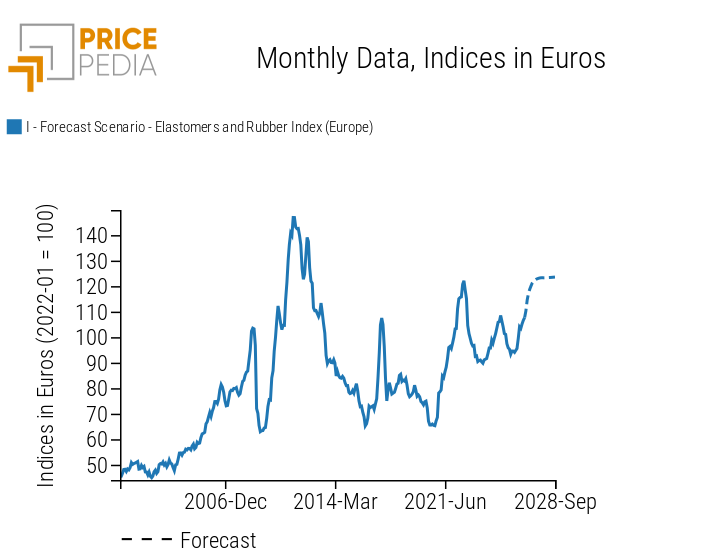
PricePedia forecasts that the current upward trend in European elastomer prices will continue, with prices expected to reach levels slightly above the relative highs recorded in 2022 during the 2021-2023 cycle by the end of the next two years.
Expected price levels in October 2028 are projected to remain significantly below the all-time highs recorded in 2011, when strong Asian demand, particularly from China, met limited supply and a sharp increase in butadiene prices. Butadiene is one of the main commodities used in synthetic rubber production.
Between July 2009 and July 2011, the European elastomer price index rose by 128%, while butadiene prices increased by 343%. The sharp rise in butadiene prices was mainly driven by structural changes in the petrochemical supply chain. In particular, the gradual spread of plants using ethane and other light hydrocarbons as feedstocks reduced the use of naphtha in ethylene production. Since butadiene is obtained primarily as a by-product of naphtha cracking, this shift contributed to a reduction in its supply, intensifying price pressures.
These pressures were compounded by a decline in synthetic rubber supply following production disruptions caused by the earthquake that struck Japan in March 2011, further aggravating supply difficulties across the industry.
Price Forecasts for Different Types of Elastomers Traded in the EU
The following table shows PricePedia's annual percentage changes forecast for the prices of different types of elastomers traded in the EU.
Table of Annual Percentage Changes in European Customs Prices for Elastomers, Expressed in Euros
| 2023 | 2024 | 2025 | 2026f | 2027f | |
|---|---|---|---|---|---|
| Natural Rubber | |||||
| Natural Rubber (TSNR) | −19.11 | +13.65 | +10.02 | +1.95 | +17.71 |
| Ribbed Smoked Sheets (RSS) | −18.14 | +16.34 | +7.47 | +2.45 | +8.41 |
| Synthetic Rubbers | |||||
| BR Rubber | −21.03 | +0.07 | +1.69 | +7.91 | +10.68 |
| E-SBR Rubber | −21.76 | +4.96 | +0.44 | +15.27 | +10.92 |
| S-SBR Rubber | −9.08 | +2.06 | +2.16 | +4.35 | +11.88 |
| NBR Rubber | −10.55 | −8.54 | +1.27 | −3.88 | +10.87 |
| EPDM Rubber | −16.63 | −9.01 | −3.72 | +5.58 | +8.00 |
| SBS Rubber | −21.65 | +4.10 | −0.26 | +8.24 | +6.69 |
| Latexes | |||||
| SBR Latex | −7.47 | +1.67 | −3.37 | +4.51 | +9.00 |
| Natural Rubber Latex | −15.90 | +11.43 | +7.61 | +5.21 | +13.69 |
| Other Elastomers | |||||
| Polyisobutylene | −7.50 | −0.97 | −4.40 | −3.28 | +19.53 |
E-SBR and SBS rubber are expected to record the largest price increases in 2026, also reflecting the more pronounced rises already observed since the beginning of the year. Growth is expected to slow for both types in 2027, as prices have already incorporated a substantial share of the increases in production input costs associated with supply disruptions from the Persian Gulf.
For other types of elastomers, higher production costs are expected to feed through to prices mainly during 2027, accelerating price growth compared with 2026. Most analysts expect energy input prices to remain high next year, owing to the difficulties in reaching a lasting peace agreement, the damage already sustained by energy infrastructure, and the time required to restore supply flows to their pre-war levels.
You may be interested in:

PricePedia Scenario for October 2026
Published by Pasquale Marzano. .
Forecast ForecastThe new escalation renews upward pressure on industrial commodity prices [ Read all ]

Cobalt: is the price decline set to continue?
Published by Luca Sazzini. .
Forecast Cobalt ForecastPrevisioni dei prezzi del cobalto LME 2026-2027 [ Read all ]
Crude steel production on the decline: how are forecasts for ferrous metals changing?
Published by Luca Sazzini. .
Ferrous Metals Forecast ForecastThe decline in crude steel production and the escalation in the Middle East are affecting the PricePedia outlook for ferrous metal prices [ Read all ]