Is the rise in non-ferrous metal prices expected to continue in 2027?
LME non-ferrous metals scenario, updated to November 2026
Published by Luca Sazzini. .
Forecast Forecast
The non-ferrous metals market is currently experiencing an upward price trend, mainly driven by four factors: increasing demand associated with the twin green and digital transitions, supply-side constraints, rising energy costs linked to the conflict in the Middle East, and higher prices of industrial products exported by China.
Since the beginning of the year, the aggregate PricePedia indices for non-ferrous metals in Europe and China have increased by 21.6% and 25.7%, respectively, in euro terms. Price developments have confirmed the trend outlined in the scenario presented in the article "PricePedia scenario for non-ferrous metals 2026-2027", which anticipated a period of rising prices, subsequently confirmed by market developments.
However, the outlook for the coming months could point to a different scenario. On the demand side, the Democrats' victory in the US elections could contribute to tempering growth expectations associated with the digital transition. In particular, the introduction of stricter restrictions on data centre construction could curb demand growth for certain non-ferrous metals, including copper and tin, which are widely used in the infrastructure required for their operation.
On the supply side, the constraints affecting several non-ferrous metals markets are gradually easing, also thanks to metal availability being higher than previously anticipated.
Potential downward signals for prices also emerge from the outlook for energy costs and prices of industrial products exported by China. Although energy costs are expected to remain high over the next two years, they are projected to decline if the conflict in the Middle East comes to an end. Prices of Chinese industrial products, meanwhile, are likely to be affected by intense competition in the domestic market and persistently weak industrial demand in China.
This article updates the non-ferrous metals forecast scenario based on the latest available information, in order to assess whether price growth is set to continue over the coming months or whether the gradual weakening of the factors driving it is creating the conditions for a trend reversal.
PricePedia Forecasts
The following chart shows PricePedia's forecasts for the aggregate euro-denominated price index of European non-ferrous metals, based on information available as of 4 November 2026.
PricePedia forecast for the total European non-ferrous metals index, in euros
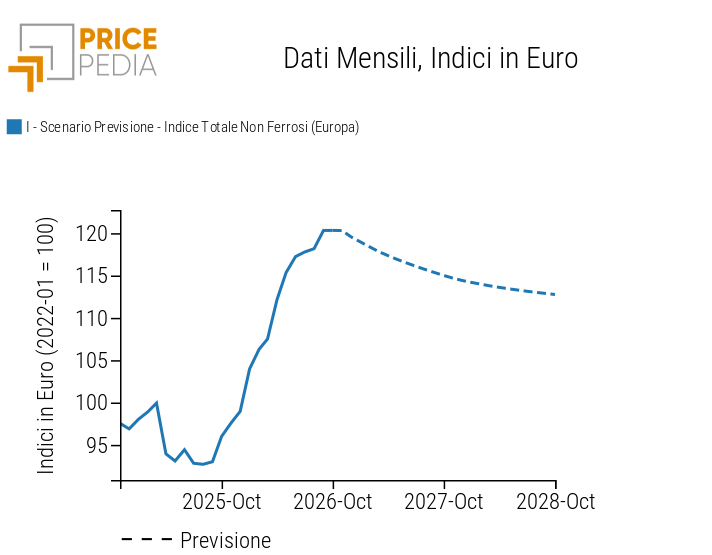
Over the coming months, the current upward trend in non-ferrous metals prices is expected to reverse. By October 2028, prices are forecast to be 5.8% lower than their October 2026 levels.
Despite the projected decline, prices are expected to remain relatively high, with the annual average in euro terms for 2027 forecast to be 1.3% higher than in 2026.
Forecasts for major LME non-ferrous metals
The following table shows the forecast annual percentage changes in the prices of major LME non ferrous-metals, expressed in US dollars.
Table of forecast annual percentage changes in major LME non-ferrous metal prices, in US dollars
| 2023 | 2024 | 2025 | 2026 | 2027 | |
|---|---|---|---|---|---|
| F-Scenario Forecast-Cobalt (LME) | −46.30 | −23.53 | +32.39 | +43.11 | −12.27 |
| F-Scenario Forecast-Aluminium (LME) | −16.82 | +7.44 | +8.74 | +24.53 | −7.28 |
| F-Scenario Forecast-Nickel (LME) | −16.12 | −21.76 | −9.86 | +11.47 | −5.54 |
| F-Scenario Forecast-Tin (LME) | −17.25 | +16.25 | +13.05 | +51.03 | −1.80 |
| F-Scenario Forecast-Lead (LME) | −0.75 | −3.00 | −5.28 | −3.09 | +1.74 |
| F-Scenario Forecast-Copper (LME) | −3.76 | +7.80 | +8.69 | +37.33 | +3.35 |
| F-Scenario Forecast-Zinc (LME) | −23.99 | +4.86 | +3.23 | +25.16 | +3.99 |
| F-Scenario Forecast-Molybdenum (LME) | +31.13 | −12.48 | +3.79 | +36.70 | +9.40 |
As shown in the table, the largest price declines in 2027 are expected for cobalt, aluminium and nickel. The steepest decrease is forecast for cobalt (-12.3%). This forecast reflects both the gradual recovery in exports from the Democratic Republic of the Congo, the world's leading producer, and the progressive weakening of Chinese demand for cobalt used in battery manufacturing. In China, the adoption of LFP (lithium iron phosphate) batteries is increasing. Unlike NMC (nickel manganese cobalt) batteries, LFP batteries do not require cobalt.
The expected decline in aluminium prices (-7.3%) is mainly attributable to the prospect of an easing of the conflict in the Middle East, while the forecast decrease in nickel prices (-5.5%) primarily reflects the expansion of Indonesian supply.
The slight decline expected for tin (-1.8%) reflects lower expectations for growth in demand for electronics and artificial intelligence infrastructure, following the sharp price increase already recorded in 2026 (+48% year on year).
Lead prices are forecast to increase by 1.7% in 2027, reversing the declines seen in previous years. Indeed, lead is the only base non-ferrous metal in the table to have recorded a negative annual price change in 2026, at -3.1%.
The largest increases are expected for molybdenum, zinc and copper, whose price outlooks remain affected by persistent supply constraints.
In the case of copper, however, the forecast annual average increase is more moderate, at 3.4%. The Democrats' victory
in the US midterm elections could reduce the likelihood of tariffs being imposed on copper cathodes, thereby promoting a
more balanced distribution of supplies across international markets. In recent months, expectations of potential US
tariffs have encouraged stockpiling in the United States, reducing metal availability in other geographical markets.
You may be interested in:

PricePedia Scenario for November 2026
Published by Pasquale Marzano. .
Forecast ForecastUpward pressure on industrial commodity prices persists despite the expected decline in energy prices [ Read all ]

From market trends to procurement budget: how to use price forecasts to plan purchases in 2027
Published by Pasquale Marzano. .
Forecast Purchasing budget Analysis tools and methodologiesCombining a Purchasing Manager's experience with PricePedia's analytical tools to navigate procurement planning in an uncertain market environment [ Read all ]

Elastomer price forecasts for 2026–2027
Published by Luca Sazzini. .
Forecast Elastomers Natural Rubber ForecastWhat is the outlook for elastomer prices amid rising petrochemical costs and supply risks? [ Read all ]