Stainless steel HRC price forecasts
What factors account for the differences in price forecasts for ferritic and austenitic coils?
Published by Luca Sazzini. .
Stainless Steel Forecast ForecastIn the analysis: "European steelmakers under pressure: margins are shrinking", it was highlighted that European steelmakers' margins have gradually narrowed since the beginning of the year. The increase in energy costs linked to the war in the Middle East has significantly raised production costs for electric arc furnace steelmakers, which are particularly exposed to fluctuations in electricity prices. These higher costs have only been partially passed on to long steel product prices, also due to intense international competition fuelled by abundant Chinese supply.
A similar trend has affected stainless steel HRCs (Hot Rolled Coils), whose prices have increased significantly less than those of their main production inputs since the beginning of the year. Given this gap, it is worth assessing whether and to what extent higher production costs may be passed on to stainless steel HRC prices, leading to an increase.
This article presents the PricePedia forecast scenario for stainless steel hot-rolled coil prices, comparing their expected evolution with that of their respective production feedstocks.
PricePedia Forecast for Stainless Steel HRCs
The following chart shows the forecast scenario for stainless steel hot-rolled coil prices, expressed in euros per tonne.
Forecast of Stainless Steel HRC Prices, in Euros per Tonne
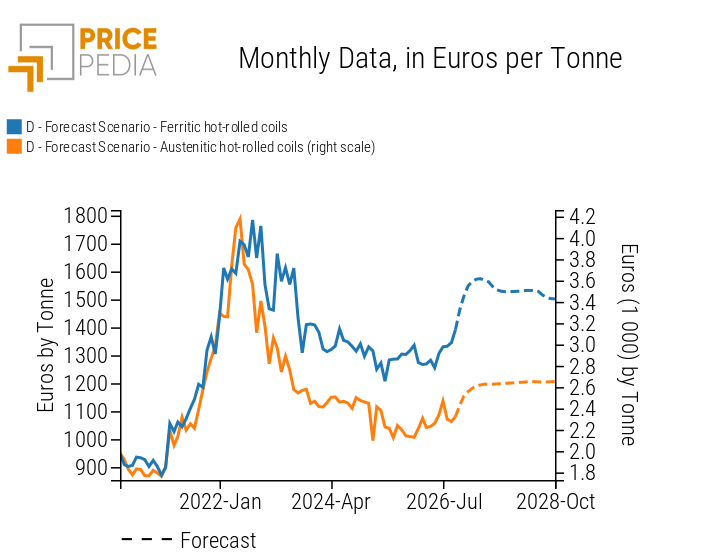
Over the next two years, stainless steel HRC prices, both ferritic and austenitic, are expected to recover following the period of weakness that characterised the market from the second quarter of 2022 to the end of 2025. However, the strength of the recovery will differ between the two product types.
Ferritic coil prices are expected to increase more rapidly in 2027, before slowing slightly in 2028, while austenitic coil prices are expected to follow a more gradual and steady growth path. This difference is consistent with forecasts of faster and stronger growth in production input costs for ferritic coils in 2027 compared with austenitic coils.
The following table shows the expected annual changes in euro-denominated prices of stainless steel HRCs and their respective feedstocks.
Table of annual percentage changes in euro-denominated prices of stainless steel HRCs and their respective feedstocks
| 2022 | 2023 | 2024 | 2025 | 2026f | 2027f | |
|---|---|---|---|---|---|---|
| Stainless Steel Coils | ||||||
| Ferritic | ||||||
| Ferritic Hot-Rolled Coils | +41.37 | −8.76 | −10.37 | −3.49 | +3.46 | +15.94 |
| Austenitic | ||||||
| Austenitic Hot-Rolled Coils | +47.04 | −23.77 | −8.99 | −9.33 | +4.21 | +12.72 |
| Production Feedstocks | ||||||
| Common | ||||||
| Italian National Single Price (PUN, GME) | +142.02 | −58.05 | −14.68 | +6.94 | +42.88 | −1.58 |
| Ferritic | ||||||
| Stainless Steel Scrap (Ni < 8%) | +23.92 | −23.24 | +2.31 | −19.38 | +14.24 | +13.74 |
| AISI 430 Stainless Steel Alloy Surcharge | +43.87 | −21.03 | −4.81 | −0.40 | +10.87 | +8.40 |
| Austenitic | ||||||
| Stainless Steel Scrap (Ni ≥ 8%) | +29.76 | −22.40 | −1.01 | −11.53 | +6.51 | +10.53 |
| AISI 304 Stainless Steel Alloy Surcharge | +49.78 | −19.48 | −14.18 | −7.00 | +9.93 | +2.55 |
With the exception of electricity prices,[1] which are expected to decline amid the gradual normalisation of natural gas flows, all other production inputs for stainless steel hot-rolled coils are expected to increase in 2027, although to varying degrees depending on the type of stainless steel HRC.
The alloy surcharge for ferritic stainless steel is expected to increase by 8.4% in 2027, a significantly higher rate than the 2.6% forecast for austenitic stainless steel compared with 2026. Scrap prices used in the production of ferritic stainless steel are also expected to rise more sharply than those of austenitic stainless steel scrap, with increases of 13.7% and 10.5%, respectively, in 2027.
These differences are mainly attributable to the higher nickel content of austenitic stainless steel, which helps contain the expected increase in production costs in 2027. The LME nickel price, the main international financial benchmark, is expected to decline by 4.2% in euro terms in 2027. This decrease reflects the persistence of excess supply from Indonesia and weak Chinese demand, linked to the gradual replacement of NMC (nickel-manganese-cobalt) batteries with LFP (lithium-iron-phosphate) batteries, which do not use nickel.
In light of these differences in production costs, ferritic coils are expected to increase by 16% in 2027, compared with a rise of almost 13% for austenitic coils.
[1] The PricePedia forecast for the Italian National Single Price (PUN) is used as a proxy for the expected evolution of European electricity prices.
You may be interested in:

European ethanol: what is the price outlook for 2027 following the 2026 price increases?
Published by Daniel Vito Lobasso. .
Forecast ForecastIl ruolo delle materie prime agricole e dei mercati energetici [ Read all ]
Is the rise in non-ferrous metal prices expected to continue in 2027?
Published by Luca Sazzini. .
Forecast ForecastLME non-ferrous metals scenario, updated to November 2026 [ Read all ]

PricePedia Scenario for November 2026
Published by Pasquale Marzano. .
Forecast ForecastUpward pressure on industrial commodity prices persists despite the expected decline in energy prices [ Read all ]