European ethanol: what is the price outlook for 2027 following the 2026 price increases?
The role of agricultural feedstocks and energy markets
Published by Daniel Vito Lobasso. .
Forecast Forecast2026 has been a particularly challenging year for european commodity markets, as adverse weather conditions and geopolitical tensions have simultaneously affected supply availability and procurement costs. Exceptionally high temperatures and drought during the summer months have weighed on agricultural output across several European countries. Meanwhile, the ongoing conflict in Ukraine and escalating tensions in the Middle East have heightened uncertainty surrounding international supplies, affecting both agricultural and energy markets.
Among the commodities most exposed to developments in both markets is ethanol, also known as ethyl alcohol, whose european prices have risen significantly over the past year, reversing the downward trend observed over the previous three years.
Against this changing market backdrop, it is particularly relevant to assess the extent to which the pressures that emerged in 2026 may continue to influence prices next year. This article therefore examines price developments for ethanol and its main feedstocks, alongside the 2027 forecasts provided by the PricePedia Forecast Scenario.
PricePedia Forecast Scenario for european ethanol prices
The following chart illustrates historical and forecast european ethanol prices, expressed in euros per tonne.
PricePedia forecasts for european denatured and undenatured ethanol prices, expressed in euros
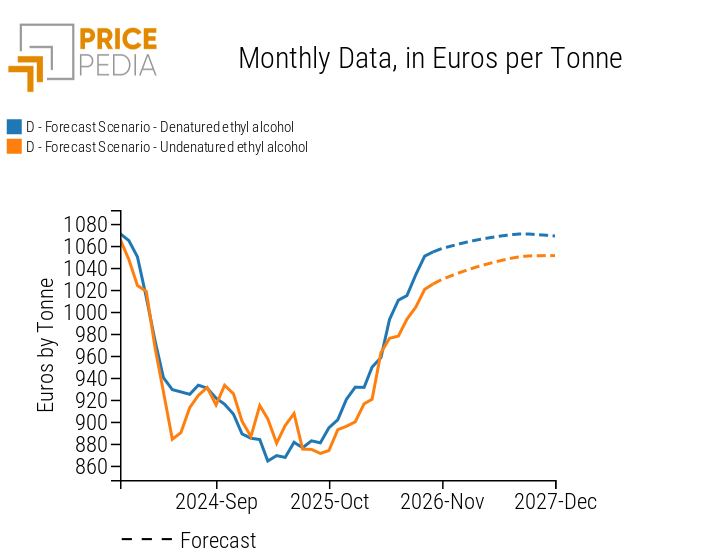
The upward trend that began in late 2025 is expected to continue in 2027, albeit at a more moderate pace. Prices are forecast to approach the levels recorded at the end of 2023 before stabilising in the second half of the year.
Among the main factors supporting this trend are tightening conditions in agricultural commodity markets, which have become increasingly important in shaping european ethanol prices over time. As discussed in a previous article, ethanol production through the fermentation of starch- and sugar-rich agricultural feedstocks has gradually gained ground over synthesis from ethylene, becoming the dominant production route in Europe. As a result, ethanol production costs have become increasingly exposed to movements in cereal prices, particularly those of maize and wheat, both of which are expected to rise further in 2027 according to the PricePedia Forecast Scenario.
Upward pressure on maize prices stems primarily from production shortfalls and supply constraints in the european market. High temperatures and drought during the summer of 2026 adversely affected harvests in major producing countries, including France and Hungary, reducing domestic availability and increasing import requirements. These difficulties have been compounded by disruptions to Ukrainian supplies arising from the ongoing conflict and logistical constraints in the Black Sea region, making it more difficult to offset Europe's production shortfall through imports.
For the european ethanol industry, these challenges are further compounded by a preference for non-genetically modified maize, for which sourcing options on international markets are more limited. Intensifying competition for supplies, combined with rising logistics costs, is therefore expected to sustain upward pressure on ethanol production costs in 2027. However, the greater price stability anticipated for other cereals could partly mitigate the impact of rising maize and soft wheat prices.
Beyond developments in agricultural markets, another important factor to consider is the close relationship between ethanol and energy markets. As highlighted in the aforementioned article, ethanol is widely used as an oxygenate in petrol blending, both to increase octane ratings and to help meet decarbonisation targets in the transport sector.
Higher oil prices can therefore improve ethanol's cost competitiveness relative to fossil-based petrol components, supporting demand for ethanol and, indirectly, for the agricultural feedstocks used in its production. Against this backdrop, the decline in energy prices forecast for 2027 could help moderate upward pressure on ethanol prices. However, ethanol demand is also underpinned by biofuel mandates, which reduce its sensitivity to fluctuations in oil prices.
Finally, the availability of competitively priced US ethanol could limit the pass-through of higher production costs to European ethanol prices, contributing to the expected price stabilisation over the course of 2027.
The following table presents PricePedia's forecasts for annual percentage changes in european ethanol prices and those of its main feedstocks.
Annual percentage changes in ethanol and its main feedstock prices
| 2023 | 2024 | 2025 | 2026f | 2027f | |
|---|---|---|---|---|---|
| Ethanol | |||||
| D-Forecast Scenario - Denatured ethyl alcohol | −15.10 | −12.60 | −5.33 | +13.55 | +6.39 |
| D-Forecast Scenario - Undenatured ethyl alcohol | −12.31 | −16.03 | −4.10 | +10.18 | +6.75 |
| Agricultural feedstocks | |||||
| F-Forecast Scenario - Corn (CME), price per bushel | −20.74 | −24.96 | −0.47 | +1.66 | +8.72 |
| D-Forecast Scenario - Soft wheat | −23.24 | −15.01 | +0.07 | +0.61 | +16.07 |
| Petrochemical feedstocks | |||||
| D-Forecast Scenario - Ethylene | −15.40 | −3.29 | −4.12 | +7.67 | +9.87 |
After three consecutive years of decline, european ethanol prices have reversed their downward trend in 2026, with the recovery expected to consolidate in 2027.
Annual average prices are forecast to increase by 6.4% for denatured ethanol and 6.8% for undenatured ethanol next year. These increases primarily reflect the persistence of the higher price levels reached in late 2026, rather than the onset of another period of significant price increases.
The stronger price increases anticipated for the main feedstocks suggest that, following the sharp rise in ethanol prices in 2026, further production cost pressures may only be partially passed through to finished product prices, allowing for a gradual rebalancing of relative prices along the value chain in 2027.
For industrial ethanol buyers, this translates into higher average procurement costs than in 2026, albeit against a backdrop of greater price stability throughout the year. In this environment, monitoring developments in cereal markets and international supply conditions will be particularly important in shaping effective procurement strategies.
You may be interested in:

Is the rise in non-ferrous metal prices expected to continue in 2027?
Published by Luca Sazzini. .
Forecast ForecastLME non-ferrous metals scenario, updated to November 2026 [ Read all ]

PricePedia Scenario for November 2026
Published by Pasquale Marzano. .
Forecast ForecastUpward pressure on industrial commodity prices persists despite the expected decline in energy prices [ Read all ]

Surfactants: European price forecasts for 2027
Published by Daniel Vito Lobasso. .
Forecast Surfactants ForecastWhat are the main factors that will drive price trends? [ Read all ]