The terephthalic acid market: asian competition and cost pressures
The European Commission seeks to shield the internal market from global production overcapacity
Published by Daniel Vito Lobasso. .
Organic Chemicals Price DriversIn recent years, the european chemical industry has faced mounting competitive pressures stemming from high production costs and rising imports from Asia. These challenges have prompted the European Commission to strengthen its trade defence measures to protect european producers. A notable example is the polyethylene terephthalate (PET) value chain, previously examined in an article focusing on anti-dumping duties imposed on imports from China.
More recently, european trade defence measures have also extended to purified terephthalic acid (PTA), a key petrochemical intermediate used primarily in the production of PET and other polyesters, of which the European Union (EU) is a net importer. In August 2025, the European Commission launched an anti-dumping investigation into imports of terephthalic acid from South Korea and Mexico, the EU's two largest non-EU suppliers. The investigation concluded in August 2026 with the imposition of definitive anti-dumping duties on imports from both countries.
In its definitive regulation, the European Commission identifies two key drivers of PTA price dynamics: price developments in paraxylene (PX), the main feedstock used in PTA production, and competitive conditions in international markets. According to the Commission, however, competitive pressures could intensify further against a backdrop of growing global production overcapacity across the PET value chain. For this reason, on 6 November 2026, the Commission launched a new safeguard investigation[1] into imports of several products within the PET value chain.
Against this backdrop, it is worth examining in greater detail how the PTA market is shaped by the two factors identified by the Commission. The analysis first focuses on the structure of international trade, with particular attention to the world's leading exporters, the EU's main suppliers and recent european trade defence measures. It then examines price dynamics across the major regional markets and their relationship with paraxylene price developments.
International trade in terephthalic acid and the EU's position
To assess the exposure of european producers to international competition, it is useful to begin by examining global trade flows in terephthalic acid, identifying the leading exporting countries and their significance in the global market, before assessing their role in european imports.
The chart below shows the leading exporters of terephthalic acid in 2025, with a breakdown by major destination regions.
Leading exporters of terephthalic acid in 2025
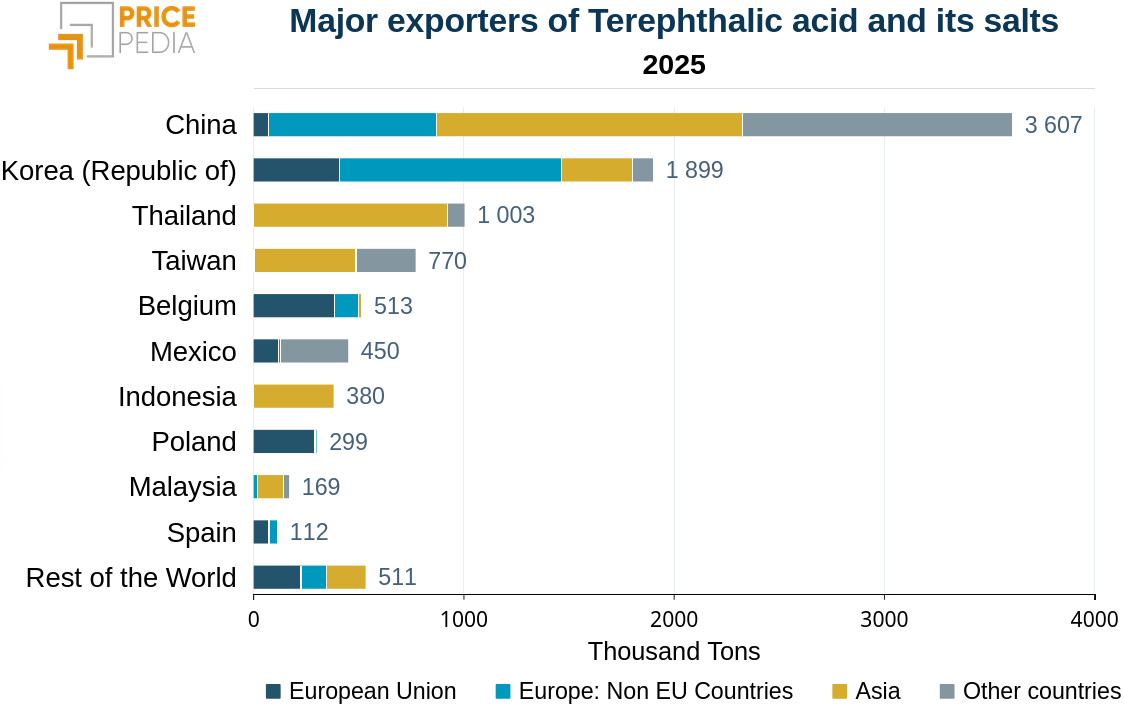
As the chart illustrates, terephthalic acid exports are highly geographically concentrated, with asian producers dominating the market and accounting for approximately 80% of global exports.
In 2025, China retained its position as the world's largest exporter of terephthalic acid, accounting for approximately 36% of global exports, followed by South Korea with a 19% share. Other major exporters include Thailand and Taiwan, with shares of 10% and 8%, respectively. Outside Asia, Belgium and Mexico stand out, accounting for 5% and 4% of global exports, respectively.
This geographical concentration of supply gives Asia a pivotal role in shaping global PTA market balances and exposes most major importing countries to potential supply risks in the event of disruptions to international trade.
As regards the European Union, total imports amounted to approximately 1.5 million tonnes in 2025, with 54% sourced from non-EU countries. Among the leading suppliers were South Korea, accounting for 24% of total imports, Mexico with 7%, and China with approximately 4%.
The significance of south korean and mexican supplies is particularly noteworthy in light of recent european trade defence measures. The investigation covered the period from 1 July 2024 to 30 June 2025, during which import volumes reached some of their highest levels in recent years.
The investigation led to the imposition of provisional anti-dumping duties in April 2026, followed by definitive duties in August 2026. These range from 6.1% to 13.3% for south korean producers subject to the measures and stand at 24.1% for mexican producers.
The chart below shows quarterly EU imports of terephthalic acid from its three main non-EU suppliers: China, South Korea and Mexico.
Quarterly EU imports of terephthalic acid from the three main non-EU suppliers
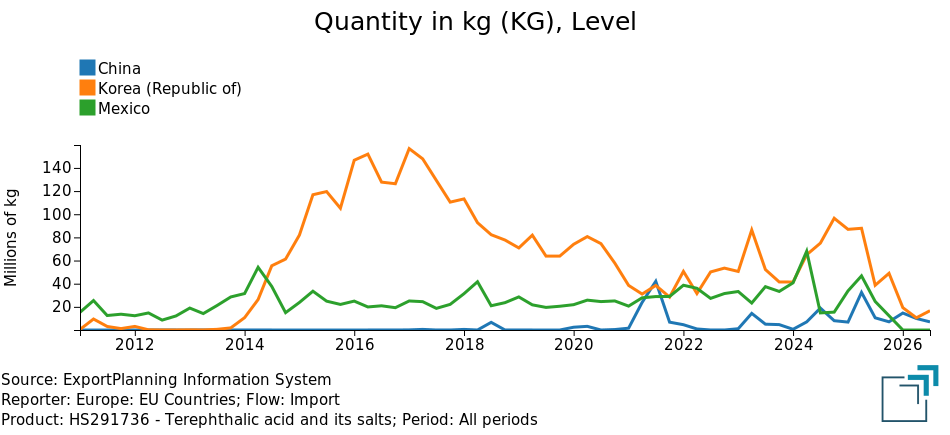
The most striking development illustrated by the chart is the sharp decline in south korean supplies. Between the second quarter of 2025 and the first quarter of 2026, imports from South Korea fell by a quarter, while imports from Mexico ceased altogether. Imports from China, by contrast, have followed a different trajectory, increasing since 2020, albeit remaining below those from South Korea.
More recently, on 6 November 2026, a new safeguard investigation was launched into imports of several products within the PET value chain, including terephthalic acid. The investigation could lead to the introduction of measures covering imports from all non-EU countries, subject to certain exemptions.
This initiative reflects the need to proactively assess the risk of additional competitive pressures from countries not covered by the previous measures, against a backdrop of growing global production overcapacity. Trade restrictions imposed in other markets could lead to the diversion of exports towards the European Union, including those originating in countries such as China, potentially harming european producers.
International terephthalic acid prices and the role of paraxylene
A comprehensive understanding of terephthalic acid market dynamics requires an analysis of trade flows alongside key production cost drivers and international prices. The dominant positions of China and India in global PTA exports and imports, respectively, mean that both countries have the potential to influence global supply and demand balances and, consequently, international price formation, with possible implications for the competitiveness of european producers.
The chart below tracks customs-based PTA prices, expressed in euros per tonne (€/t), across the major international markets (Europe, China and India), alongside the european price of paraxylene (PX), the main feedstock for PTA production.
International terephthalic acid prices
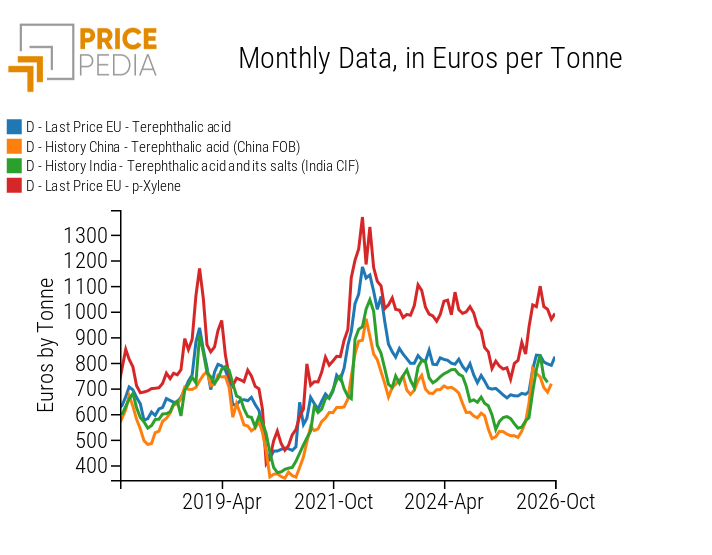
The most notable feature emerging from a comparison of international terephthalic acid prices is the close alignment of regional price movements, suggesting a highly integrated global market driven by common underlying factors. One of the key factors is the price of paraxylene, which directly affects PTA production costs. This relationship is further supported by historical price correlations between paraxylene and terephthalic acid, as well as across the various regional PTA markets, with all correlation coefficients close to 0.9.
Despite following broadly similar trends, regional prices differ in absolute terms, with chinese prices generally below their european and indian counterparts. As the world's largest PTA exporter, China serves as a key reference point for international price formation. India, meanwhile, as the world's largest importer, can provide a useful price benchmark for other importing countries through its CIF import prices.
Conclusions
The terephthalic acid market is characterised by a high degree of international integration, both in terms of trade patterns and price formation. The continued expansion of asian production capacity is shaping global trade balances, while paraxylene prices remain the primary driver of PTA price dynamics.
Want to stay up to date with commodity market developments?
Subscribe to the free PricePedia newsletter!
[1] See Commission Implementing Regulation (EU) 2026/1904, imposing definitive anti-dumping duties on imports of terephthalic acid originating in South Korea and Mexico.
You may be interested in:
Methanol: the impact of the Middle East crisis on international prices
Published by Daniel Vito Lobasso. .
Organic Chemicals Price DriversMethanol prices rise sharply across Europe and Asia, but the magnitude of the increases varies depending on each market's reliance on international supplies [ Read all ]
Methionine prices: asian market pressures and european price stability
Published by Daniel Vito Lobasso. .
Organic Chemicals Price DriversL’aumento dei costi dei feedstock e le difficoltà negli approvvigionamenti hanno alimentato forti rincari in Asia, mentre il mercato europeo ha mostrato una maggiore stabilità [ Read all ]
Strait of Hormuz risk after more than six months of conflict in the Persian Gulf
Published by Pasquale Marzano. .
Energy Organic Chemicals Petrolchimica Strait of HormuzTrade flows and prices of the commodities most vulnerable to a Strait of Hormuz closure [ Read all ]