Cyclohexanone cost pass-through
The role of phenol and cyclohexane in the price formation and transmission of one of the most important chemical intermediates in the benzene-nylon value chain
Published by Daniel Vito Lobasso. .
Organic Chemicals Price DriversIn a previous article, the mechanisms of price transmission along the benzene-nylon value chain were analysed, with particular attention to the effects of the Strait of Hormuz crisis and the role of cyclohexane.
The analysis showed that, despite the contraction in cyclohexane flows from Saudi Arabia, European customs prices for the product recorded relatively limited increases. At the same time, the examination of international trade revealed a sharp decline in the trade of certain intermediates, particularly pronounced in the case of cyclohexane.
This trend is consistent with increasing vertical integration along the value chain: a larger share of processing may take place within the same industrial group or at integrated plants, through internal flows that do not require intermediates to be purchased on the international market. However, the decline in trade does not in itself constitute proof of production integration, as it may also depend on plant location, the geographical concentration of supply, or substitution among different production technologies.
With greater vertical integration, the share of product traded on the open market decreases. Observable prices for intermediates may therefore become less representative of the economic conditions of the value chain as a whole, while still remaining relevant to the cost formation of companies that continue to source these products on the market.
This article further explores price transmission along the benzene-nylon value chain, focusing on another key chemical intermediate: cyclohexanone, produced from cyclohexane and used in the production of caprolactam and nylon 6. For a comprehensive description of the value chain, see the article Benzene: a global price for a strategic value chain.
To understand the factors influencing the price of cyclohexanone, it is also necessary to consider the existence of an alternative production route to the one based on cyclohexane. Cyclohexanone can in fact be obtained through the hydrogenation of phenol, which is itself mainly produced via the cumene process (cumene is an aromatic hydrocarbon obtained by alkylating benzene with propylene).
The presence of two production routes links the cyclohexanone market both to the cyclohexane value chain and to the phenol value chain. The fact that a product can be obtained through alternative processes may therefore reduce its exposure to shocks affecting a specific input.
To reconstruct more accurately the factors contributing to cyclohexanone price formation, the following analysis considers both international trade flows and the price dynamics of the main commodities involved in the two production chains.
International trade in the cyclohexanone value chain
The following table shows the evolution of international trade in the main commodities forming the cyclohexanone value chain over the past twenty-five years. The production chain begins with benzene and propylene and develops through two main intermediates: cyclohexane, obtained from benzene, and phenol, produced mainly through cumene. Both routes can lead to the production of cyclohexanone.
International trade in products of the cyclohexanone value chain (thousand tonnes)
| Product | 2000 | 2005 | 2010 | 2015 | 2020 | 2025 |
|---|---|---|---|---|---|---|
| Benzene | 4906 | 5876 | 6396 | 8895 | 8666 | 10148 |
| Propylene | 3808 | 4563 | 6376 | 7262 | 6791 | 4484 |
| Cumene | 795 | 1166 | 1576 | 1835 | 1360 | 256 |
| Phenol | 1656 | 2326 | 2568 | 2190 | 2578 | 1312 |
| Cyclohexane | 1372 | 1720 | 1316 | 1155 | 360 | 253 |
| Cyclohexanone | 366 | 328 | 322 | 323 | 272 | 264 |
The most significant finding concerns the different sizes of the international markets for the main intermediates. In 2025, global trade in phenol amounted to approximately 1.3 million tonnes, more than five times the volumes recorded for cyclohexane and cumene, both only slightly above 250 thousand tonnes.
The divergence becomes even more evident when looking at the long-term trend. Between 2000 and 2025, international trade in cyclohexane fell by more than 80%. Trade in phenol also declined from the peaks reached in previous years, but remained at considerably higher levels.
These data suggest a different degree of relevance of the two products in international trade. Cyclohexane appears to be more closely linked to integrated production systems, whereas phenol continues to be traded in significant quantities between countries. The larger volumes therefore make phenol customs prices potentially more representative of international market conditions.
Changes in international prices along the value chain
Price developments along the value chain also provide particularly interesting indications. The following table reports the price changes observed between February and July 2026 for the main commodities in the cyclohexanone value chain, based on different sources of information: international quotations recorded in the European Union, China and Japan, and data collected by the Industrial Chemical Products Price Commission of the Milan Chamber of Commerce.
% change in prices along the cyclohexanone value chain from February to July 2026
| Product | EU | China | Japan | Milan Chamber of Commerce |
|---|---|---|---|---|
| Benzene | 26.97 | 31.25 | 34.21 | |
| Propylene | 27.05 | 34.49 | 32.88 | |
| Cumene | 51.33 | 58.73 | 31.12 | |
| Phenol | 30.87 | 32.04 | 39.34 | |
| Cyclohexane | 12.84 | 32.76 | ||
| Cyclohexanone | 24.39 | 48.84 | 40.66 | 48.44 |
For cyclohexanone, the increases range from 24% on the European market to values close to 49% for Chinese exports and in the Chamber of Commerce data. This dispersion indicates that the intensity of the shock was not uniform across markets and suggests caution when attempting to describe international dynamics using a single price indicator.
Focusing on European customs data, the price of phenol increased by approximately 31%, cyclohexane by 12%, and cyclohexanone by 24%. The change in cyclohexanone therefore lies between those of its two main inputs. This pattern is consistent with a price formation mechanism influenced by both production routes, but does not, by itself, make it possible to identify their respective contributions. To do so, it is necessary to estimate the relationship linking prices over the long term.
Cost pass-through
To assess how price changes are transmitted along the value chain, it is possible to use cost pass-through analysis, i.e. the extent to which a change in the price of an input is reflected in the price of the derived product.
Pass-through is measured using long-run elasticities. Within the Engle-Granger two-step approach, these elasticities are estimated through an OLS regression describing the equilibrium relationship between the price of the derived product and the prices of the main inputs. Interpreting this relationship as a long-run equilibrium requires the series to exhibit statistical properties consistent with a cointegration relationship.
All series are expressed in logarithms. The estimated coefficients therefore indicate the percentage change in the price of the derived product associated, in the long run, with a 1% change in the price of the input, all else being equal within the model.
The following map shows the estimated long-run elasticities along the value chain.
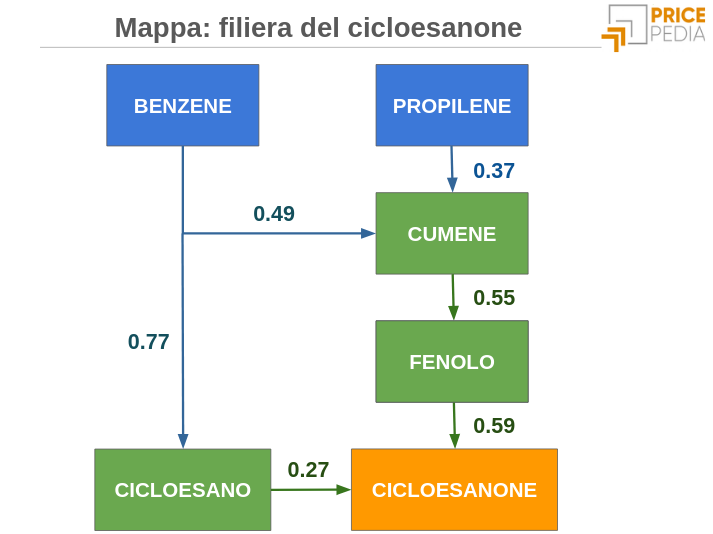
The results indicate that the price of cyclohexanone displays greater long-run sensitivity to changes in phenol prices than to changes in cyclohexane prices. The estimated elasticity with respect to phenol is 0.59: a 10% increase in the price of phenol is therefore associated, in the long run, with an increase of approximately 6% in the price of cyclohexanone. The elasticity with respect to cyclohexane is instead below 0.3, indicating that a 10% increase in its price is associated with an increase in the price of cyclohexanone of less than 3%.
Conclusions
The analysis shows that cyclohexanone price formation depends on both production routes, although the phenol value chain plays a more significant role. This greater influence emerges both from the scale of international trade and from the long-run elasticities, which indicate a stronger transmission of price increases than in the case of cyclohexane.
The presence of alternative production processes can therefore mitigate the impact of shocks confined to a single input. At the same time, to correctly interpret cyclohexanone market dynamics, it is necessary to consider jointly both phenol and cyclohexane price developments.
Would you like to stay up to date on commodity market trends?
Subscribe to the PricePedia newsletter for free!
You may be interested in:
Polymeric MDI: Prices rising across international markets
Published by Daniel Vito Lobasso. .
Organic Chemicals Strait of HormuzThe Hormuz crisis reduces Saudi supply and strengthens China’s role as a benchmark in the global market [ Read all ]
International Octanol Prices on the Rise
Published by Daniel Vito Lobasso. .
Organic Chemicals Price DriversIl ruolo del propilene e il cost pass-through nella formazione dei prezzi internazionali [ Read all ]
Xylenes: A Global Market Under Pressure
Published by Daniel Vito Lobasso. .
Organic Chemicals Petrolchimica Strait of HormuzLe tensioni geopolitiche e il rialzo del petrolio sostengono i prezzi internazionali degli xileni [ Read all ]