The AI race is exacerbating tensions in the DRAM market
DRAM: strong demand growth and highly concentrated supply
Published by Luca Sazzini. .
Semiconductors Electronic Components Price Drivers
The race to develop artificial intelligence is accelerating the growth in demand for DRAM (Dynamic Random Access Memory), essential components for AI systems.
Unlike SSDs, which are used to store data over time, DRAM temporarily stores the information required by processors, allowing it to be accessed quickly during processing. In artificial intelligence, DRAM plays a crucial role both during training, when model parameters and intermediate computational results are processed, and during inference, when the system generates responses to user requests.
The increasing complexity of models and the growing number of requests processed simultaneously are driving up memory requirements and the need for faster data transfer. As a result, HBM (High Bandwidth Memory) has become strategically important. These high-performance DRAMs offer high bandwidth[1] and are used in artificial intelligence accelerators[2].
The strategic importance of DRAM, combined with rapidly growing demand, makes ensuring a reliable supply essential for individual countries. This is particularly challenging because global exports are highly concentrated in a small number of countries, exposing supply chains to the risk of trade restrictions or supply disruptions.
This article examines the memory market, focusing on DRAM used in artificial intelligence systems, before analysing price trends.
Analysis of Trade Flows
The following chart shows the world's top 10 exporters of DRAM with a capacity greater than 512 Mbit[3] in 2025, with values expressed in millions of USD.
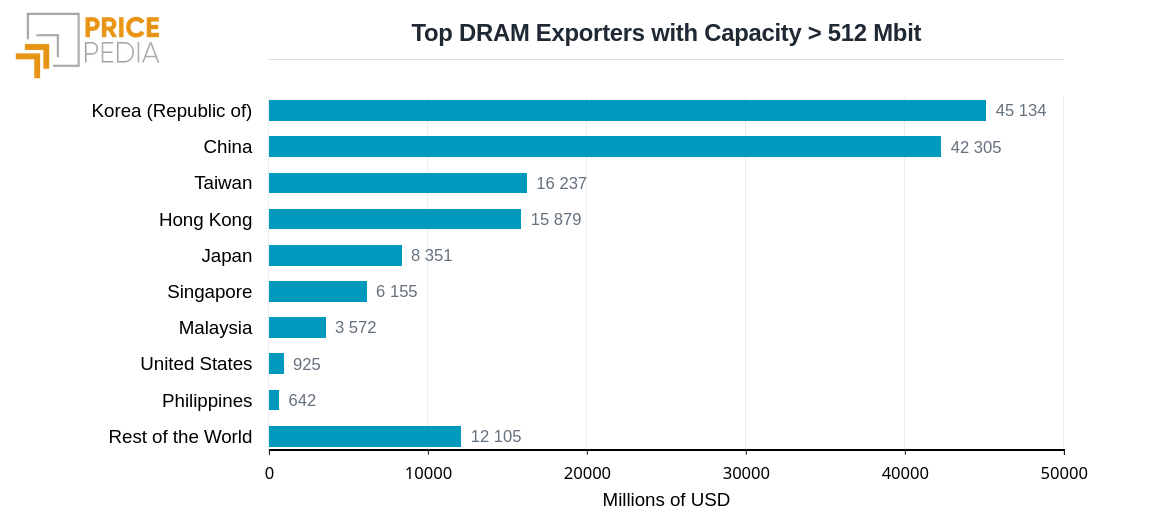
In 2025, South Korea and China exported DRAM with a capacity greater than 512 Mbit worth USD 45,134 million and USD 42,305 million, respectively. Together, they accounted for almost 60% of global exports of these memories.
Taiwan and Hong Kong ranked third and fourth among global suppliers, each accounting for approximately 11% of the total value of worldwide exports.
These figures highlight the high concentration of exports among the top four suppliers, particularly South Korea and China. Any restriction or disruption to exports from either of these two countries could therefore trigger a global supply crisis, with significant repercussions for international prices.
Price Analysis
The following chart compares the European customs price index for DRAM with a capacity greater than 512 Mbit with the index for the corresponding Chinese FOB export price. Both indices use January 2022 = 100 as the base period.
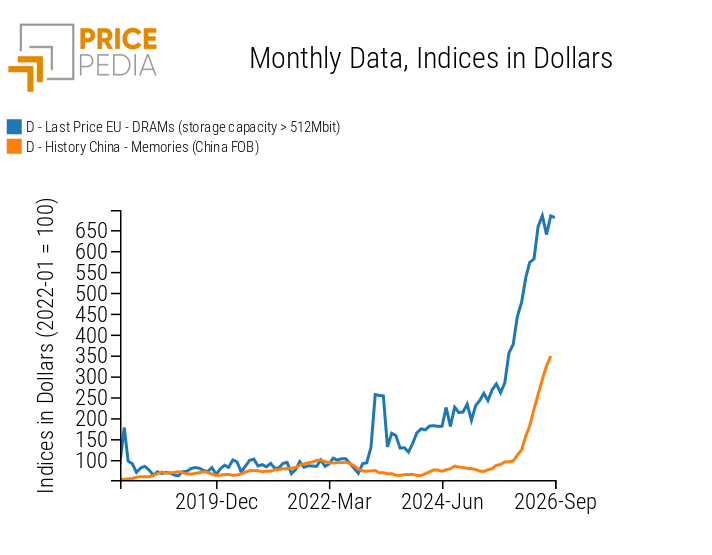
Since January 2025, FOB prices for Chinese memory exports have increased by approximately 350%, while EU customs prices for DRAM with a capacity greater than 512 Mbit have risen by 250% over the same period.
Price increases in the European market have not affected all types of memory equally. Those less widely used in artificial intelligence applications have generally experienced more moderate price increases.
The following table compares year-on-year changes in EU customs prices for different types of memory.
Year-on-Year Changes in European Memory Prices
| 2022 | 2023 | 2024 | 2025 | 2026 | |
|---|---|---|---|---|---|
| D-Last Price EU - DRAM Capacity > 512 Mbit | +9.03 | +82.96 | +16.51 | +45.49 | +113.70 |
| D-Last Price EU - DRAM Capacity ≤ 512 Mbit | +1.60 | +35.35 | −15.73 | −3.27 | +2.82 |
| D-Last Price EU - EEPROM | +9.98 | −10.30 | −24.26 | +8.02 | +29.48 |
| D-Last Price EU - EPROM | −26.52 | −30.78 | −6.39 | +25.52 | +34.30 |
| D-Last Price EU - FLASH Capacity > 512 Mbit | +40.64 | −47.51 | +12.55 | +8.94 | +28.50 |
| D-Last Price EU - FLASH Capacity ≤ 512 Mbit | −18.29 | −26.90 | +41.30 | +21.74 | −6.02 |
| D-Last Price EU - RAM | −5.69 | +14.02 | −2.69 | −17.04 | −3.60 |
| D-Last Price EU - Multichip Memories | −23.73 | −61.13 | +32.25 | +64.64 | +57.74 |
| D-Last Price EU - Multicomponent Memories (MCO) | −2.13 | −11.33 | +5.88 | +47.51 | +26.82 |
The table shows that, in recent years, after high-capacity DRAM, the most significant price increases have affected multichip memories, MCO memories, FLASH memories and EPROM memories. By contrast, RAM and lower-capacity DRAM have experienced price declines in the most recent period.
These trends are consistent with the varying degrees to which different types of memory are exposed to demand growth driven by the development of artificial intelligence.
Summary
The development of generative artificial intelligence and the substantial investments made by major technology companies in the infrastructure required to support it have intensified tensions in international DRAM markets, driving prices sharply higher.
Since the beginning of 2025, FOB prices for memory exported from China have increased by approximately 350%, while EU customs prices for DRAM with a capacity greater than 512 Mbit have risen by 250% over the same period. The high geographical concentration of global production exposes the market to further price increases if the main producing countries, particularly South Korea and China, impose export restrictions.
Other types of memory imported into the EU have experienced more moderate price increases, reflecting their lower exposure to demand growth associated with the development of artificial intelligence infrastructure.
[1] The maximum amount of data that a system can transfer per unit of time through a given communication channel.
[2] Processors designed or optimised to perform the calculations required by artificial intelligence models at high speed.
[3] In the European customs market, DRAM is divided into two categories based on storage capacity, below or above 512 Mbit. The latter includes high-capacity memory used in artificial intelligence applications, such as HBM (High Bandwidth Memory), with capacities that can reach several dozen gigabytes per stack.
You may be interested in:
Moore's law and the strange case of semiconductors
Published by Luigi Bidoia. .
Semiconductors Electronic Components Price DriversAnalysis of the mechanisms governing the industry can help reduce the uncertainty surrounding semiconductor prices [ Read all ]