Rising timber prices put renewed upward pressure on European pallet prices
What the comparison between pallet prices and the cost of their main raw material reveals
Published by Pasquale Marzano. .
Wood and Paper Wood Price DriversIn a previous article, we examined the relationship between pallet prices and softwood prices, highlighting how supply pressures in the timber market contributed to the sharp price increases recorded in 2021-2022. Despite the subsequent downward correction, European pallet prices remain significantly above their pre-2021 levels.
This article examines recent pallet price trends across Europe, comparing them with developments in fir and spruce sawlogs prices to assess the extent to which timber market dynamics may help explain the persistence of these price increases.
European pallet prices
The following table compares ex-works producer prices, collected by national statistical offices and published by Eurostat, for some of the main EU countries, alongside average unit prices derived from intra-EU trade data[1].
Table 1: European pallet prices, euros per unit
| 2020 | 2021 | 2022 | 2023 | 2024 | 2025 | 2026 | |
|---|---|---|---|---|---|---|---|
| O-Ex Works Price Germany Ex Works Price-Pallets, Price/Unit | 7.46 | 11.53 | 14.85 | 11.04 | 10.79 | 10.65 | N.A. |
| O-Czech Republic Ex Works Price-Pallets, Price/Unit | 6.37 | 9.07 | 10.88 | 9.61 | 9.15 | 9.34 | N.A. |
| O-Belgium Ex Works Price-Pallets, Price/Unit | 7.53 | 10.49 | 15.61 | 12.81 | 12.73 | 12.92 | N.A. |
| O-Italy Ex Works Price-Pallets, Price/Unit | 6.05 | 7.94 | 7.92 | 9.27 | 9.18 | 8.26 | N.A. |
| D-Last Price EU-Pallets, Price/Unit | 7.19 | 10.44 | 13.89 | 11.25 | 10.70 | 10.87 | 11.50 |
Between 2020 and 2022, pallet prices nearly doubled in Germany and more than doubled in Belgium, while the Czech Republic recorded a 71% increase. In Italy, price growth was more gradual and continued into 2023, when prices peaked at 9.3 euros per unit, 53% above their 2020 level.
From 2023 onwards, prices declined across most European markets, although they did not return to the levels observed before the 2021-2022 price surge. By 2025, prices were still higher than in 2020 in all the countries examined.
The comparison also reveals increasing price dispersion across European countries. While prices were relatively similar in 2020, differences in the magnitude of subsequent increases led to widening price gaps, which were only partially reversed during the following downward correction.
The persistence of prices well above their pre-2021 levels makes it particularly relevant to examine developments in timber costs and assess how far they can help explain pallet price trends.
Fir and Spruce sawlogs prices
To further investigate the relationship between raw material costs and pallet prices, it is useful to compare price developments for fir and spruce sawlogs, an upstream input in the pallet production chain, with those of finished pallets.
The following chart compares average prices derived from intra-EU trade data for both products, expressed in euros per tonne, with fir and spruce sawlogs prices shown on the right-hand axis.
Chart 1. European fir and spruce sawlogs and pallets prices
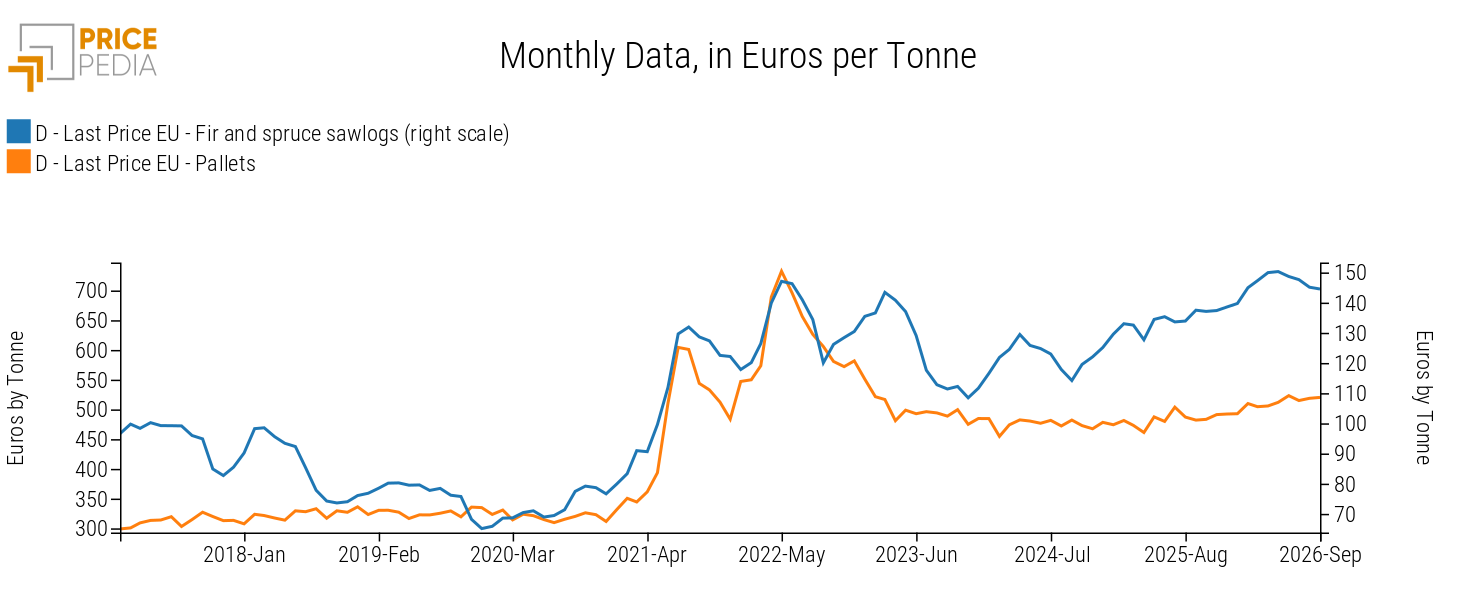
The chart shows that fir and spruce sawlogs and pallet prices followed broadly similar trends until 2022. In particular, fir and spruce sawlogs prices rose from around 70 euros per tonne in 2020 to nearly 150 euros per tonne in 2022.
However, while pallet prices underwent a relatively sharp correction after peaking in 2022, fir and spruce sawlogs prices remained close to their historical highs throughout the first part of 2023. From 2024 onwards, log prices resumed their upward trend, reaching new record highs during 2026.
Against the current backdrop of rising energy and transport costs, higher timber prices represent an additional source of upward pressure on pallet prices. However, the relative stability of pallet prices in recent years, despite renewed increases in timber costs, may reflect a gradual pass-through of higher input costs to finished product prices. The extent and speed of this pass-through also depend on demand conditions and the degree of market competition, which may limit or delay price adjustments.
Conclusions
The analysis shows that, despite the decline from their 2022 peaks, European pallet prices remain significantly above their 2020 average levels. The comparison with fir and spruce sawlogs prices also suggests that changes in raw material costs may be passed through to finished pallet prices gradually, rather than immediately. This makes further increases in pallet prices[2] a plausible scenario over the coming months.
1. Prices expressed in euros per tonne have been converted into euros per unit, assuming an average pallet weight of 22.5 kg.
2. The 24-month pallet price forecast is available in the Price Data section, within the PricePedia Scenario dataset.
You may be interested in:

Graphic Paper Prices: July 2025 Update
Published by Pasquale Marzano. .
Wood and Paper Graphic Paper Price DriversHow energy costs and product features shape prices [ Read all ]
Cost Pass-Through in Wood Panels
Published by Pasquale Marzano. .
Wood Engineered wood Cost pass-throughThe transmission of wood price dynamics to panels of different compositions [ Read all ]
Price differentiation along the packaging paper supply chain
Published by Pasquale Marzano. .
Wood and Paper Packaging Paper Analysis tools and methodologiesThe case of multilayer paperboard [ Read all ]