Methionine Prices: Asian Market Pressures and European Price Stability
Rising feedstock costs and supply disruptions have driven sharp price increases in Asia, while the European market has remained relatively stable
Published by Daniel Vito Lobasso. .
Organic Chemicals Price DriversMethionine is an essential amino acid primarily used in the animal feed industry, where it plays a key role in livestock nutrition, particularly for poultry and pigs. Its addition to animal feed helps supplement the protein content of plant-based raw materials, improving nutritional efficiency and supporting animal growth.
From an industrial perspective, methionine is mainly produced through chemical synthesis processes using intermediates derived from petrochemical and sulphur-based value chains.
The methionine market is therefore characterised by distinct drivers of demand and supply: demand is primarily determined by the requirements of the animal feed industry, while supply is closely linked to the global chemical industry.
During 2026, this dependence on chemical supply chains became particularly significant. Geopolitical tensions in the Middle East and disruptions to maritime traffic through the Strait of Hormuz heightened supply risks for raw materials and chemical intermediates, contributing to operational difficulties and production shutdowns at several major Asian manufacturing facilities.
These disruptions reduced product availability and increased production costs, putting upward pressure on methionine prices.
However, the impact of these pressures has varied considerably across regional markets. While methionine prices rose sharply in Asia, the European market remained relatively stable. This divergence warrants a closer examination of global methionine trade patterns to understand how differences in sourcing structures may help explain regional price trends.
A Global Market Dominated by a Small Number of Major Exporters
International methionine trade is characterised by a high geographical concentration of export-oriented production, making the market particularly vulnerable to manufacturing disruptions and logistical constraints affecting major supplier countries.
To illustrate the structure of global trade, the following chart shows the world's leading methionine exporters in 2025 (source: ExportPlanning).
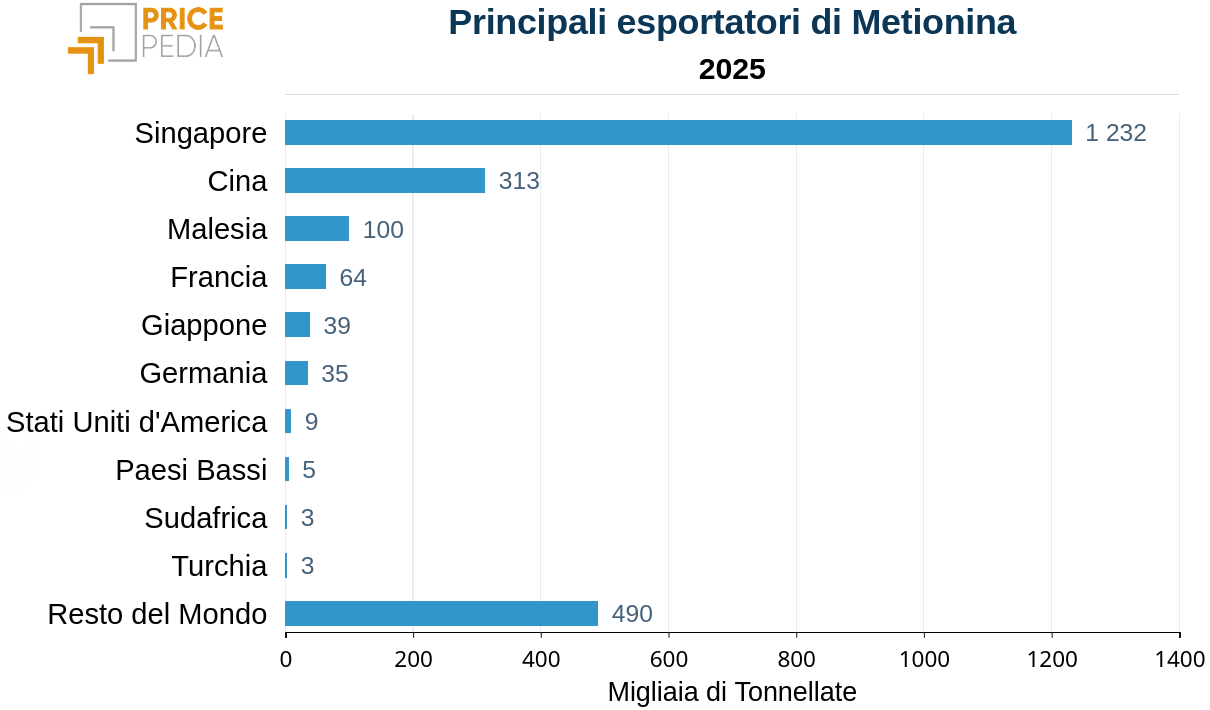
As shown in the chart, Singapore dominates global methionine exports, accounting for approximately 54% of the total. It is followed at a considerable distance by China, with a 14% share, Malaysia with just over 4%, France with nearly 3%, and Japan and Germany with around 2% each.
Singapore's leading position reflects the presence of major petrochemical complexes, including large-scale facilities dedicated to producing methionine for international markets. The country is also one of Southeast Asia's key industrial and logistics hubs, benefiting from its strategic location along major international shipping routes.
However, this concentration also represents a potential source of vulnerability, as production outages or transport disruptions can affect supplies to numerous importing markets.
To assess the extent to which different regions are exposed to these risks, it is useful to examine the geographical origin of their methionine imports.
The following table compares the geographical distribution of methionine imports into Asia and the EU in 2025, expressed as a percentage of total imports.
| Region of Origin | Asian Imports | EU Imports |
|---|---|---|
| Asia | 74.9% | 37.0% |
| European Union | 1.7% | 62.2% |
| Non-EU Europe | – | 0.7% |
| NAFTA | 0.2% | 0.1% |
| Latin America | 0.1% | – |
| Rest of the World | 23.1% | – |
| Total | 100.0% | 100.0% |
Approximately 75% of Asian methionine imports originate from other Asian countries (Singapore, China, Malaysia and Japan), highlighting the importance of intraregional trade. Disruptions affecting major Asian production hubs can therefore have significant implications for supply availability across the region.
In the European Union (EU), approximately 62% of methionine imports in 2025 originated from other EU member states, while 37% came from Asia. Among Asian suppliers, China played a dominant role, accounting for more than half of imports from the region, followed by Malaysia and Japan.
The greater importance of regional sourcing and the presence of major European production facilities may help limit direct exposure to disruptions in Asia. Nevertheless, these factors do not entirely eliminate the risks associated with the global concentration of production and dependence on chemical raw materials and intermediates.
International Methionine Price Trends
Differences in the geographical origin of imports may help explain the contrasting trends observed in regional methionine prices.
To explore this relationship, the following chart compares European methionine prices with CIF import prices in China and India and FOB export prices from China, expressed in euros per tonne (€/t).
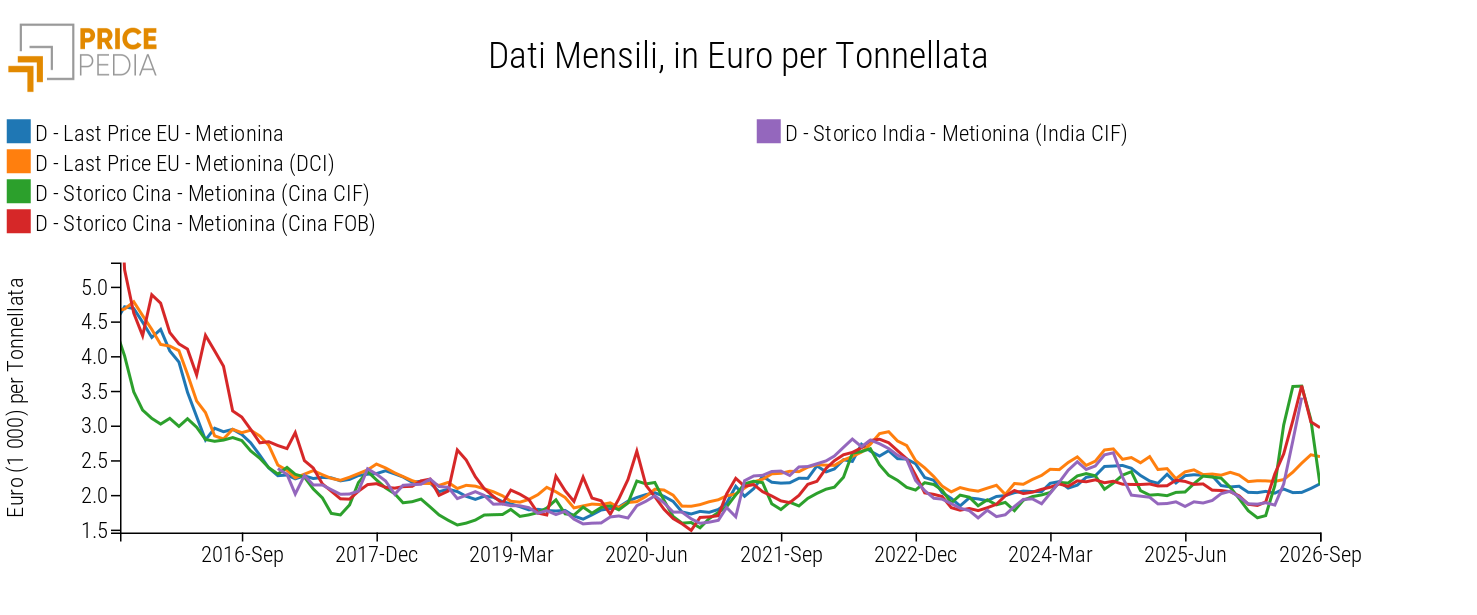
Over the longer term, international methionine prices have experienced several cycles of expansion and contraction. Although prices across different markets have frequently moved in the same direction, the magnitude and speed of these movements have often differed significantly.
Asian prices have generally exhibited greater volatility, with periods of sharp increases followed by subsequent corrections. By contrast, the European market has displayed more gradual price movements during several periods, although it has not been immune to major international market disruptions.
These differences suggest that, despite trade links between regions, local supply and demand conditions can exert a significant influence on regional price formation.
During the second quarter of 2026, this divergence became particularly pronounced. Against a backdrop of supply constraints and production disruptions affecting the Asian chemical industry, methionine prices in China and India rose sharply, while European prices remained broadly stable.
Between February and July, the CIF price of Chinese methionine imports more than doubled, rising from 1670 €/t to over 3500 €/t. Over the same period, FOB export prices from China recorded an increase of a similar magnitude, while Indian CIF import prices rose by approximately 80%.
By contrast, over the same period, European prices for feed-grade methionine remained around 2000 €/t, showing no comparable response to the sharp increases recorded in Asian markets. Pharmaceutical-grade methionine (DCI), however, experienced a more pronounced increase, with prices rising from approximately 2200 €/t in February to over 2400 €/t in July.
From August onwards, Chinese prices began to decline, signalling a gradual easing of earlier market pressures. By September, the CIF price of Chinese imports had fallen to approximately 2150 €/t, representing a decrease of nearly 40% from July. FOB export prices from China also followed a downward trend, falling below 3000 €/t, although they remained substantially higher than at the beginning of the year.
In the European Union, meanwhile, prices recorded more moderate increases in September, remaining below 2200 €/t for feed-grade methionine and below 2600 €/t for pharmaceutical-grade methionine (DCI).
The pronounced price divergence observed during the summer therefore began to narrow, primarily as a result of the correction in Chinese prices rather than any significant increase in European quotations.
Conclusions: Are Regional Price Disparities Set to Narrow?
Market developments in 2026 have highlighted how the geographical concentration of production and the vulnerability of international supply chains can contribute to sharp fluctuations in methionine prices, particularly in markets that rely heavily on Asian suppliers.
The greater stability of the European market suggests that regional production capacity and a different sourcing structure may have helped cushion the impact of international supply disruptions.
The recent decline in Chinese prices also points to a potential normalisation of the Asian market, which could lead to a further narrowing of regional price disparities in the coming months.
For the European market, there is currently insufficient evidence to suggest that prices will converge towards the peaks reached in Asia during the summer. Nevertheless, renewed upward pressure cannot be ruled out if production or logistics disruptions re-emerge in major exporting countries.
For industrial buyers, it will therefore be important to monitor price developments in both European and Asian markets to assess whether the recent rebalancing is likely to prove sustainable.
Want to stay up to date on commodity market trends?
Subscribe to the free PricePedia newsletter!
You may be interested in:

Strait of Hormuz risk after more than six months of conflict in the Persian Gulf
Published by Pasquale Marzano. .
Energy Organic Chemicals Petrolchimica Strait of HormuzTrade flows and prices of the commodities most vulnerable to a Strait of Hormuz closure [ Read all ]
Cyclohexanone cost pass-through
Published by Daniel Vito Lobasso. .
Organic Chemicals Price DriversThe role of phenol and cyclohexane in the price formation and transmission of one of the most important chemical intermediates in the benzene-nylon value chain [ Read all ]
Polymeric MDI: Prices rising across international markets
Published by Daniel Vito Lobasso. .
Organic Chemicals Strait of HormuzThe Hormuz crisis reduces Saudi supply and strengthens China’s role as a benchmark in the global market [ Read all ]