Strait of Hormuz risk after more than six months of conflict in the Persian Gulf
Trade flows and prices of the commodities most vulnerable to a Strait of Hormuz closure
Published by Pasquale Marzano. .
Energy Organic Chemicals Petrolchimica Strait of Hormuz
In the article Supply risks in the event of a closure of the Strait of Hormuz, a vulnerability index for European supplies was developed to identify the commodities for which Europe was most exposed to a reduction in trade flows through the Strait[1].
The highest vulnerability was found for energy commodities, for which Gulf countries are among the world's leading producers and exporters, as well as for several chemical intermediates.
More than six months after the outbreak of the conflict in the Persian Gulf, trade flows for these products remain significantly below pre-war levels, although they have not come to a complete halt.
In particular, between the fourth quarter of 2025 and the second quarter of 2026, global imports of oil and natural gas from Gulf countries fell by approximately -50% and -70%, respectively.
Reduced traffic through the Strait has also affected petrochemical value chains, lowering the availability of several chemical intermediates on international markets.
The following chart shows the quarterly trend in global imports of organic chemicals from countries bordering the Persian Gulf, expressed in volume terms (source: ExportPlanning).
Chart 1: Global imports of organic chemicals from the Persian Gulf, kg
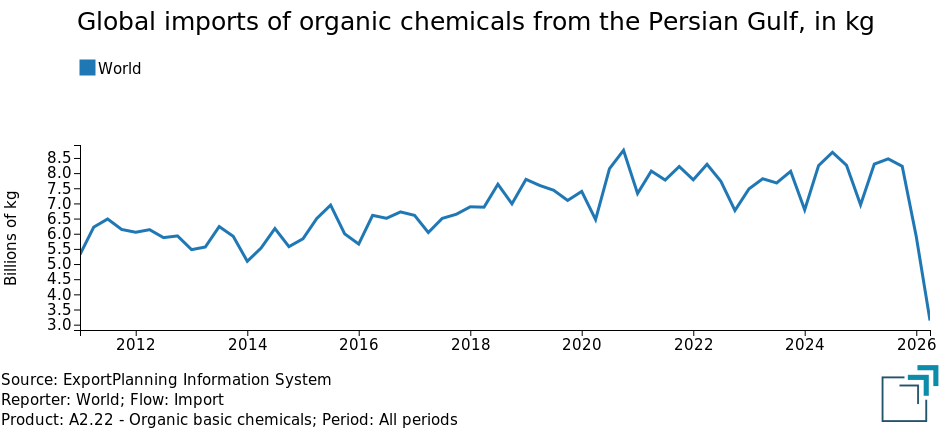
In the second quarter of 2026, global import volumes from Gulf countries were more than 60% below their fourth-quarter 2025 level, indicating that the geopolitical shock also led to a reduction in international supply from the region for organic chemical products.
Effects on the most vulnerable products
Against this backdrop, it is possible to assess how the commodities identified as most vulnerable to a closure of the Strait reacted in the months following the outbreak of the conflict. For each product considered, the table below reports:
- the share of EU imports originating from countries in the Strait of Hormuz area;
- the share of global imports originating from countries in the Strait of Hormuz area;
- the vulnerability index;
- the value of EU imports, in billions of euros;
- the percentage change in European prices between February and August 2026;
- China's share of world exports in 2025 and its change during the first months of 2026.
The latter indicator provides an initial measure of China's potential role in the international supply of these products. In recent years, the Asian economy has gained increasing importance in the global chemical industry, not only as its largest consumer, but also as a producer and exporter.
Table 1: Commodities most vulnerable to a closure of the Strait of Hormuz
| Commodity | Share of EU imports from Strait of Hormuz countries | Share of world imports from Strait of Hormuz countries | Vulnerability Index | EU imports EUR bn |
% change in EU prices in EUR Feb-Aug '26 | China's share of world exports (absolute change in 2026) |
|---|---|---|---|---|---|---|
| Crude oil | 10.8 | 39.0 | 2.02 | 234.5 | 23.9 | 0.1 (-0.0) |
| Fuel oil for chemical uses | 41.1 | 10.9 | 2.30 | 3.3 | 19.5 | 4.8 (-0.6) |
| Styrene | 14.8 | 27.7 | 1.90 | 2.8 | 31.5 | 2.5 (+9.7) |
| Methacrylic acid esters | 13.0 | 11.3 | 1.50 | 0.9 | 10.5 | 10.5 (+7.0) |
| Helium | 20.1 | 34.8 | 2.11 | 0.9 | -20.8 | 1.6 (+0.3) |
| Ethylene glycol | 14.6 | 49.5 | 2.48 | 0.8 | 15.2 | 0.8 (+3.8) |
| Cyclohexane | 33.2 | 31.6 | 2.72 | 0.5 | 11.6 | 2.1 (-0.1) |
| Diethylene glycol | 25.2 | 21.5 | 2.17 | 0.3 | 39.0 | 2.7 (+3.6) |
| p-Xylene | 28.7 | 16.2 | 2.03 | 0.2 | 21.5 | 0.0 (+0.0) |
| Triethanolamine | 25.8 | 35.7 | 2.59 | 0.1 | 71.5 | 0.1 (+0.1) |
The table shows that, in the months following the outbreak of the conflict, all the commodities considered recorded increases in European prices of more than +10%. The only exception was helium, whose price dynamics require a separate analysis.
The strongest increase was recorded for triethanolamine (TEA), whose price rose by +71.5%, reaching an all-time high over the period considered. This product is particularly exposed to supplies from the Gulf region, which accounts for a significant share of global supply. In this case, China's role remains limited, as highlighted in the article Ethanolamines: between market fundamentals and supply concerns.
A different pattern emerges for methacrylic acid esters, which recorded one of the smallest price increases among the products analysed, at around +10%. In this market, China has significantly strengthened its position, raising its share of world exports to around 17% and helping to contain the risk of potential supply shortages.
The clearest example of China's growing role, however, is styrene[2]. China's share of world exports increased by 9.7 percentage points, reaching 12.2%. Over the same period, European styrene prices rose by more than +30%. The simultaneous increase in Chinese supply does not appear to have been sufficient to prevent a significant rise in prices, although it may have helped ease market tensions.
The case of styrene
To assess more closely the extent to which Chinese supplies may have offset the decline in shipments from Gulf countries, it is useful to compare trade flows from the two regions.
The following chart compares global imports of styrene originating from China with those from countries in the Persian Gulf region (based on ExportPlanning data).
Chart 2: Global styrene imports from the Persian Gulf and China, thousand tonnes
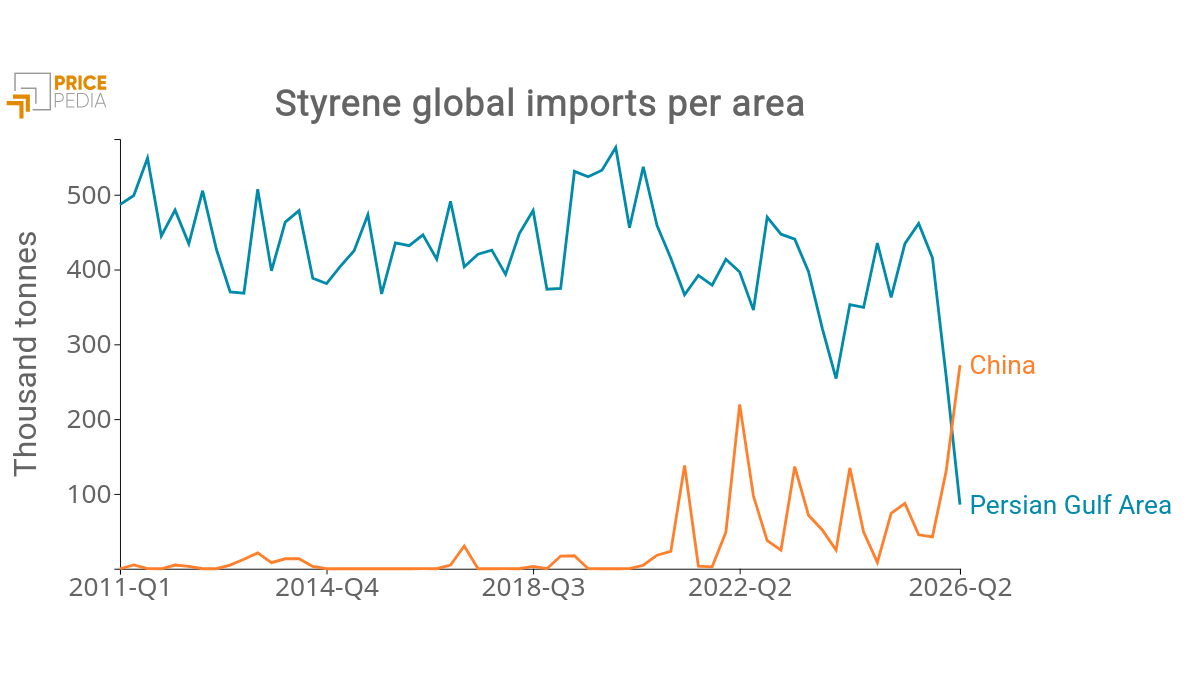
During 2026, the geography of supply changed significantly. Volumes originating from the Gulf region fell sharply, declining by 80% in the second quarter of 2026 compared with the same quarter of the previous year. By contrast, over the same period supplies from China increased by more than 200%, exceeding the total volumes exported by Gulf countries and reaching an all-time high.
However, the increase in Chinese supply was not sufficient to fully offset the contraction in Middle Eastern supplies.
Conclusions
More than six months after the outbreak of the conflict, the evidence confirms that the reduction in trade flows through the Strait of Hormuz has had significant effects beyond energy commodities, affecting several products along the petrochemical value chain. Most of the commodities previously identified as highly vulnerable have recorded significant increases in European prices, although the magnitude of these increases has varied considerably.
Trade-flow developments nevertheless show that the initial vulnerability did not automatically translate into outright supply shortages. In some markets, China significantly increased its share of world exports, partially offsetting the contraction in supplies from the Gulf region.
The case of styrene is particularly illustrative: during 2026, Chinese export volumes reached historically high levels and surpassed those originating from countries bordering the Persian Gulf, although they were not sufficient to fully compensate for the decline in Middle Eastern supply.
Overall, developments over the past several months suggest that supply risk depends both on the degree of exposure to countries in the Strait of Hormuz area and on the ability of international markets to activate alternative sources of supply. Greater availability of Chinese material can help reduce the risk of physical shortages without necessarily preventing sharp increases in prices.
1. The eBook section includes an in-depth analysis on Closure of the Strait of Hormuz and supply risk.
2. A case similar to that of styrene was discussed in the article Polyethylene: the rise of Chinese exports in a market affected by supply shortages.
You may be interested in:
Cyclohexanone cost pass-through
Published by Daniel Vito Lobasso. .
Organic Chemicals Price DriversThe role of phenol and cyclohexane in the price formation and transmission of one of the most important chemical intermediates in the benzene-nylon value chain [ Read all ]
Polymeric MDI: Prices rising across international markets
Published by Daniel Vito Lobasso. .
Organic Chemicals Strait of HormuzThe Hormuz crisis reduces Saudi supply and strengthens China’s role as a benchmark in the global market [ Read all ]
International Octanol Prices on the Rise
Published by Daniel Vito Lobasso. .
Organic Chemicals Price DriversIl ruolo del propilene e il cost pass-through nella formazione dei prezzi internazionali [ Read all ]