Increasing raw material prices for food packaging
The hierarchy of energy shock transmission is confirmed
Published by Pasquale Marzano. .
Energy cost Food Global Economic TrendsThe economic effects of the energy shock triggered by the conflict in the Persian Gulf are spreading across industrial supply chains not only through higher direct energy costs, but also through rising prices of raw materials used in production processes. Since February 2026, aggregate commodity prices have increased by more than +17%, as documented in the April 2026 update. However, the intensity of the increases is heterogeneous across categories, with stronger pressures for commodities directly linked to the petrochemical and natural gas value chain.
The effects are also visible in an industrial sector such as food processing. Although food commodities as a whole show relatively moderate dynamics, increases linked both directly and indirectly to the energy shock are emerging within the sector.
This is the case, for example, for wheat, which has a strong link with fertilizer costs (see the article How fertilizer prices affect cereal prices), among the commodities most impacted by the increase in natural gas prices, and for vegetable oils, whose prices are affected by stronger demand for biofuels, for which they are production inputs, due to the substitution effect between biofuels and fossil fuels.
In addition to rising prices of direct purchasing materials, the food industry is also experiencing increases in purchasing costs for packaging materials, particularly plastics, paper and metals. In this case as well, the hierarchy of energy shock transmission is confirmed, with stronger increases for plastics.
This dynamic is summarized by the index shown in the following chart, built by aggregating the prices of more than 35 raw materials used in food packaging.
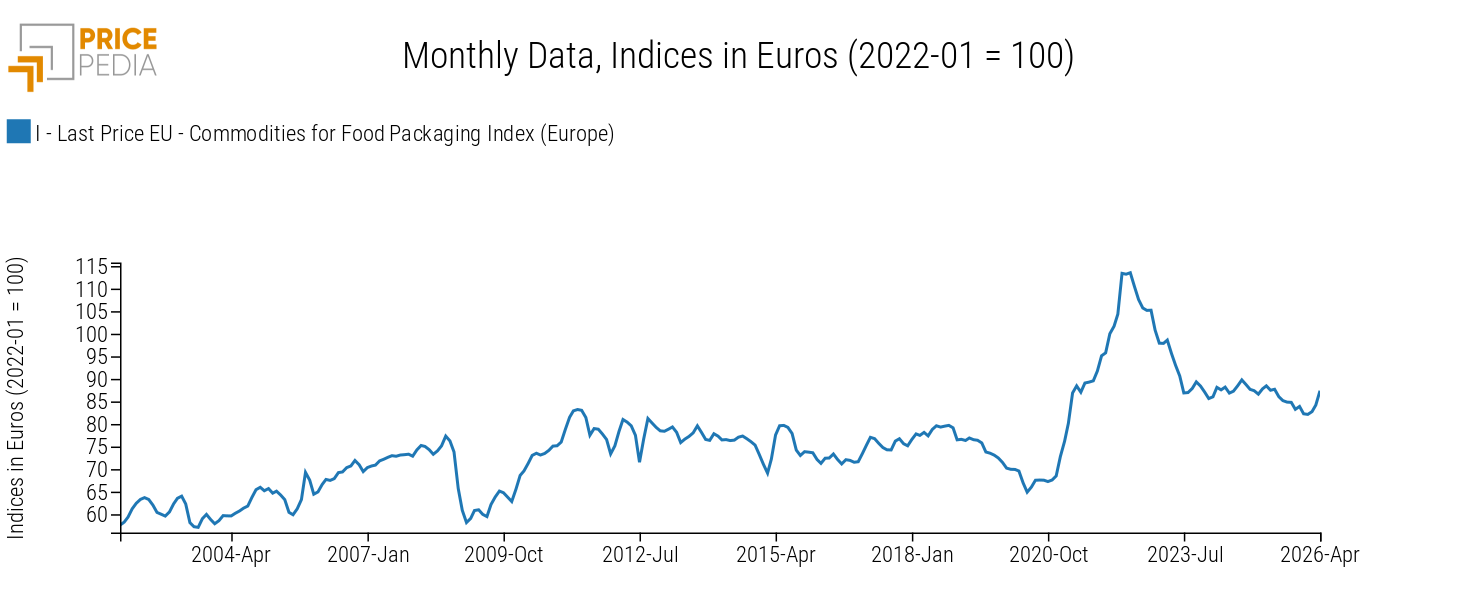
In April 2026, food packaging commodity prices increased by almost +4% compared with the previous month, quickly returning to the average levels of the first half of 2025 and effectively reversing the downward trend that had characterized the sector in the final part of last year.
Evolution of food packaging prices since the beginning of the conflict
To provide an initial measure of the increases recorded by individual food packaging products since the start of the conflict, the table below reports the overall changes recorded in April 2026 compared with February of the same year.
Table 1: Commodity prices for food packaging in euros, April–February 2026 change (%)
| Product | Percentage change Apr–Feb '26 |
Category |
|---|---|---|
| Polystyrene | +32.68 | Plastics |
| Polyethylene terephthalate (PET, low viscosity number) | +10.12 | Plastics |
| Kraftliner (weight < 150 g/m²) | +9.70 | Paper |
| Polyethylene (LLDPE) | +9.16 | Plastics |
| Polypropylene (PP) | +7.64 | Plastics |
| Fluting paper | +6.73 | Paper |
| Testliner | +6.63 | Paper |
| Multilayer paperboard (outer layer bleached) | +5.91 | Paper |
| Beverage can body stock | +5.74 | Metals |
| Unbleached sack kraft paper | +5.20 | Paper |
The table confirms the trends described above, with particularly strong increases in plastic prices. In particular, polystyrene rose by more than +32%, PET by +10%, and LLDPE by +9.2%.
Paper prices also recorded average increases between +5% and +10%. Among metals, beverage can body stock increased by +5.7% since the beginning of the conflict.
Do you want to stay up-to-date on commodity market trends?
Sign up for PricePedia newsletter: it's free!
You may be interested in:
Cocoa price forecast for 2026-2027
Published by Pasquale Marzano. .
Food Cocoa ForecastUncertainty rises over El Niño's impact on cocoa supply [ Read all ]
Flexible packaging tailored to technical requirements: the PET/ALU/PE coffee pouch case
Published by Pasquale Marzano. .
Food Should CostStarting from the PET/PE stand-up pouch, how preservation requirements reshape the Should Cost structure [ Read all ]
Hormuz Strait crisis and food packaging: from price dynamics to cost structure
Published by Pasquale Marzano. .
Food Packaging Paper Basic thermoplastics Should CostAn example of integrating non-material costs into the Should Cost for two stand-up pouch configurations [ Read all ]