China economic update May 2026
FOB prices for Chinese commodity exports continue to rise
Published by Luca Sazzini. .
Conjunctural Indicators Global Economic TrendsThe monthly PricePedia update of Chinese commodity prices for May 2026 has been published.
In aggregate terms, in May 2026 the dollar prices of Chinese exports, measured by the FOB aggregate indices of Total Commodities[1] and Industrial products[2], recorded month-on-month changes of +3.1% and +4.3%, respectively.
The chart below shows the two-year trend, expressed in dollars, of FOB prices of Chinese exports for the aggregate indices of Total Commodities and Industrial Commodities.
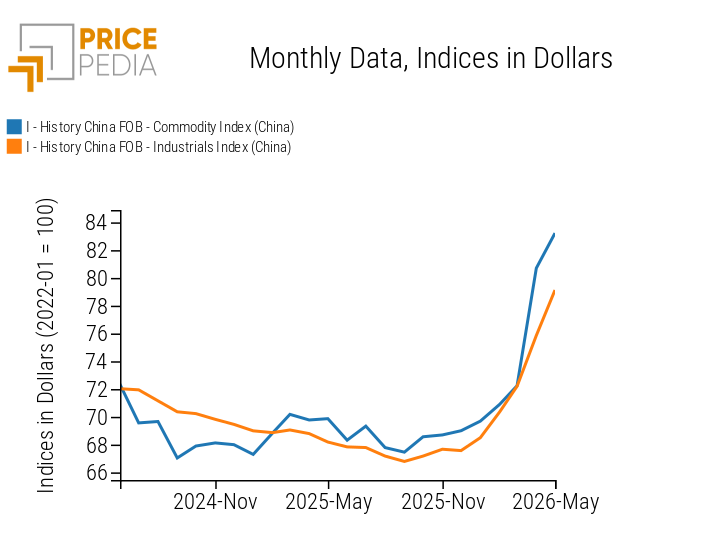
In May 2026, the increase in FOB prices of Chinese exports was driven by the rise in international energy costs following the closure of the Strait of Hormuz.
The slight slowdown in price dynamics is attributable, on the one hand, to the early signs emerging in the same period of a rapprochement between the United States and Iran and, on the other hand, to the worsening supply surplus in the domestic market, alongside a progressive weakening of domestic Chinese demand.
For June, a further slowdown in price growth is plausible, linked to the resumption of trade flows through the Strait of Hormuz following the agreements signed between the US and Iran on June 19, and to the persistence of excess supply in the domestic market. These factors are expected to dampen the growth dynamics of Chinese industrial commodity prices.
Do you want to stay up-to-date on commodity market trends?
Sign up for PricePedia newsletter: it's free!
Analysis of industrial commodities by product category
The table below shows the month-on-month dynamics of dollar prices of Chinese export commodities, broken down by the product categories included in the industrial commodities aggregate.
Month-on-month changes in industrial commodities by product category, expressed in dollars
| 2026-01 | 2026-02 | 2026-03 | 2026-04 | 2026-05 | |
|---|---|---|---|---|---|
| I-Historical China FOB - Total Ferrous Index (China) | −0.10 | +3.46 | +1.07 | +0.68 | +1.39 |
| I-Historical China FOB - Total Non-Ferrous Index (China) | +4.69 | +4.77 | +2.79 | +1.36 | +4.67 |
| I-Historical China FOB - Total Plastics and Elastomers Index (China) | −0.82 | +0.39 | +2.91 | +9.90 | +5.00 |
| I-Historical China FOB - Total Organic Chemicals Index (China) | +0.23 | +0.56 | +3.92 | +15.19 | +5.79 |
| I-Historical China FOB - Total Inorganic Chemicals Index (China) | +2.47 | +3.54 | +4.54 | +5.36 | +5.11 |
| I-Historical China FOB - Total Specialty Chemicals Index (China) | +0.26 | +1.25 | +2.03 | +2.63 | +6.13 |
| I-Historical China FOB - Total Pharmaceutical Chemicals Index (China) | −3.16 | −0.85 | +1.50 | +16.34 | +5.88 |
| I-Historical China FOB - Total Textile Fibres Index (China) | −0.46 | +0.68 | +3.64 | +9.11 | +4.78 |
The table shows that in May, the product families recording the strongest month-on-month price increases belong to the chemical commodities sector. In particular, the most significant increase concerned the aggregated prices of Specialty Chemicals, the only segment that showed an acceleration in prices, mainly driven by the rise in FOB prices of ammonium sulfate (+13.5% m/m), following the more moderate growth observed in previous months.
The other product families showing relatively strong price increases were Plastics and Elastomers and Textile Fibres, with month-on-month rises of +5% and +5.8%, respectively. These increases are still less intense than those recorded in April 2026.
The categories with the smallest price increases are Industrial Metals, both Ferrous and Non-Ferrous, although they show an acceleration compared to the previous month.
Within the non-ferrous segment, the strongest acceleration concerned Chinese export prices of aluminium derivatives, such as raw aluminium alloys and sheets with a thickness between 0.2 and 3 mm, which rose from +7.3% and +2.8% in April to +13% and +8.3% in May, respectively. These dynamics are linked not only to higher energy costs but also to supply risks caused by the closure of the Strait of Hormuz.
[1] The PricePedia FOB Total Commodity China index is obtained by aggregating FOB indices for industrial and energy commodities.
[2] The FOB Industrial China index is obtained by aggregating FOB indices for the following categories: Ferrous metals, Non-ferrous metals, Plastics and Elastomers, Organic Chemicals, Inorganic Chemicals, Specialty Chemicals, Pharmaceutical Chemicals, and Textile Fibres.
You may be interested in:

Uncertainty in the commodity markets remains high
Published by Luca Sazzini. .
Conjunctural Indicators Commodities Financial WeekCommodity prices show divergent trends [ Read all ]

From Hormuz to Bab el-Mandeb, tensions are rising over energy commodity prices
Published by Luca Sazzini. .
Conjunctural Indicators Commodities Financial WeekIncreased supply is driving down cobalt prices [ Read all ]

China economic update July 2026
Published by Luca Sazzini. .
Conjunctural Indicators Global Economic TrendsThe temporary decline in energy prices halts the rise in Chinese commodity prices [ Read all ]