Monthly commodity prices update for June 2026
Commodity prices show mixed trends following the US-Iran peace agreement
Published by Pasquale Marzano. .
EU Customs Global Economic TrendsAfter more than 100 days of conflict, the United States and Iran signed a Memorandum of Understanding (MoU) on June 18, 2026, officially ending hostilities and reopening the Strait of Hormuz.
Following the agreement, crude oil and refined product prices entered a downward trend, anticipating the gradual restoration of trade flows through the Strait. By last Friday, Brent crude had returned to its pre-conflict level of around USD 72 per barrel (see our weekly market update). Overall, the average Brent price in June declined by more than 17% compared with the previous month.
The improvement in the geopolitical environment was quickly reflected in European physical energy commodity prices, which fell by -9.3% in June compared with May, in line with expectations of a recovery in shipping activity across the Persian Gulf. This trend also affected the euro-denominated prices of the commodities monitored by PricePedia, which overall recorded a -3.9% decline compared with their average levels in May 2026.
The chart below shows the price trends, in euros, of European-market raw materials for the main PricePedia aggregates, indexed to January 2022 = 100: Commodity[1], Industrials[2], Energy, and Food.
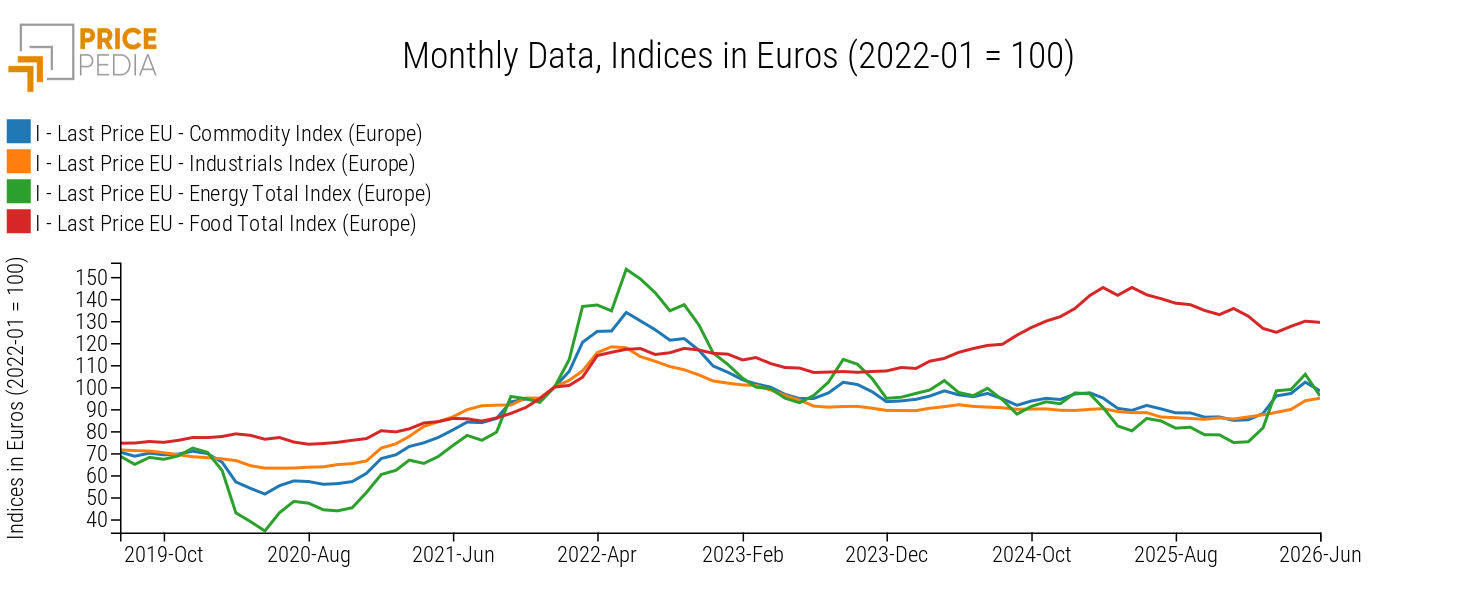
As the chart shows, despite the optimism following the peace agreement and the subsequent price correction, both energy commodities and the overall commodity index remained well above their pre-conflict averages recorded in February 2026, by more than 18% and 11%, respectively.
Food commodity prices, by contrast, remained broadly stable overall, edging down by just -0.4% in June compared with May. However, performance varied across segments: Tropical Commodities declined by 3.4%, while Milk and Dairy Products rose by 11%.
Prices for core industrial commodities continued to increase in euro terms during June (+1.2% month-on-month), although at a slower pace than in the previous month.
Unlike energy commodities, which have partly priced in the optimism surrounding the US-Iran agreement, industrial commodity markets continue to be driven primarily by supply-side constraints. This is particularly evident for commodities whose production is concentrated in Gulf countries and/or whose supply chains rely on shipments through the Strait of Hormuz, where traffic has not yet fully returned to pre-conflict levels.
Industrial Commodity Price Trends Since the Beginning of the Conflict
The dynamics described above for industrial commodities are illustrated in the chart below, which shows the percentage changes in euro-denominated prices for the main industrial subcategories between February and June 2026.
Chart 2: Percentage Change in Euro Prices, June 2026 vs. February 2026
Source: PricePedia
With the exception of Pharmaceutical Chemicals, all major industrial commodity categories recorded higher euro-denominated physical prices between February and June 2026.
The strongest increases were observed in Plastics and Elastomers, where prices rose by more than 22%, followed by Organic Chemicals, up 15.6%.
Price increases for the remaining categories remained below 10%, broadly in line with the outlook presented in our May 2026 market update.
Conclusions
The US-Iran agreement has triggered the first downward corrections in commodity prices, with the most immediate response occurring in energy markets, where prices quickly reflected expectations of a normalization in shipping through the Strait of Hormuz.
Industrial commodity markets, however, continue to be driven primarily by supply conditions, with scarcity effects still outweighing improving sentiment. Against this backdrop, the future direction of industrial commodity prices will largely depend on the effective implementation of the peace agreement and the gradual recovery of commercial traffic through the Strait.
Do you want to stay up-to-date on commodity market trends?
Sign up for PricePedia newsletter: it's free!
1. The PricePedia Commodity index is the aggregation of Industrials, Food and Energy indices.
2. The PricePedia Industrials index is the aggregation of indices related to the following categories: Ferrous Metals, Non-Ferrous Metals, Wood and Paper, Pharmaceutical Chemicals, Chemicals: Specialty, Organic Chemicals, Inorganic Chemicals, Plastics and Elastomers, and Textile Fibers.
You may be interested in:
Monthly commodity prices update for August 2026
Published by Pasquale Marzano. .
EU Customs Global Economic TrendsEuropean commodity prices continue to rise [ Read all ]
Monthly commodity prices update for July 2026
Published by Pasquale Marzano. .
EU Customs Global Economic TrendsRenewed tensions in the Persian Gulf halt the downward trend in commodity prices [ Read all ]
Monthly commodity prices update for May 2026
Published by Pasquale Marzano. .
EU Customs Global Economic TrendsEuropean prices of purchased materials up +17% since the start of the Iran conflict [ Read all ]