European steelmakers under pressure: margins are shrinking
The impact of high energy prices on electric arc furnace steelmakers
Published by Luca Sazzini. .
Energy cost Long steels Cost pass-through
High energy costs have been one of the key issues of 2026. The sharp increase in international energy prices has weighed on household budgets and raised companies' operating costs, spreading throughout production chains and affecting the entire industrial sector, although to varying degrees depending on the type of activity.
In the steel industry, the impact has been particularly significant for companies using the electric arc furnace production route, which requires large amounts of electricity to melt scrap. Electricity has indeed been one of the energy components most affected by price increases, partly due to the close relationship between electricity prices and those of natural gas, which is used as fuel in thermal power plants.
The following table shows average annual wholesale electricity prices in major European countries, expressed in euros per MWh.
Day-Ahead Market Electricity Prices (Euro/MWh)
| 2022 | 2023 | 2024 | 2025 | 2026* | 2026 Annual Change | |
|---|---|---|---|---|---|---|
| Italy | 304.1 | 127.0 | 108.6 | 115.8 | 159.8 | +37.93 |
| Germany | 235.4 | 95.2 | 74.8 | 91.0 | 120.6 | +32.51 |
| France | 275.8 | 96.9 | 54.6 | 64.9 | 98.4 | +51.62 |
| Spain | 167.5 | 88.4 | 63.2 | 65.2 | 88.6 | +35.80 |
| Poland | 166.7 | 111.7 | 88.3 | 103.8 | 129.8 | +25.01 |
| Hungary | 271.5 | 106.9 | 101.0 | 108.5 | 148.4 | +36.77 |
With the exception of Poland, where the average price since the beginning of the year is 25% higher than in 2025, all the other countries analysed have recorded increases of more than 30%. France has seen the sharpest increase, exceeding 50%. However, this change should be viewed in context, as the average French price since the beginning of the year, at 98 euros/MWh, remains the second lowest among those reported.
The other largest increases have been recorded in Italy and Hungary, where average prices since the beginning of 2026 are respectively 38% and 37% higher than the 2025 average. Both countries also have the highest price levels among those analysed. Despite the sharp increases over the past year, electricity prices in all the countries analysed remain below the historical peaks reached in 2022, when the annual average in Italy, the country with the highest price levels, exceeded 300 euros/MWh.
For steelmakers using electric arc furnaces, increases in electricity prices have been compounded by higher steel scrap prices, as scrap is one of the main raw materials used in the production process.
In 2026, steel scrap prices also recorded substantial increases, which can likewise be attributed to rising energy and transportation costs following the outbreak of the conflict in the Middle East.
The following chart compares the year-to-date trend in daily Turkey steel scrap prices, sourced from the LME, with that of Brent crude oil, used as a proxy for the energy shock. Both series are expressed in $/tonne.
Comparison of steel scrap and Brent financial prices, expressed in $/tonne
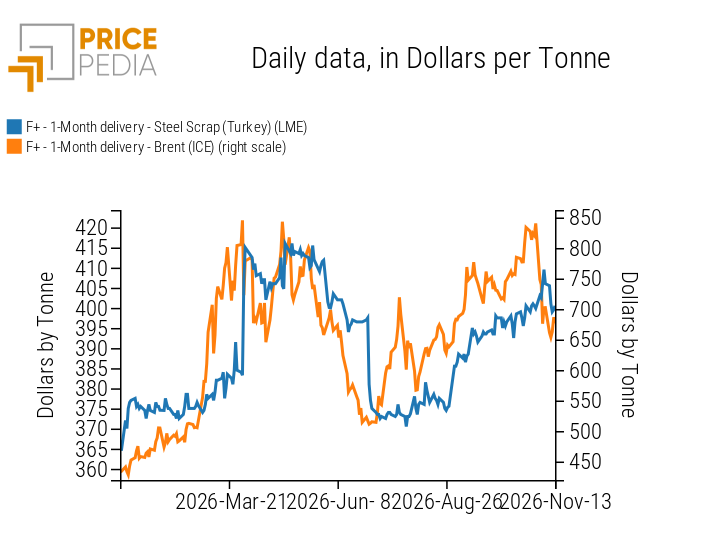
In 2026, Turkey LME steel scrap prices followed the trend in Brent crude oil prices, albeit with a slight time lag. When a 30-day lag is taken into account to reflect the time required for transportation costs to feed through into scrap prices, the correlation between the two series reaches 0.81, against a theoretical maximum of 1.
Overall, since the beginning of the year, Turkey LME steel scrap prices in US dollars have increased by 15.5%. The combined impact of higher scrap and electricity prices is captured by the PricePedia index of the electric arc furnace metallic charge, which tracks price trends for both production inputs.
The following chart compares the PricePedia metallic charge index with the aggregate PricePedia index of steel long product prices in euros, both with January 2022 as the base period.
Comparison of PricePedia indices of steel long product and metallic charge prices in euros
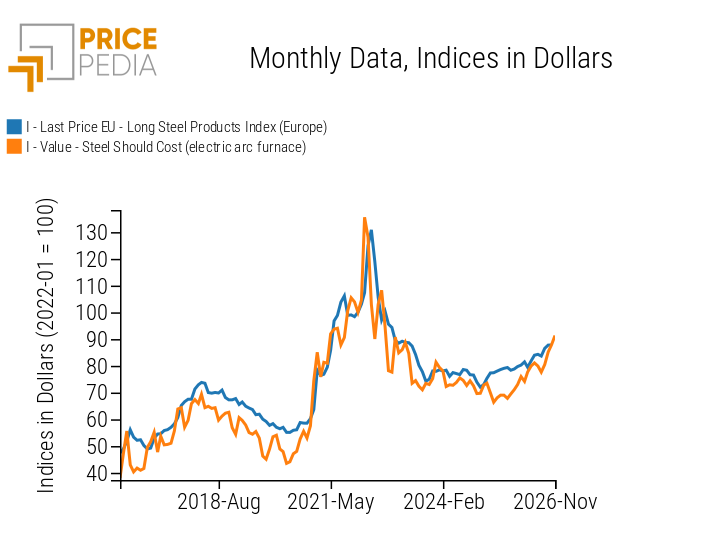
The chart highlights the close relationship between steel long product prices and metallic charge prices, with a correlation coefficient of 0.93 between the two series.
In 2025, a slight divergence emerged between the two series, as steel long product prices remained more stable than metallic charge prices, which declined.
In 2026, by contrast, metallic charge costs increased significantly more than finished steel prices, squeezing electric arc furnace steelmakers' margins, all other things being equal. From December 2025 to October 2026, metallic charge prices increased by 128.8%, compared with a 69.7% increase in long steel products. Steelmakers were therefore forced to absorb most of the cost increases internally, passing on only a limited share to selling prices. This was due to intense international competition, fuelled by abundant Chinese supply, which continues to keep prices low on international markets. The limited scope for passing higher costs on to selling prices has undermined the profitability of numerous European steelmakers. Some have been forced to suspend or reduce production over the past month due to high energy costs.
Conclusions
The experience of 2026 highlights a phenomenon of incomplete cost pass-through, whereby intense international competitive pressure has limited European steelmakers' ability to pass higher production costs on to selling prices. In 2027, margins are expected to recover gradually, supported by resilient long steel product prices and an anticipated decline in electric arc furnace metallic charge costs, driven by expectations of easing conflicts in the Middle East.
You may be interested in:

Increasing raw material prices for food packaging
Published by Pasquale Marzano. .
Energy cost Food Global Economic TrendsThe hierarchy of energy shock transmission is confirmed [ Read all ]
How the Italian electricity market has changed over the last 6 years
Published by Luigi Bidoia. .
Energy cost Electricity's National Single Price Electric Power Energy Transition Price DriversConsumi e mix produttivo: le basi per comprendere l’evoluzione dei prezzi [ Read all ]

Long steels: Italian efficiency challenges high energy cost
Published by Luca Sazzini. .
Long steels Price DriversAnalysis of the main cost factors affecting long steel prices [ Read all ]