Methanol: the impact of the Middle East crisis on international prices
Methanol prices rise sharply across Europe and Asia, but the magnitude of the increases varies depending on each market's reliance on international supplies
Published by Daniel Vito Lobasso. .
Organic Chemicals Price DriversMethanol, also known as methyl alcohol, is one of the key building blocks of the chemical industry. It is used to manufacture a wide range of industrial intermediates and derivatives, including formaldehyde, acetic acid, olefins, and fuels.
Methanol is primarily produced through natural gas reforming or coal gasification, with the choice of production process largely determined by feedstock availability and cost. Natural gas-based production dominates in gas-rich countries such as the United States and several Middle Eastern producers, while coal-based production is more prevalent in countries such as China, where coal resources are abundant.
This production structure makes methanol prices closely linked to developments in energy markets and exposes the industry to geopolitical and supply risks, given the central role of Persian Gulf countries in global exports of both natural gas and methanol.
These risks materialized with the outbreak of the conflict in Iran in late February 2026, which disrupted Middle Eastern supplies and destabilized energy markets. Shipping disruptions through the Strait of Hormuz have hindered methanol exports, reducing availability on international markets, while the simultaneous rise in energy costs has added further upward pressure on prices. Together, these factors have driven sharp increases in international methanol prices, with the magnitude of the impact varying according to each market's dependence on Middle Eastern supplies.
To better understand current market dynamics and the near-term outlook for prices, this article examines the structure of international methanol trade, the impact of geopolitical tensions in the Persian Gulf on prices, and the signals emerging from financial markets.
The Structure of International Trade
Beyond driving up energy costs, the conflict in the Middle East has directly affected global methanol availability. Several Persian Gulf countries rank among the world's largest exporters and are particularly important suppliers to Asian markets.
The following chart shows the world's leading methanol exporters in 2025 (source: ExportPlanning).
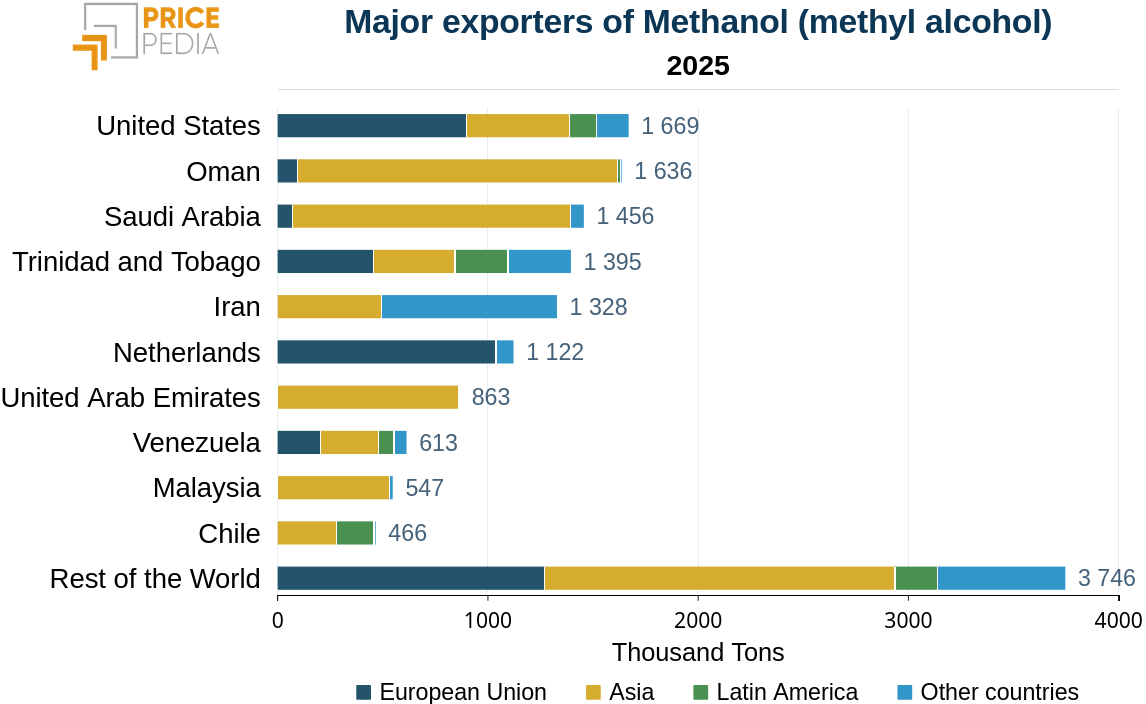
In 2025, the United States and Oman were the world's largest methanol exporters, each shipping more than 1.6 million tonnes and accounting for approximately 11% of global trade. They were followed by Saudi Arabia, Trinidad and Tobago, and Iran, each with a market share close to 10%. Together, these five countries accounted for more than half of global methanol exports.
Overall, Persian Gulf countries accounted for approximately 38% of global methanol exports in 2025, although their combined share exceeded 40% in some previous years.
This geographical concentration of supply gives the region a critical role in the global methanol market and exposes several major Asian importers, including China, India, and Japan, to significant supply risks.
In 2025, approximately 90% of India's methanol imports originated from the Persian Gulf region, compared with 60% of China's imports and 50% of Japan's. Overall, the region supplied 63% of Asian methanol imports, compared with just 14% of European imports.
Any disruption to exports from the Persian Gulf therefore poses a particularly significant threat to Asian supply chains, forcing importers to seek alternative suppliers and potentially driving up logistics costs and prices. However, the effects can also extend to Europe, where stronger international competition for available volumes may put upward pressure on prices despite the region's lower direct dependence on Middle Eastern supplies.
International Price Trends
The following chart compares methanol price trends in Europe, China, Japan, and India, expressed in euros per tonne (€/t).

Over the longer term, international methanol prices have experienced several cycles of increases and declines. Although prices across the different markets have generally followed similar trends, differences in price levels and the magnitude of fluctuations have become more persistent since 2022.
Asian markets have generally experienced sharper price fluctuations and lower price levels than Europe, where movements have often been more gradual. These differences suggest that, despite the trade links connecting the various regions, local supply and demand conditions can significantly influence price formation.
In the second quarter of 2026, however, price differences between markets narrowed somewhat as international tensions had a particularly strong impact on Asian countries. Between February and June, methanol prices in Japan and India nearly doubled, while increases were more moderate in China and Europe, where prices rose by approximately 20% and more than 30%, respectively.
From July onwards, international prices began to ease slightly amid expectations of an improvement in the geopolitical situation. However, Asian prices resumed their upward trend in late August, particularly in China, where methanol prices increased by more than 20% in September alone.
Overall, the 2026 shock triggered widespread price increases, with the sharpest rises occurring in markets most dependent on Middle Eastern supplies. The relatively moderate increase in Chinese prices compared with other Asian markets can be partly attributed to China's substantial domestic coal-based production capacity, which reduces its reliance on imports of natural gas-based methanol. The future direction of international prices will therefore depend on developments in feedstock costs and, above all, the restoration of trade flows from the Persian Gulf.
Signals from Financial Markets
In the near term, methanol price movements will largely depend on the resumption of Middle Eastern exports and developments in feedstock costs. Market expectations regarding these factors can be assessed through Chinese methanol futures traded on the Zhengzhou Commodity Exchange (ZCE), as shown in the following chart.
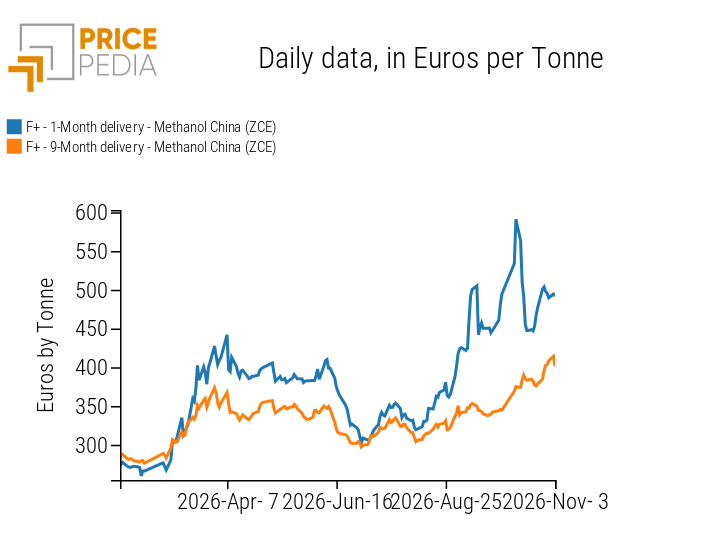
In early November 2026, the one-month methanol futures contract in China is trading at nearly 500 €/t, compared with approximately 400 €/t for the nine-month contract.
This downward-sloping futures curve, known as backwardation, reflects the severe supply pressures currently affecting the market and lends support to expectations of a gradual decline in prices over the coming months, potentially driven by the reopening of the Strait of Hormuz and the resumption of trade flows from the Persian Gulf.
In Europe, too, despite the region's lower direct dependence on Middle Eastern supplies, a normalization of international trade could help bring prices down by easing competition for available volumes. However, the extent of any price correction will also depend on developments in energy costs, and prices may remain above the levels recorded before the outbreak of the conflict in Iran.
Want to stay up to date with commodity market trends?
Subscribe to the free PricePedia newsletter!
You may be interested in:
Methionine prices: asian market pressures and european price stability
Published by Daniel Vito Lobasso. .
Organic Chemicals Price DriversL’aumento dei costi dei feedstock e le difficoltà negli approvvigionamenti hanno alimentato forti rincari in Asia, mentre il mercato europeo ha mostrato una maggiore stabilità [ Read all ]
Strait of Hormuz risk after more than six months of conflict in the Persian Gulf
Published by Pasquale Marzano. .
Energy Organic Chemicals Petrolchimica Strait of HormuzTrade flows and prices of the commodities most vulnerable to a Strait of Hormuz closure [ Read all ]
Cyclohexanone cost pass-through
Published by Daniel Vito Lobasso. .
Organic Chemicals Price DriversThe role of phenol and cyclohexane in the price formation and transmission of one of the most important chemical intermediates in the benzene-nylon value chain [ Read all ]