Surfactants: European price forecasts for 2027
What are the main factors that will drive price trends?
Published by Daniel Vito Lobasso. .
Forecast Surfactants ForecastIn 2026, European surfactant prices followed different trends across the main product categories, reflecting their varying sensitivity to raw material costs. As discussed in a previous article, oleochemical and petrochemical intermediates are important price determinants, whose impact varies according to the production characteristics of each category.
Despite these differences, over the long term, prices across the various surfactant categories tend to follow a common underlying trend, partly due to the influence of energy markets on the inputs used in their respective production chains. Against this backdrop, the expected moderation in energy commodity prices in 2027 could help ease cost pressures on production feedstocks and, consequently, on surfactant prices.
The outlook for 2027 will depend primarily on developments in raw material costs and geopolitical tensions in the Middle East. The following analysis examines these factors and outlines the expected price trends for the main surfactant categories based on the information currently available and incorporated into the PricePedia Scenario.
PricePedia Forecast Scenario for European Surfactants
The following chart shows the historical and forecast evolution of the aggregate index of European surfactant prices.
PricePedia Forecasts for the Total European Surfactants Index, Expressed in Euro
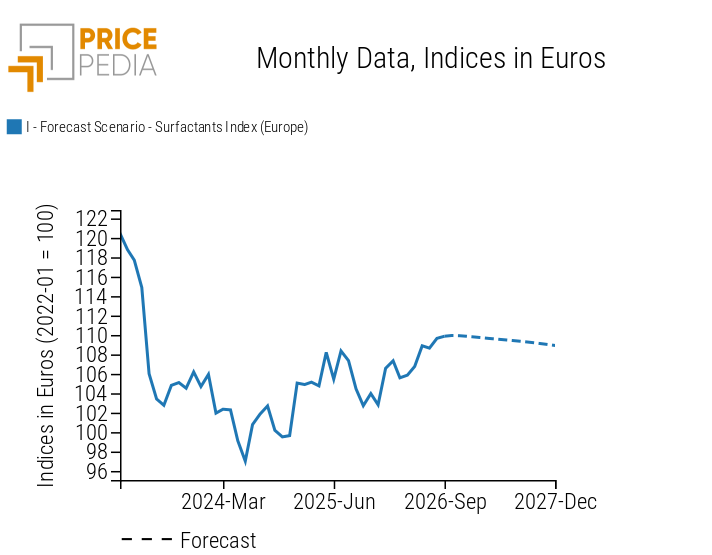
Following the price increases recorded this year, the aggregate surfactant price index is forecast to decline in 2027, while remaining above its levels at the beginning of 2026.
The expected decline is mainly attributable to forecast reductions in the prices of certain key raw materials, including fatty acids and fatty alcohols, two oleochemical intermediates that are essential to the production of numerous surfactants.
The prices of these two intermediates are closely linked to those of vegetable oils, particularly palm and rapeseed oils, which are themselves influenced by developments in energy markets. This relationship stems primarily from competition between the different industrial uses of vegetable oils, which are used both in biodiesel production and as raw materials in the oleochemical industry.
An increase in oil prices can make biodiesel more competitive, boosting demand for vegetable oils for energy purposes and intensifying competition for their supply. The resulting price pressures on vegetable oils are therefore also transmitted to oleochemical intermediates, affecting surfactant production costs.
The following table shows the annual percentage changes forecast by the PricePedia Scenario, expressed in euro, for the main product categories within the surfactants family.
Table of Annual Percentage Changes in Surfactant Prices, Expressed in Euro
| 2023 | 2024 | 2025 | 2026f | 2027f | |
|---|---|---|---|---|---|
| D-Forecast Scenario-Surfactant Preparations | +0.90 | −5.09 | −2.86 | −2.30 | +0.40 |
| D-Forecast Scenario-Nonionic Surfactants | −8.65 | −8.71 | +8.35 | +5.41 | +2.19 |
| D-Forecast Scenario-Amphoteric Surfactants | −4.01 | −8.27 | +2.35 | +3.92 | −3.77 |
| D-Forecast Scenario-Cationic Surfactants | −11.66 | −8.43 | +3.68 | +6.47 | +0.56 |
Although the forecasts point to a gradual month-on-month decline across almost all categories, average prices in 2027 are still expected to be higher than in 2026, as the projected correction will not be sufficient to bring them back to their pre-increase levels. The exceptions are amphoteric surfactants and, to some extent, cationic surfactants, for which a more pronounced correction is forecast, bringing prices back to levels close to those at the beginning of 2026.
A different trend is expected for surfactant preparations, the only category to have recorded a decline in average prices in 2026. In 2027, prices are forecast to reverse this trend, with a recovery that would help narrow the gap with other surfactant categories and gradually restore historically observed price relationships.
You may be interested in:

Is the rise in non-ferrous metal prices expected to continue in 2027?
Published by Luca Sazzini. .
Forecast ForecastLME non-ferrous metals scenario, updated to November 2026 [ Read all ]

PricePedia Scenario for November 2026
Published by Pasquale Marzano. .
Forecast ForecastUpward pressure on industrial commodity prices persists despite the expected decline in energy prices [ Read all ]

From market trends to procurement budget: how to use price forecasts to plan purchases in 2027
Published by Pasquale Marzano. .
Forecast Purchasing budget Analysis tools and methodologiesCombining a Purchasing Manager's experience with PricePedia's analytical tools to navigate procurement planning in an uncertain market environment [ Read all ]