Ethanolamines: Between Market Fundamentals and Supply Concerns
Does the closure of the Strait of Hormuz justify a doubling of prices?
Published by Daniel Vito Lobasso. .
Petrolchimica economic analysis Strait of HormuzIn the European ethanolamines market - monoethanolamine (MEA), diethanolamine (DEA) and triethanolamine (TEA) - producers and distributors are putting forward particularly significant price increase requests. In some cases, prices have more than doubled within just two months, according to data collected by the Industrial Chemical Products Price Commission of the Milan Chamber of Commerce.
The most frequently cited reason is the geopolitical crisis in the Persian Gulf and the potential closure of the Strait of Hormuz, one of the world's most important transit routes for oil, gas and petrochemical products.
Faced with increases of this magnitude, European industrial users inevitably ask: are these price increases genuinely supported by market fundamentals, or do they also reflect commercial dynamics and market expectations?
The information available in PricePedia makes it possible to assess whether developments in costs, demand and global supply are consistent with the increases being requested. It is, however, more difficult to measure a factor that is often decisive during periods of heightened uncertainty: the tendency of industrial consumers to bring forward purchases. When companies fear potential supply disruptions, they often increase inventories and place orders earlier than usual, temporarily amplifying price pressures beyond what market fundamentals alone would suggest.
Focusing only on observable factors, the analysis will examine three key aspects:
- the evolution of raw material costs used in the production of ethanolamines;
- the structure of demand and the degree of substitutability among MEA, DEA and TEA across their main industrial applications;
- the structure of global supply, with particular attention to the role of Gulf countries, the potential effects of a closure of the Strait of Hormuz, and the ability of other international producers to offset any supply shortages.
Ethanolamines Production Process and Cost Drivers
The first question to address is whether the current geopolitical crisis is having a significant impact on production costs. Ethanolamines are produced through the reaction of ethylene oxide and ammonia. Depending on operating conditions and the ratio between the two feedstocks, the process yields different combinations of MEA, DEA and TEA.
- MEA is primarily used in gas treatment applications, including the capture and removal of CO₂ and H₂S, and serves as a key intermediate in the production of high-performance household and industrial detergents.
- DEA occupies an intermediate position in terms of complexity and applications. It is widely used in the manufacture of industrial detergents and agricultural formulations.
- TEA is the most stable of the three ethanolamines and is extensively used as a cement additive and in cosmetic formulations.
From a cost perspective, the latest market data indicate only a modest increase in the prices of ethylene oxide and ammonia, significantly smaller than the price increases currently being requested for ethanolamines. Between March and May 2026, the ethanolamines should-cost index (calculated from the prices of the two main feedstocks) increased by only 6%.
Historical trend of ethanolamine producers' margins
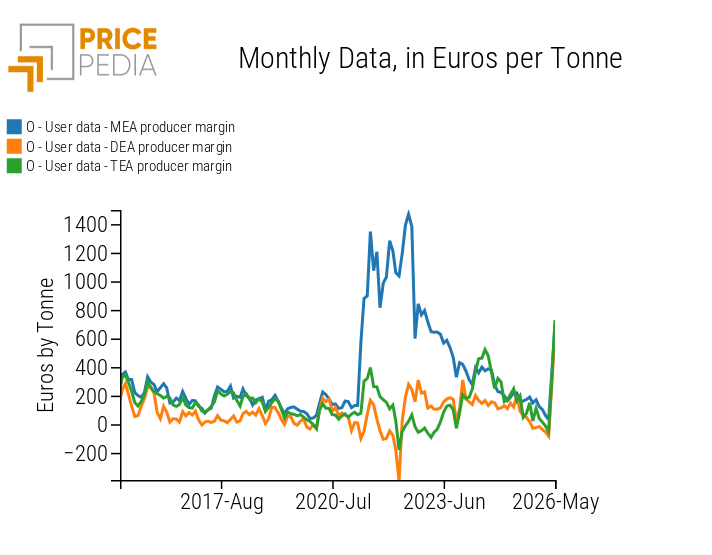
A historical analysis of producers' margins, measured as the difference between ethanolamine selling prices and their estimated should cost, reveals substantial fluctuations over time, typically driven by periods of significant imbalance between supply and demand. The current situation therefore appears consistent with a market experiencing genuine supply tightness. However, cost developments alone do not seem sufficient to justify price increases of the magnitude currently being proposed.
Ethanolamine Applications and Their Degree of Substitutability
Demand for ethanolamines is driven primarily by consumer chemicals, particularly detergents, surfactants, personal care products and a wide range of industrial formulations. In addition to these applications, ethanolamines also serve specific end uses: MEA is widely employed in gas treatment processes, while TEA plays an important role as an additive and grinding aid in the cement industry.
Overall, the degree of substitutability of ethanolamines can be considered medium to high, although it varies significantly depending on the end-use application. In some formulations, substitution is technically straightforward and already well established, whereas in more specialized applications the available substitution options are more limited.
In gas treatment, substitutability is moderate. Different ethanolamines can often serve as alternatives to one another, but the main substitutes are frequently other amine-based products specifically developed for these applications. In detergents, surfactants, cosmetics and personal care products, substitutability is relatively high, both among MEA, DEA and TEA and with other neutralizing and pH-adjusting agents such as caustic soda, caustic potash and other amines. In the cement industry, by contrast, the substitutability of TEA with MEA or DEA is very limited; however, partial replacement through other types of chemical additives remains possible.
The availability of technically viable alternatives reduces the likelihood that temporary supply disruptions will translate into permanent price increases. In the short term, however, the need to ensure continuity of production may make industrial users less sensitive to price, particularly when the perceived risk concerns product availability or delivery lead times. In other words, substitutability limits the structural pricing power of suppliers, but it does not prevent temporary market tensions, even severe ones, during periods of heightened uncertainty.
Global Supply and the European Ethanolamines Market
The third area of analysis concerns the structure of global supply and the role of the Gulf countries. Among Middle Eastern producers, Saudi Arabia is by far the largest exporter of ethanolamines, accounting for approximately 30% of global trade. As a result, it represents the main channel through which geopolitical tensions in the Persian Gulf can affect international markets.
For the European market, dependence on Saudi supply is particularly significant in the case of TEA. In 2025, Saudi Arabia accounted for approximately 30% of EU imports of TEA, compared with 13% for MEA and 9% for DEA. This suggests that any disruption to shipments from the region could have different impacts across the three products, with TEA being considerably more exposed than MEA and DEA.
A partial or complete disruption of traffic through the Strait of Hormuz would therefore constitute a clearly bullish factor for the market. Reduced deliveries, longer lead times and potentially higher logistics costs could encourage market participants to build additional safety stocks, further increasing upward pressure on prices.
Particular attention should also be paid to the growing role of China. In recent years, international trade data have shown a significant expansion of China's presence, especially in the MEA segment. As shown in the following chart, China's share of global MEA exports increased from negligible levels before 2020 to more than 10% in 2023, reaching a peak of around 16% in 2024 and remaining close to 12% in 2025.
China's share of global trade in MEA, DEA and TEA
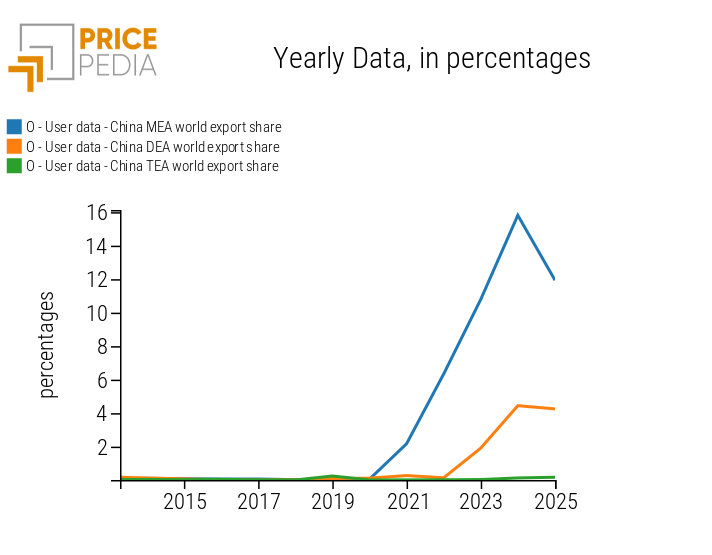
A similar, though more moderate, trend can be observed for DEA, while China's role in the TEA market remains relatively limited. Consequently, the ability of Chinese suppliers to offset potential supply reductions from other regions appears substantial for MEA, more limited for DEA, and largely insufficient for TEA.
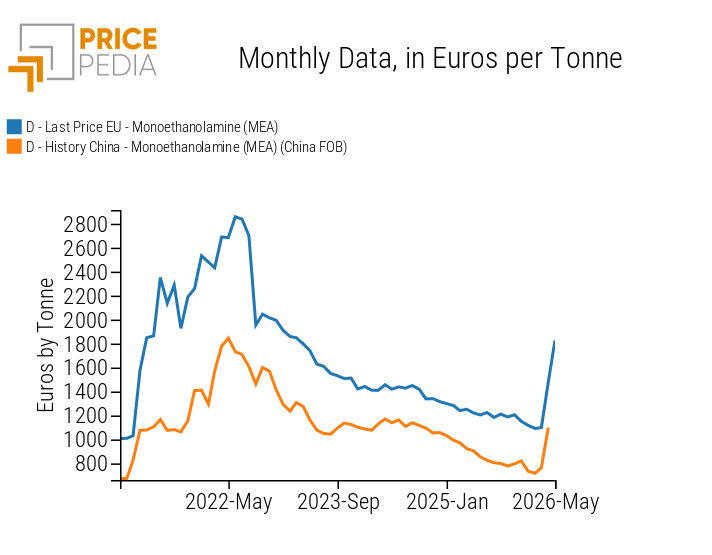
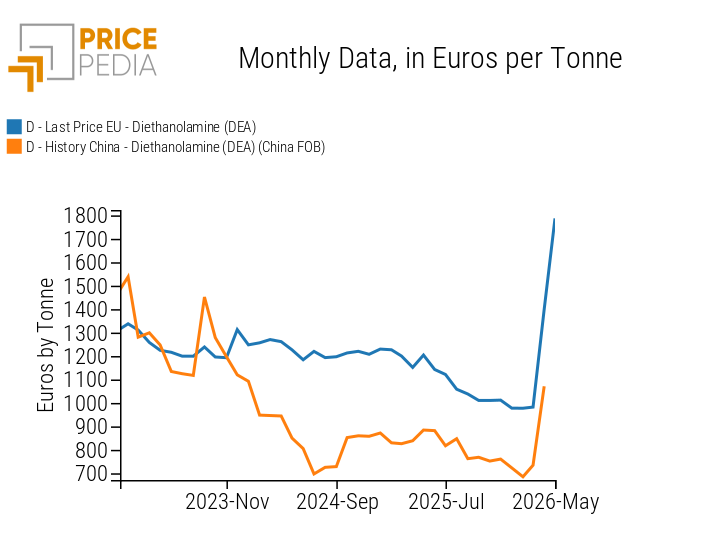
A further test of market conditions comes from comparing European prices with international benchmarks, particularly FOB China prices.
Price comparison for MEA and DEA between European market versus FOB China
| Monoethanolamine (MEA) | Diethanolamine (DEA) |
|
|
Available data indicate that market tightness is not confined to Europe. Between March and April 2026, FOB China prices also recorded significant increases, pointing to a genuine strengthening of global market fundamentals.
At the same time, Chinese prices remain below European levels. This comparison suggests that the current upward price trend is supported by real market fundamentals, while also indicating that part of the price premium observed in Europe may be driven by factors specific to the regional market.
Conclusions
The analysis of market fundamentals points to the existence of genuine tightness in the global ethanolamines market. The crisis in the Persian Gulf, uncertainty surrounding flows through the Strait of Hormuz, the central role of Middle Eastern producers and the vulnerability of certain supply chains all represent objectively bullish factors. Recent trends in European import prices also confirm that the market has already incorporated a significant upward revision in expectations.
At the same time, the evidence reviewed in this article suggests that the observed changes in raw material costs, demand and supply do not appear sufficient, on their own, to justify price increases of a magnitude that would result in a doubling of market prices. Part of the price increase requests currently observed in the European market therefore appears to reflect not only market fundamentals, but also the high level of uncertainty characterizing the current environment, which tends to strengthen suppliers' negotiating position.
If price increases of this scale were ultimately to materialize, a plausible explanation would also lie in the behavior of end users. When companies fear future supply disruptions, they often bring forward purchases and increase safety stock levels. This can create demand that temporarily exceeds actual consumption requirements, amplifying market imbalances well beyond what would be justified by the underlying fundamentals of the supply chain.
You may be interested in:
Xylenes: A Global Market Under Pressure
Published by Daniel Vito Lobasso. .
Organic Chemicals Petrolchimica Strait of HormuzLe tensioni geopolitiche e il rialzo del petrolio sostengono i prezzi internazionali degli xileni [ Read all ]
Methyl Ethyl Ketone: european price increases under review
Published by Daniel Vito Lobasso. .
Organic Chemicals Petrolchimica Price DriversIl calo dei prezzi cinesi mette in discussione la sostenibilità dei rincari europei [ Read all ]
Effects of the reopening of the Strait of Hormuz on prices in the petrochemical supply chains
Published by Luca Sazzini. .
Petrolchimica ForecastFrom an energy shock to normalization? What PricePedia’s structural models indicate [ Read all ]