Xylenes: A Global Market Under Pressure
Geopolitical tensions and rising oil prices are supporting international xylene prices
Published by Daniel Vito Lobasso. .
Organic Chemicals Petrolchimica Strait of HormuzAs highlighted in the article Supply risks in the event of a closure of the Strait of Hormuz, the European market for several chemical commodities is particularly exposed to tensions in the Persian Gulf and to disruptions in shipping flows through the Strait of Hormuz.
This is especially true for para-xylene (p-xylene), approximately 30% of whose European supply was imported from Saudi Arabia alone in 2025. P-xylene is the main isomer within the xylene family, a class of aromatic hydrocarbons that also includes ortho-xylene (o-xylene) and meta-xylene (m-xylene). Together, these products form a key group of intermediates used across numerous industrial value chains.
In particular, p-xylene is the primary feedstock used to produce purified terephthalic acid (PTA), which is subsequently processed into PET and polyester fibres. The other isomers are mainly used in the production of resins, paints, coatings, solvents and a range of additional chemical intermediates.
Between February and June 2026, European xylene prices followed an upward trend, although the scale of the increase varied across products. The rise was particularly pronounced for p-xylene, whose price increased by approximately 40%, compared with a 20% increase for the other xylenes.
This divergence suggests that the greater vulnerability of European p-xylene supplies originating from Saudi Arabia played a significant role. However, to assess whether these recent price increases are sustainable, it is also useful to examine international p-xylene prices, feedstock costs and the relationships between the different isomers.
International prices, costs and production processes
The chart below shows customs prices for p-xylene, expressed in euro per tonne, across the main international markets—Europe, the United States, China and Japan—together with the price of crude oil, which influences virgin naphtha prices, the primary feedstock used in xylene production.
Comparison of p-xylene prices across global markets
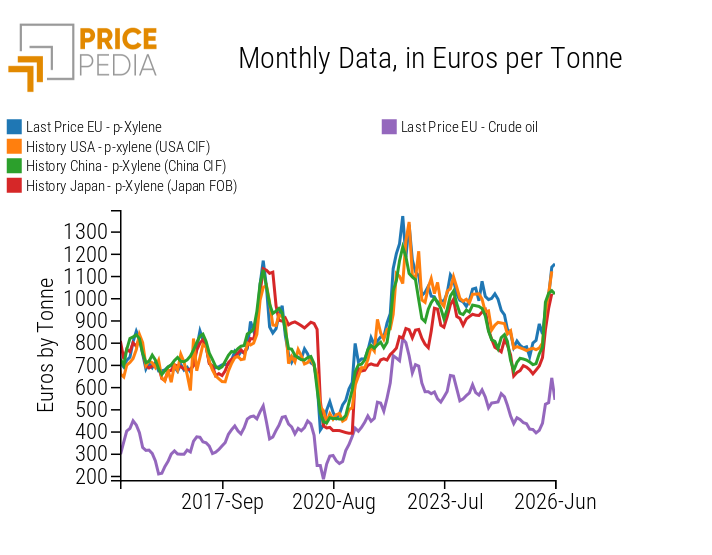
The first notable feature is the high degree of integration within the global market. Prices follow very similar trends, while differences in absolute price levels are generally limited and relatively stable over time. Even the temporary divergence observed in the Japanese market following the outbreak of the Russia-Ukraine war gradually narrowed, confirming the ability of international markets to bring regional prices back towards a common benchmark.
The strong alignment between regional price movements also indicates that the market is primarily driven by common underlying factors. The most evident of these is the price of crude oil, which directly affects the cost of virgin naphtha.
Crude oil, however, is not the only raw material from which xylenes can be produced. A proportion of output is derived from the distillation of coal tar, resulting in xylenes with a higher level of impurities, commonly referred to as Xylenes from coal tar.
The use of different raw-material sources does not, however, result in entirely separate markets or independently determined prices.
The following chart compares European customs prices for p-xylene, o-xylene and tar xylenes[1], expressed in euro per tonne.
Comparison of European xylene prices
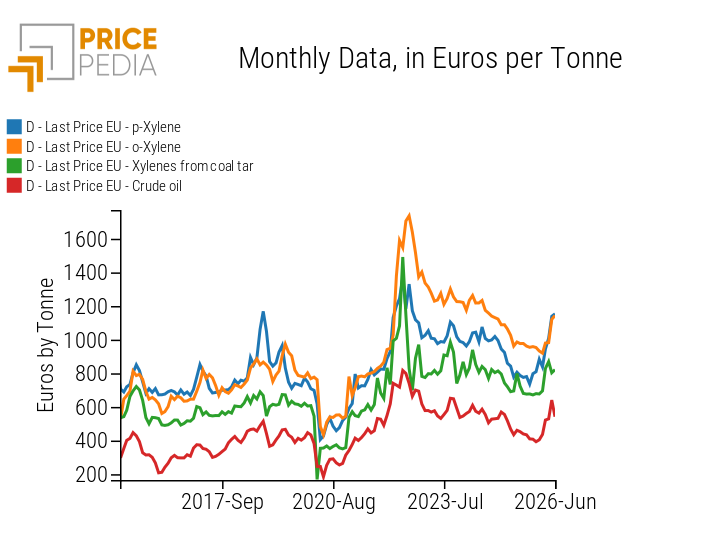
Over the long term, the three xylene price series display very similar trends, with relatively stable differences in price levels that are consistent with variations in quality, purity and end use. Consequently, the price differential normally observed between conventional xylenes and tar xylenes mainly reflects differences in quality, purity and intended application, rather than a structural production-cost advantage. This means that xylenes produced through different manufacturing processes are ultimately affected by the same market shocks.
As discussed in the article From raw materials to markets: how prices are formed in basic petrochemicals, extensive international trade, competition among suppliers and arbitrage activity contribute to the formation of a global benchmark price for xylenes. This benchmark acts as an equilibrating force, promoting price alignment between products obtained through different production processes, despite differences in their respective raw-material costs.
However, the existence of a common benchmark does not prevent individual products from deviating from the broader market trend, including for prolonged periods, when they are affected by product-specific supply shocks.
O-xylene provides a clear example. Following the outbreak of the Russia-Ukraine war and the suspension of supplies from Russia, product availability in the European market declined. This led to the emergence of a price premium over other xylenes, which has persisted into the most recent period.
This higher starting point also helps explain the differences in growth rates recorded between February and June 2026. O-xylene posted a smaller percentage increase than p-xylene not because it was less exposed to recent market tensions, but because its price already incorporated a premium associated with limited availability in Europe.
Over the same period, tar xylenes also displayed more moderate price dynamics, with an increase of less than 20%. Given the historically high correlation between the three price series — close to 0.9 — and the role of crude oil as the market’s primary reference point, a differential of this magnitude appears difficult to sustain over the medium to long term. A gradual narrowing of the current gap is therefore plausible.
This adjustment could occur through a recovery in tar xylene prices, should crude oil continue to support aromatic hydrocarbon prices, or through a reduction in the premium currently embedded in p-xylene prices, should geopolitical tensions and energy costs ease.
Conclusions
The recent increase in xylene prices has been driven primarily by higher crude oil and naphtha prices, resulting from geopolitical tensions in the Persian Gulf and the increased supply risk affecting shipping through the Strait of Hormuz. The rise in feedstock costs has consequently been transmitted across the petrochemical value chain, supporting higher aromatic hydrocarbon prices in the international markets.
However, the differing price dynamics observed for p-xylene, o-xylene and tar xylenes also reflect product-specific supply conditions. In particular, p-xylene recorded sharper increases because of Europe’s greater dependence on supplies from the Persian Gulf. O-xylene, by contrast, was already trading at elevated levels due to the premium associated with reduced availability in the European market following the outbreak of the Russia-Ukraine war.
Over the medium term, the high degree of integration within the global market and the strong correlation between the different types of xylene suggest that the current excess differentials — that is, those not explained by differences in product quality — are likely to narrow progressively. The direction of this adjustment will depend primarily on feedstock price developments and the evolution of geopolitical tensions.
Would you like to stay up to date on commodity market developments?
Subscribe to the PricePedia newsletter free of charge!
```
[1] The term “tar xylenes” more precisely refers to a mixture of different xylene isomers with a purity level below 95%, irrespective of the raw material from which they are produced. Xylenes obtained through coal-tar distillation are chemically identical to those produced through the catalytic reforming of naphtha, but they generally contain higher concentrations of impurities, including sulphur compounds, nitrogen compounds and polycyclic hydrocarbons. However, this classification may also include petroleum-derived mixtures and therefore does not uniquely identify the production process used.
You may be interested in:
Methionine Prices: Asian Market Pressures and European Price Stability
Published by Daniel Vito Lobasso. .
Organic Chemicals Price DriversL’aumento dei costi dei feedstock e le difficoltà negli approvvigionamenti hanno alimentato forti rincari in Asia, mentre il mercato europeo ha mostrato una maggiore stabilità [ Read all ]
Strait of Hormuz risk after more than six months of conflict in the Persian Gulf
Published by Pasquale Marzano. .
Energy Organic Chemicals Petrolchimica Strait of HormuzTrade flows and prices of the commodities most vulnerable to a Strait of Hormuz closure [ Read all ]
Cyclohexanone cost pass-through
Published by Daniel Vito Lobasso. .
Organic Chemicals Price DriversThe role of phenol and cyclohexane in the price formation and transmission of one of the most important chemical intermediates in the benzene-nylon value chain [ Read all ]