Sulphuric acid: the suspension of chinese exports tightens an already fragile market
The decline in chinese supply intensifies price pressures and supply risks
Published by Daniel Vito Lobasso. .
Inorganic ChemicalsThe international sulphuric acid market continues to be characterised by particularly tight supply. Difficulties in sourcing sulphur from the Middle East have been compounded by the reduction in Chinese exports, amplifying the effects of a structural feature of the market: a significant share of sulphuric acid supply has traditionally depended on by-products from other industries and therefore responds only weakly or slowly to increases in demand.
This supply rigidity makes the market particularly sensitive to shocks, with adjustments tending to be reflected more rapidly in prices than in production volumes. As a result, international markets face a risk of greater volatility and persistent upward price pressures, particularly if demand from the main consuming sectors remains strong.
The following analysis therefore examines recent developments in trade flows, the ability of other exporters to offset the decline in Chinese supply, the effects on international prices and supply risk and, finally, the degree to which sulphuric acid can be substituted in its main industrial applications, with the aim of assessing whether the current market tightness is likely to be temporary or more persistent.
The collapse in Chinese exports
Since May 2026, China has effectively suspended sulphuric acid exports, after having already restricted them during the first four months of the year through a quota system aimed at preserving domestic availability amid severe tensions in the sulphur market (for further information, see the article "€800 for a tonne of sulphur? This price is unsustainable"). Although the suspension of shipments, expected to remain in place until the end of 2026, has not been formally announced as an export ban by the authorities, it has already led to a sharp reduction in trade flows.
The following chart shows sulphuric acid export volumes from the main Asian exporters, expressed in millions of kilograms (source: ExportPlanning).
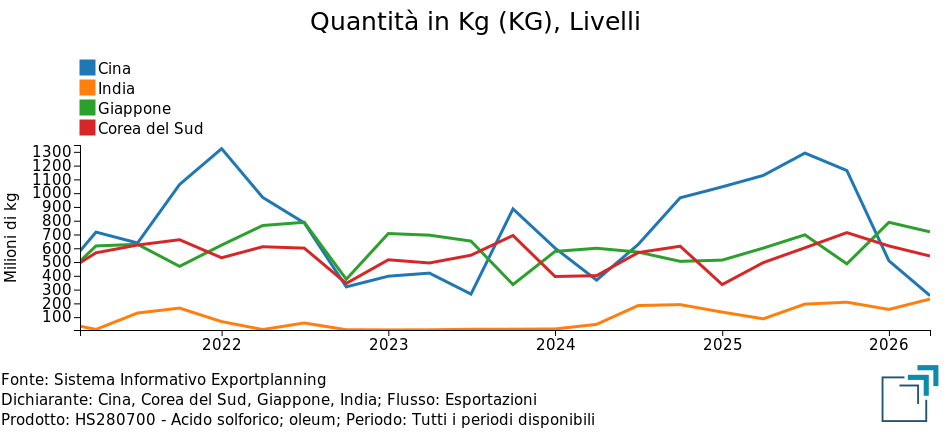
Trade data clearly show the speed of the contraction in Chinese exports. In the first quarter of 2026, China's sulphuric acid exports fell by 56% compared with the previous quarter, before declining by a further 50% in the second quarter. Overall, during the first half of 2026, Chinese export volumes were approximately 65% lower than in the same period of 2025.
Part of these volumes has been replaced by other exporters. In the first half of 2026, compared with the same period of 2025, exports increased by approximately 35% in Japan, 39% in South Korea and 73% in India. Outside Asia, Peru recorded the strongest growth, at around 40%, while Germany and Poland posted more moderate increases of approximately 15% and 25%, respectively. Canada and Spain, by contrast, reduced their exports.
The market is therefore redistributing the available trade flows, but there is no evidence of a full replacement of Chinese supply. The increase in exports from some countries thus primarily represents a reallocation of existing supply rather than a genuine expansion in production capacity.
Why does supply respond slowly?
The difficulty in rebalancing the market mainly stems from the structure of sulphuric acid production.
The sulphur used in dedicated acid production plants is itself predominantly a by-product of other industries. Most of it comes from the desulphurisation of oil and gas, while a smaller but still significant share of sulphuric acid supply derives from the recovery of sulphur dioxide generated during the smelting of copper, zinc and other non-ferrous metal concentrates.
Consequently, since the production of these raw materials responds primarily to conditions in their respective markets, demand for sulphuric acid alone is unlikely to justify the large investments required to open a refinery or expand a smelter in order to increase sulphuric acid production. This feature of the supply chain limits supply elasticity and makes it more difficult to rapidly compensate for the disappearance of Chinese volumes.
The impact on prices and supply risk
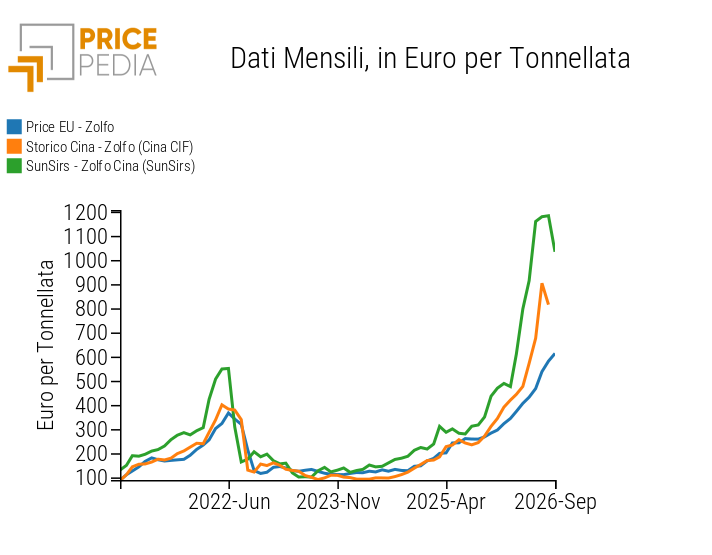
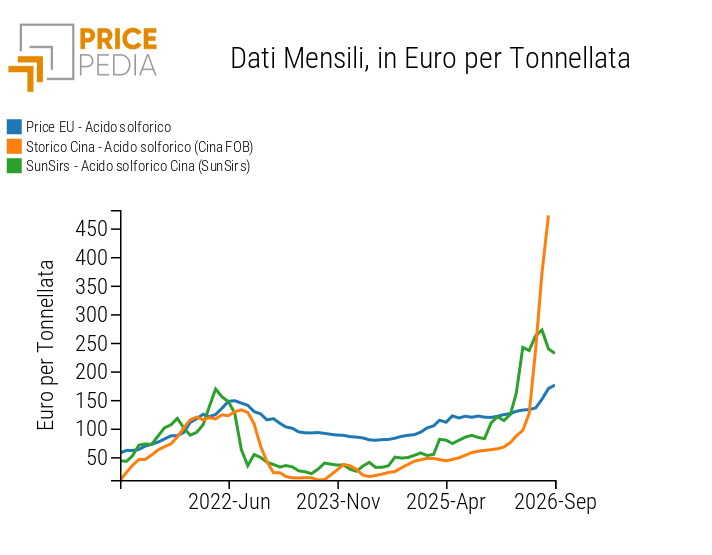
The following charts show European and Chinese customs prices for sulphur and sulphuric acid, together with SunSirs Over-the-Counter (OTC) prices for the Chinese domestic market, expressed in euros per tonne (€/t).
Chinese and European sulphur and sulphuric acid prices
| Sulphur | Sulphuric acid |
|
|
For sulphur, price increases have been substantial in both markets, but more pronounced in China. In Europe, the customs price rose from €323/t in January 2026 to €613/t in September (+90%). In China, the domestic OTC price more than doubled, from €489/t to €1,034/t, after exceeding €1,180/t in August. The greater intensity of Chinese price increases mainly reflects the country's strong dependence on imports from the Persian Gulf, as discussed in the article "Sulphuric acid: sulphur drives the price". Europe, by contrast, while exposed to the same international pressures on energy feedstocks, has relatively greater domestic production and less geographically concentrated sources of supply in the Middle East.
As regards sulphuric acid, the European customs price increased more moderately, from €124/t in January to €176/t in September (+42%). Europe's substantial domestic production reduces its dependence on acid imports, mitigating the risk of physical shortages, although higher sulphur prices continue to put upward pressure on production costs.
In China, the domestic OTC price of sulphuric acid rose from €114/t in January to a peak of €272/t in July, before declining to €231/t in September. This decrease of approximately 12% occurred despite sulphur remaining very expensive and is linked to the restrictions on sulphuric acid exports introduced by the Chinese government. Lower volumes destined for foreign markets increased availability in the domestic market, putting downward pressure on OTC prices. At the same time, reduced supply to international markets pushed the Chinese FOB price from €68/t in January to more than €470/t in August.
Chinese restrictions have therefore produced a twofold effect: greater availability and easing prices in the domestic market, but increasing scarcity and sharp price rises for international buyers.
The consequences of these price increases are particularly significant for importing countries such as Chile and Morocco, whose sulphuric acid supplies from China accounted for approximately 25% of their total imports. In particular, during the first half of 2026, flows from China fell by approximately 70% compared with the same period of the previous year for Chile, while they virtually disappeared for Morocco, increasing supply risks for the copper and phosphate fertiliser industries, in which the two countries are respectively the world's largest producers.
How substitutable is sulphuric acid?
The sulphuric acid market also displays a degree of rigidity on the demand side. In its main industrial applications, substitution with other acids is complex because of differences in reaction chemistry, by-products, corrosiveness and, often, the production equipment itself.
The table below compares the main alternatives in terms of chemical characteristics, production process, commercial concentration, and intra-EU customs prices in September 2026.
| Acid | Characteristics | Main industrial production method | EU customs price Sep-26 (€/t) |
|---|---|---|---|
| Hydrochloric acid HCl |
Very strong acidity, monoprotic | Direct synthesis of hydrogen and chlorine; also obtained as a co-product of chlorination processes. | 82.4 |
| Sulfuric acid H₂SO₄ |
Strong and oxidising acidity, diprotic | Sulfur combustion and catalytic oxidation of SO₂; also recovered from sulfur-containing metallurgical gases. | 176 |
| Chlorosulfuric acid HSO₃Cl |
Strong and oxidising acidity, monoprotic | Direct reaction in equimolar proportions between hydrogen chloride and sulfur trioxide. | 578 |
| Nitric acid HNO₃ |
Strong and oxidising acidity, monoprotic | Ostwald process based on the catalytic oxidation of ammonia, mainly produced through the Haber-Bosch process. | 233 |
| Phosphoric acid H₃PO₄ |
Moderate acidity, triprotic | Mainly produced through the wet process, by reacting phosphate rock with sulfuric acid. | 1304 |
| Citric acid C₆H₈O₇ |
Weak acidity and chelating properties, triprotic | Fermentation of sugars using microorganisms, mainly Aspergillus niger. | 1136 |
| Acetic acid CH₃COOH |
Weaker acidity, monoprotic | Mainly produced through methanol carbonylation with carbon monoxide. | 548 |
To assess the economic viability of substitution, neutralising capacity (acidity) and concentration must first be taken into account.
Sulfuric acid is a diprotic acid, meaning that it has two acidic hydrogen atoms per molecule. This gives it a high neutralising capacity per unit of volume compared with monoprotic acids such as hydrochloric acid and nitric acid.
To match the theoretical neutralising capacity of one tonne of pure sulfuric acid, approximately 2.32 tonnes of 32% hydrochloric acid — the concentration commonly traded on the market — are required. At September prices, this would amount to around €191, compared with €176 for one tonne of sulfuric acid.
In the case of nitric acid, approximately 1.12 tonnes are required, which at September prices would cost around €260. Sulfuric acid therefore retains an economic advantage in this case as well, while phosphoric, acetic, and citric acids are even less competitive in terms of both price and chemical characteristics.
These calculations, however, represent a theoretical comparison that is particularly relevant when the acid is used simply to lower pH or neutralise a base. In major industrial applications, substitutability can be much more limited, as processes are designed around specific chemicals and switching to another acid may require different technologies and production equipment.
Substitution is therefore more feasible in relatively flexible applications, such as certain water treatment processes, pH adjustment, cleaning and surface treatment. In the main industrial applications, by contrast, a sharp increase in sulphuric acid prices is more likely to translate into higher costs or lower demand than into rapid substitution with other acids.
A market balance that remains fragile
The current sulphuric acid market is characterised by a strong asymmetry. In China, the halt in exports has increased domestic availability and contributed to a correction in local prices. On the international market, by contrast, the loss of Chinese supply has compounded the shortage of sulphur and the limited ability of other producers to rapidly increase supply.
Japan, South Korea, India and Peru have increased their exports, but this primarily represents a redistribution of available trade flows rather than a genuine expansion in production capacity.
For procurement, the main factors to monitor over the coming months will therefore be the duration of Chinese export restrictions, the normalisation of sulphur flows from the Middle East, and developments in demand from the fertiliser and copper sectors. Until at least some of these pressures ease, the international sulphuric acid market will remain exposed to persistent upward price pressures and supply risk.
You may be interested in:
Sulfuric Acid: Sulfur Sets the Price
Published by Daniel Vito Lobasso. .
Inorganic Chemicals Strait of HormuzIl ribasso dei prezzi OTC cinesi dello zolfo dopo il parziale sblocco dello Stretto di Hormuz segnala un alleggerimento del premio geopolitico [ Read all ]
An Economic Classification of the Chemical Industry
Published by Daniel Vito Lobasso. .
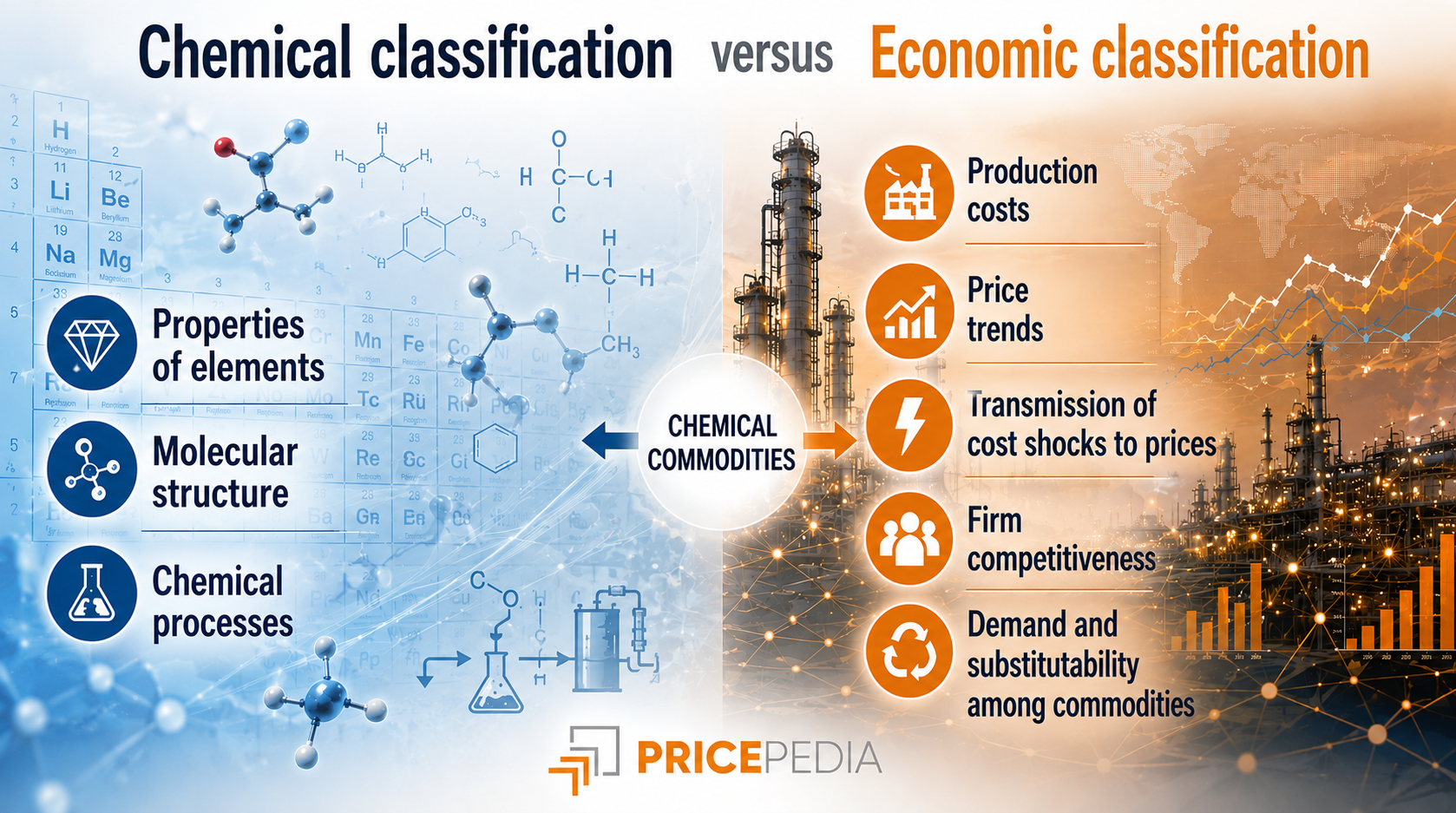
Organic Chemicals Specialty chemicals Inorganic Chemicals Petrolchimica Analysis tools and methodologiesLa mappa per l’analisi dei prezzi: dalle relazioni chimiche alle relazioni economiche [ Read all ]
Iodine: concentrated supply and a single global price
Published by Pasquale Marzano. .
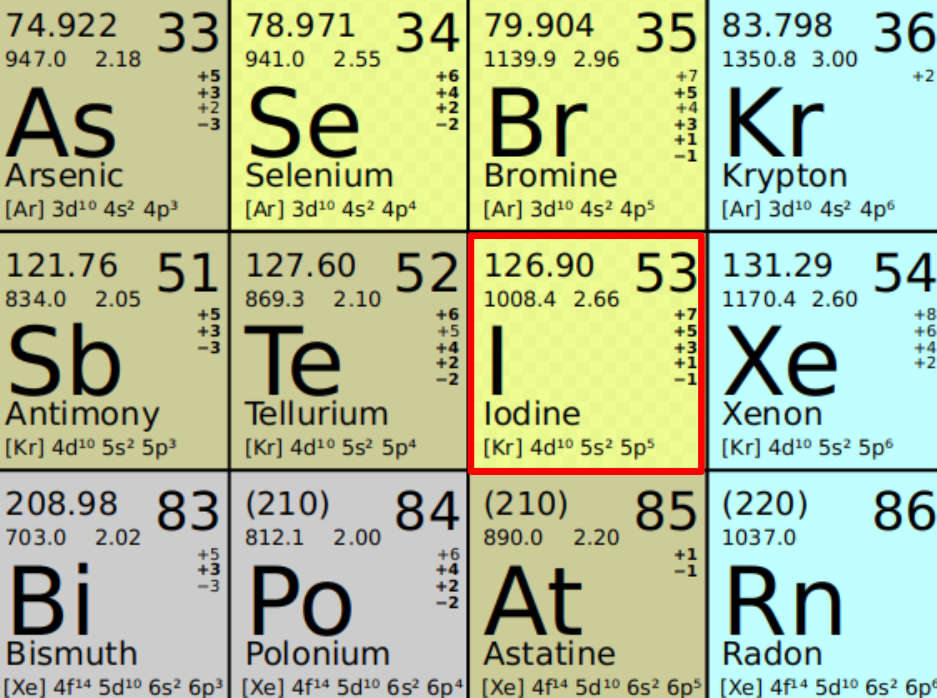
Inorganic Chemicals Price DriversThe comparison across different geographical areas highlights a common pricing dynamic [ Read all ]