Restrictions on Chinese exports of permanent magnets are increasing
New risks to European supplies arising from China's trade policy
Published by Luca Sazzini. .
economic analysis China in global commodity markets
Permanent magnets are strategic products that are essential for the production of electric motors, wind turbines and electronic components, thanks to their ability to generate a stable magnetic field that enables greater efficiency and power density. According to the IEA, they represent the fastest-growing and most strategically important application of rare earths, accounting for around 95% of total rare earth consumption by value.
On the supply side, their supply is highly concentrated, as highlighted in the analysis Market concentration and commodity risk, which ranks permanent magnets second in terms of concentration risk among the more than 900 products included in PricePedia's EU Customs database.
China's leading position in the permanent magnet market has enabled it to use these products as a tool of geopolitical and commercial pressure. The first restrictions were introduced in April 2025, in the context of the trade war with the United States, through an export licensing system that made foreign sales subject to authorisation by the Chinese authorities. Controls were further expanded in October 2025, but the new extension was suspended in November as part of the trade agreement reached between China and the United States, which also provided for a reduction in US tariffs on Chinese imports.
In July 2026, China once again used export controls as a means of exerting pressure, banning its operators from exporting dual-use goods, including rare-earth permanent magnets, to 14 European companies, in response to the EU's 21st package of sanctions against Russia, which also affected some Chinese companies.
These new restrictions could worsen the shortage of permanent magnets in the European market, increasing supply difficulties.
Given the importance of permanent magnets to European industry, this article examines trade flows and international prices in greater detail.
Trade Flow Analysis
The following chart shows the top 10 global suppliers of permanent magnets in terms of exported quantities, distinguishing between exports destined for EU countries and those destined for non-EU countries.
Main Exporting Countries of Permanent Magnets by Destination Area, in million kg
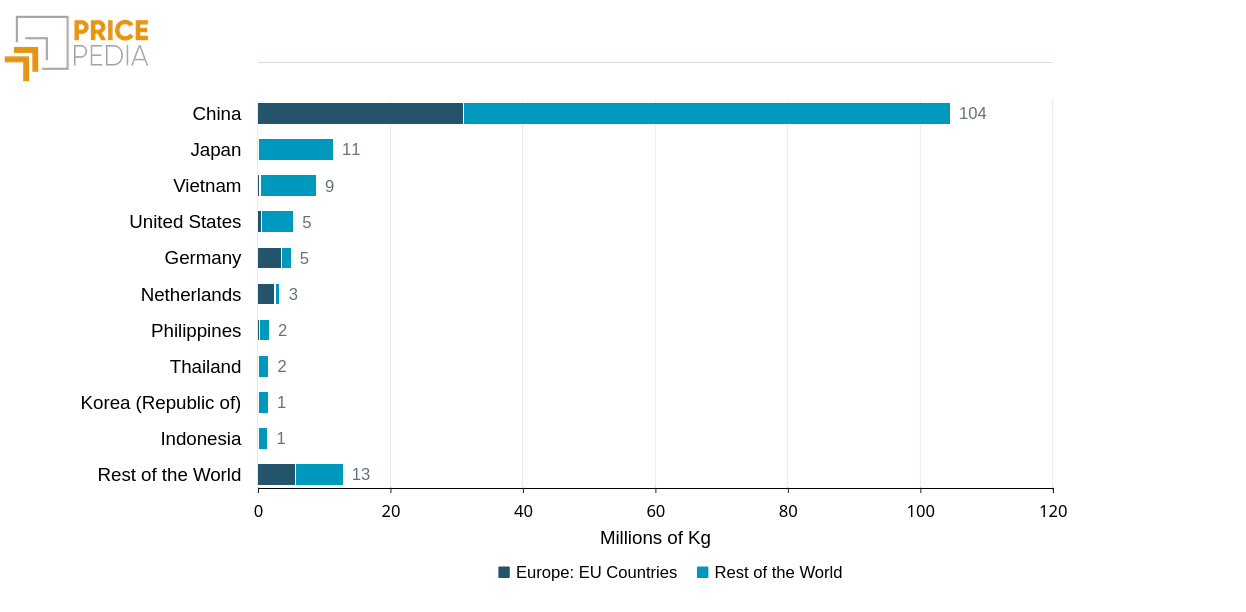
The chart highlights China's predominant role in supplying permanent magnets to both the European and global markets. In 2025, China exported 31 thousand tonnes of permanent magnets to Europe and 73.4 thousand tonnes to non-EU countries, accounting on its own for more than 70% of European supply and around 63% of supply destined for non-EU markets.
Japan is the world's second-largest exporter, with around 11 thousand tonnes of permanent magnets exported, a volume almost ten times lower than China's.
Germany is the second-largest supplier to the European market, with 3.6 thousand tonnes of permanent magnets exported to the EU, equal to just over one-tenth of Chinese exports to the European market.
Given the EU's strong dependence on permanent magnet imports, a blockade of Chinese exports could generate a significant supply shortage in the European market, with possible repercussions for availability and prices.
Do you want to stay up-to-date on commodity market trends?
Sign up for PricePedia newsletter: it's free!
Price Analysis
The following chart compares the historical price series of permanent magnets recorded at the customs of the European Union and China, expressed in euros per tonne.
Historical Price Series of Permanent Magnets in Europe and China, in Euros per Tonne
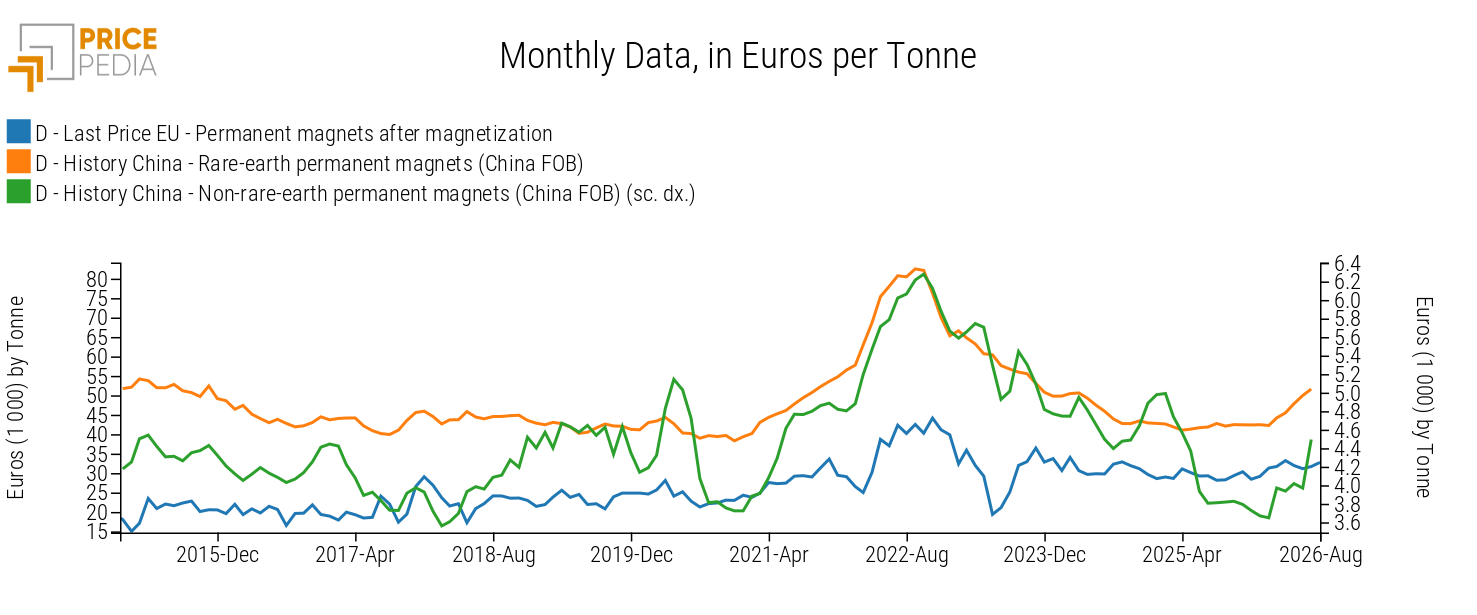
Since the beginning of the year, the two FOB prices in euros for Chinese exports of permanent magnets have increased by more than 20% compared with January 2026 levels.
The increase in Chinese prices, which represent an international benchmark for permanent magnet prices, has progressively been reflected in the European market as well. Between January and September 2026, European permanent magnet prices expressed in euros increased by more than 12%.
Upward price pressures in Europe could intensify further in the coming months in light of the new restrictions introduced by China on exports of rare-earth permanent magnets to some European companies. If these restrictions were to remain in place over time, the availability of permanent magnets in the European market could decline significantly, increasing pressure on prices and accelerating their growth further.
In Summary
The permanent magnet market is characterised by a high degree of supply concentration, with China representing the main supplier to both the European and global markets. This strong dependence leaves the European market particularly exposed to potential restrictions on Chinese exports.
If China were to maintain or expand the recent restrictions on exports of rare-earth permanent magnets to some European companies, prices in the European market could accelerate the growth already underway.
You may be interested in:
Ethanolamines: Between Market Fundamentals and Supply Concerns
Published by Daniel Vito Lobasso. .
Petrolchimica economic analysis Strait of HormuzGli aumenti di prezzo sono realmente giustificati dal rischio di blocco dello Stretto di Hormuz? [ Read all ]
The difficult defense of EU melamine production against China's large-scale economies
Published by Luigi Bidoia. .
economic analysis melamine Price DriversLa speculazione approfitta del passaggio dai dazi specifici ai dazi ad valorem [ Read all ]
Hourly PUN price: is there a specific “hour” effect?
Published by Emanuele Morelli. .
Electricity's National Single Price Electric Power economic analysis Machine learning and EconometricsAn econometric analysis reveals the existence of a temporal pattern in electricity prices. [ Read all ]