Monthly commodity prices update for September 2026
European input prices accelerate amid renewed Middle East escalation
Published by Pasquale Marzano. .
Last Price Global Economic TrendsIn September 2026, input prices for European manufacturing companies returned to strong growth. Overall, euro-denominated prices of the commodities monitored by PricePedia rose by +6.5% compared with August, moving above the previous highs recorded since the outbreak of the conflict.
The increase was driven by a renewed escalation in the Middle East, involving both the Strait of Hormuz and the Bab el-Mandeb Strait, another crucial chokepoint for global energy trade through which Saudi exports carried by the East-West Pipeline pass. Following drone attacks launched from Iraq, Saudi Arabia temporarily shut down the pipeline, while the Iran-backed Houthis consolidated their control over Yemen's Red Sea coast as far as Perim Island, at the entrance to the strait.
This environment has heightened market concerns on two fronts: on the one hand, global oil supply, with Brent crude climbing back above $100 per barrel; on the other, the risk of a slowdown in global trade, as the only alternative to sailing through Bab el-Mandeb is to reroute around Africa via the Cape of Good Hope, resulting in higher freight costs and longer delivery times.
The following chart illustrates the performance of euro-denominated commodity prices on the European market through PricePedia’s main aggregates, indexed to their respective January 2022 levels: Commodity[1], Industrials[2], Energy and Food.
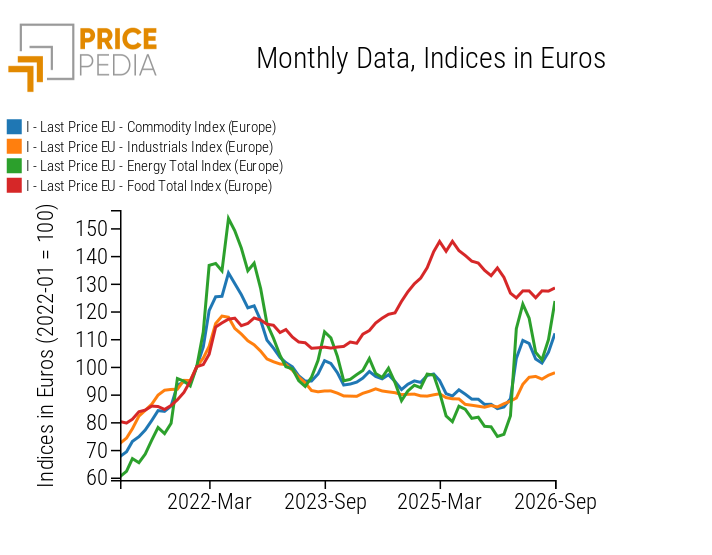
At the individual macro-category level, the September increase was driven primarily by energy commodities, whose euro-denominated prices rose by an average of around +13% compared with August. Within this group, the strongest increase was recorded for crude oil, up by more than +15% month-on-month, followed by natural gas and diesel, both rising by more than +14%.
The increase in food commodities was more moderate, averaging +0.9% month-on-month. Within this category, prices for wheat and other cereals continued to rise, by +3.3% and +2.2%, respectively. Prices for eggs and egg products, by contrast, recorded a monthly decline of -1.6%, while remaining only slightly below the historical highs reached in May 2026.
In September 2026, industrial commodities, like food commodities, also recorded an increase in euro-denominated prices of close to +1% compared with August, confirming the upward trend triggered by the conflict in the Persian Gulf. Compared with pre-conflict levels in February 2026, prices of industrial purchasing materials are now almost +12% higher, reaching their highest level since May 2023.
Industrial raw material price trends since the start of the conflict
Within the industrial commodity segment, the categories most closely linked to the petrochemical value chain continue to show the greatest sensitivity to developments in the conflict.
The following chart breaks down the Industrials index into its main sub-categories, showing the percentage change in euro-denominated prices between February and September 2026.
Chart 2: Percentage changes in euro-denominated prices, September 2026 compared with February 2026
Source: PricePedia
With the exception of Pharmaceutical Chemicals, whose prices are almost one percentage point below their average February 2026 level, all major commodity categories recorded price increases in September.
The strongest purchasing pressures concern organic chemicals and plastics and elastomers, with euro-denominated prices rising by more than +21%. Higher costs across the petrochemical value chain are being compounded by growing supply risk, due to the reduced availability of products originating from Persian Gulf countries, as discussed in the article Strait of Hormuz risk after more than six months of conflict in the Persian Gulf.
Significant increases have also affected textile fibres and non-ferrous metals, both up by more than +13%. Non-ferrous metal prices, in particular, are being supported both by concerns over supply and by growing demand associated with investment in artificial intelligence infrastructure. Upward cost pressures are being further reinforced by the sharp increase in sulphuric acid prices, a key input used in metal refining processes, which are currently at historically high levels.
The increase in inorganic chemicals has been more moderate, though still significant, at close to +10%. Price increases for wood and paper, specialty chemicals and ferrous metals remain below +5%, indicating more moderate cost pressures so far compared with the other industrial commodity categories.
Do you want to stay up-to-date on commodity market trends?
Sign up for PricePedia newsletter: it's free!
1. The PricePedia Commodity index is the aggregation of Industrials, Food and Energy indices.
2. The PricePedia Industrials index is the aggregation of indices related to the following categories: Ferrous Metals, Non-Ferrous Metals, Wood and Paper, Pharmaceutical Chemicals, Chemicals: Specialty, Organic Chemicals, Inorganic Chemicals, Plastics and Elastomers, and Textile Fibers.
You may be interested in:

PricePedia Scenario for September 2025
Published by Pasquale Marzano. .
Last Price Forecast ForecastA downward forecast for commodity prices in the next two years is confirmed [ Read all ]

PricePedia Scenario for June 2024
Published by Pasquale Marzano. .
Last Price ForecastCommodity prices amid demand uncertainty and short-term financial market pressures [ Read all ]

Industrial Cycle Recovery and Commodity Prices in 2025
Published by Pasquale Marzano. .
Last Price Forecast ForecastPricePedia Scenario May 2024 [ Read all ]