Monthly commodity prices update for May 2026
European prices of purchased materials up +17% since the start of the Iran conflict
Published by Pasquale Marzano. .
EU Customs Global Economic TrendsIn May 2026, European commodity prices monitored by PricePedia continued to increase, recording a +2% rise compared to April. This confirms the ongoing upward phase that began following the conflict, which led to the near-complete blockage of the Strait of Hormuz. Compared to February 2026, the last month preceding the spread of the economic effects of the crisis, the cumulative increase in total commodity prices, expressed in euro, reached +17%.
The chart below shows the price trends, in euro, of raw materials related to the European market for the main PricePedia aggregates, indexed to 100 in January 2022:
- Commodity[1],
- Industrials[2],
- Energy,
- Food.
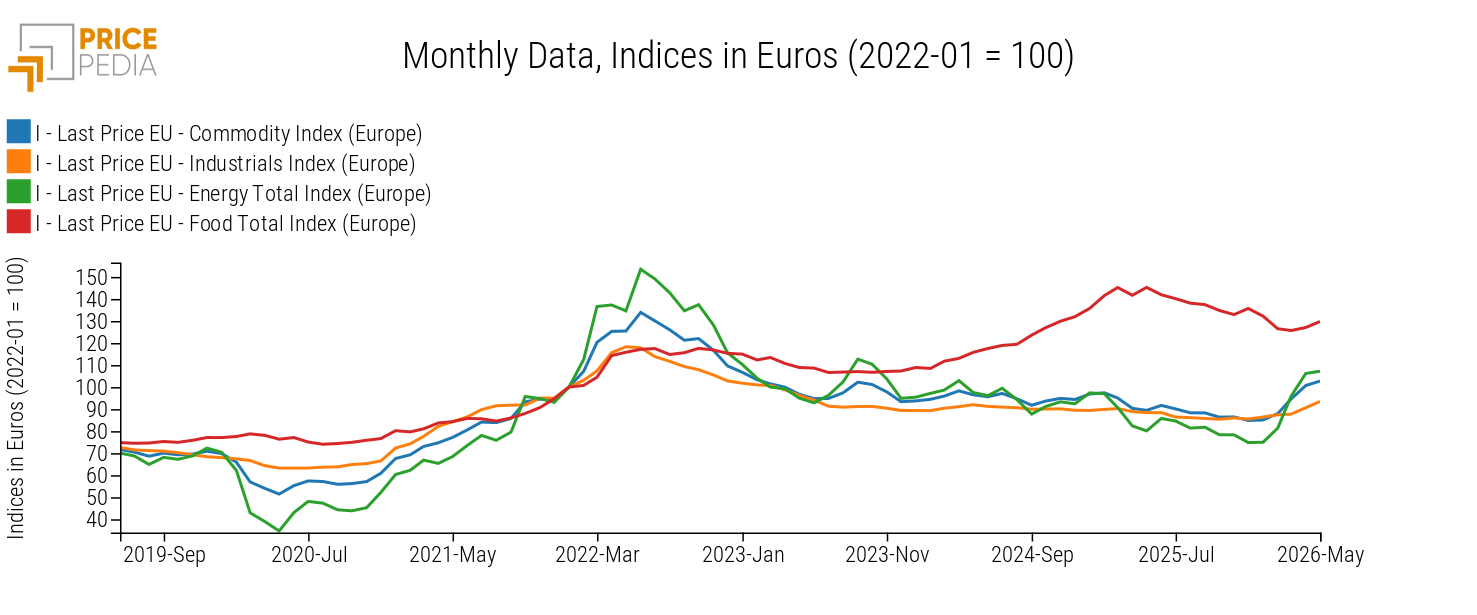
The May increase in total commodities affected all major macro-categories, each contributing to the month-on-month rise.
The smallest increase was recorded in energy commodities, whose euro prices rose on average by +1%. This is not surprising, as these commodities are the most directly linked to the evolution of the conflict, instantly absorbing—via financial markets—more or less positive news (see, in this regard, the latest weekly update on commodity markets).
Food commodities also recorded a +2.1% monthly increase in euro prices in the latest month. One of the supporting categories was tropical commodities (+3.9%), driven by supply risks linked to El Niño conditions.
As for core industrial commodities, in May prices recorded the strongest month-on-month increase across macro-categories, at +3.2%. This reflects a transmission of conflict-related effects that is more distributed over time and less immediate than for energy prices: since February 2026, physical prices of industrial commodities have increased overall by around 7 percentage points, compared to a +32% rise in physical energy commodity prices.
As previously highlighted (see, for example, the March 2026 update), within the industrial segment there is a hierarchy in the transmission of energy shock effects, resulting in greater exposure to conflict dynamics for products linked to the petrochemical and natural gas supply chains and/or to supplies originating from Gulf countries.
Price dynamics of industrial raw materials since the start of the conflict
The overall price dynamics since the start of the conflict between the United States–Israel coalition and Iran are illustrated in the chart below, showing percentage changes in euro prices for key industrial product groups between February and May 2026. The comparison highlights the intensity and breadth of the conflict’s impact across commodity segments.
Chart 2: % changes in euro prices, May 2026 vs February 2026
Source: PricePedia
The chart shows that over the period February–May 2026, all major industrial product groups recorded an increase in euro-denominated physical prices, with the sole exception of Pharmaceutical Chemicals, which remained broadly stable.
The strongest increase was recorded in Plastics and Elastomers (+17%), driven by the dynamics of key thermoplastic polymers—such as polyethylene and polypropylene—and copolymers, which increased on average by +34% and +24% respectively over the same period.
The Organic Chemicals segment is also highly exposed to petrochemical supply chain dynamics, recording a cumulative +11.4% increase between February and May. Within this group, ethylene glycols stand out, with supply flows largely transiting through the Strait of Hormuz, as illustrated in the article PET, ethylene glycol and the Strait of Hormuz. Significant increases were also observed in toluene (+46%) and methanol (+29%).
For the other main industrial product groups, cumulative increases over the period remain below +10%, indicating a broadly spread but more contained impact of the conflict compared to segments more closely linked to the petrochemical value chain.
Do you want to stay up-to-date on commodity market trends?
Sign up for PricePedia newsletter: it's free!
1. The PricePedia Commodity index is the aggregation of Industrials, Food and Energy indices.
2. The PricePedia Industrials index is the aggregation of indices related to the following categories: Ferrous Metals, Non-Ferrous Metals, Wood and Paper, Pharmaceutical Chemicals, Chemicals: Specialty, Organic Chemicals, Inorganic Chemicals, Plastics and Elastomers, and Textile Fibers.
You may be interested in:
Monthly commodity prices update for August 2026
Published by Pasquale Marzano. .
EU Customs Global Economic TrendsEuropean commodity prices continue to rise [ Read all ]
Monthly commodity prices update for July 2026
Published by Pasquale Marzano. .
EU Customs Global Economic TrendsRenewed tensions in the Persian Gulf halt the downward trend in commodity prices [ Read all ]
Monthly commodity prices update for June 2026
Published by Pasquale Marzano. .
EU Customs Global Economic TrendsCommodity prices show mixed trends following the US-Iran peace agreement [ Read all ]