Analysis of rhodium's criticality: the world's most expensive precious metal
What factors are driving rhodium price trends?
Published by Luca Sazzini. .
Precious Metals Critical raw materialsRhodium is the most expensive precious metal in the world, with a price that in 2021 exceeded more than ten times the average annual value of gold. It is, in fact, one of the rarest metals found in the Earth's crust, and its extraction and refining processes are particularly complex.
At the industrial level, rhodium is mainly used as a catalyst in the automotive sector and the chemical industry, thanks to its high catalytic activity, exceptional thermal stability, and remarkable corrosion resistance. These properties make it essential in vehicle emission control systems and in several industrial chemical reactions, such as hydrogenation and oxidation processes.
Over the last year, industrial demand in these sectors has increased significantly, while supply, as well as global production, has contracted[1].
Its strategic importance, combined with limited supply heavily concentrated in a few producing countries, has led the European Union to classify it among critical raw materials, within the so-called platinum group metals (PGMs), which include, in addition to rhodium, platinum, palladium, iridium, ruthenium, and osmium.
As already highlighted in the article:
Criticality analysis of platinum group metals, these metals share similar chemical and physical characteristics and often have overlapping industrial applications. In the case of rhodium, however, its substitutability with other metals such as platinum and palladium in catalytic converters is only partial, as it is constrained by specific performance requirements that limit their effectiveness in certain applications.
In particular, rhodium plays a highly specialized role in the reduction of nitrogen oxides (NOx), a function in which it demonstrates catalytic efficiency that is difficult to replicate with other metals in the group. This functional specialization helps maintain strong industrial dependence on rhodium, making its substitution particularly challenging.
Commodity and trade flow analysis of rhodium
From a trade perspective, rhodium is mainly traded in the form of unwrought metal.
Its leading global producer is South Africa, which is also the world's largest exporting country.
The chart below shows the top 10 global exporters of unwrought rhodium in 2025, expressed in current prices.
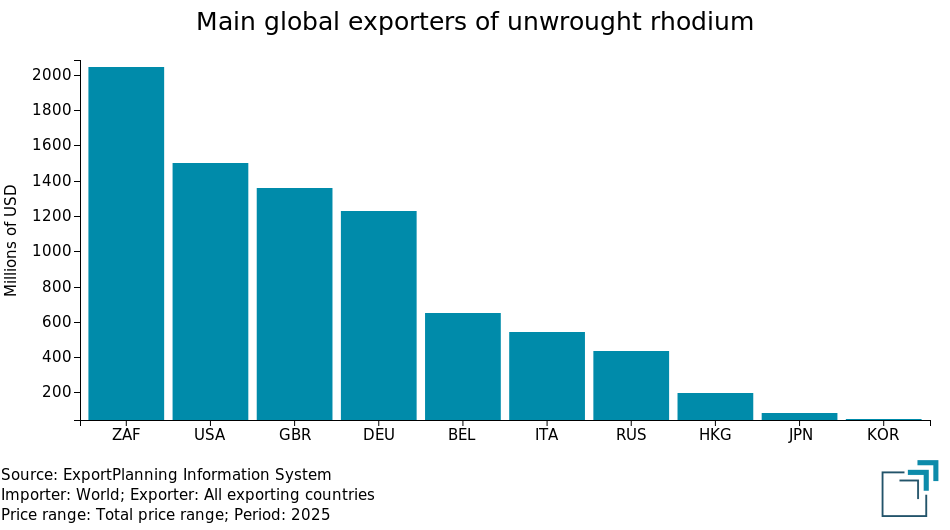
In 2025, South Africa exported unwrought rhodium worth more than 2 billion dollars, compared with total global trade amounting to approximately 7.5 billion dollars.
The second-largest exporting country is the United States, which nevertheless remains a net importer of rhodium overall: in the same year, it imported unwrought rhodium worth more than 2.5 billion dollars, making it the world's leading importing country.
Excluding the United Kingdom and other European countries, which are also major rhodium importers, Russia ranks as the second-largest global exporter and is also the second-largest global producer.
Considering also that both the United States and Europe import rhodium mainly from South Africa, it is clear that any disruption in South African supply would be sufficient to generate significant tensions in the global rhodium market, potentially triggering price shocks.
Do you want to stay up-to-date on commodity market trends?
Sign up for PricePedia newsletter: it's free!
Analysis of international rhodium prices
The chart below compares historical rhodium price series recorded by customs authorities in the European Union, China, and Japan, expressed in euros per gram.Historical series of international rhodium prices, expressed in euro/gram
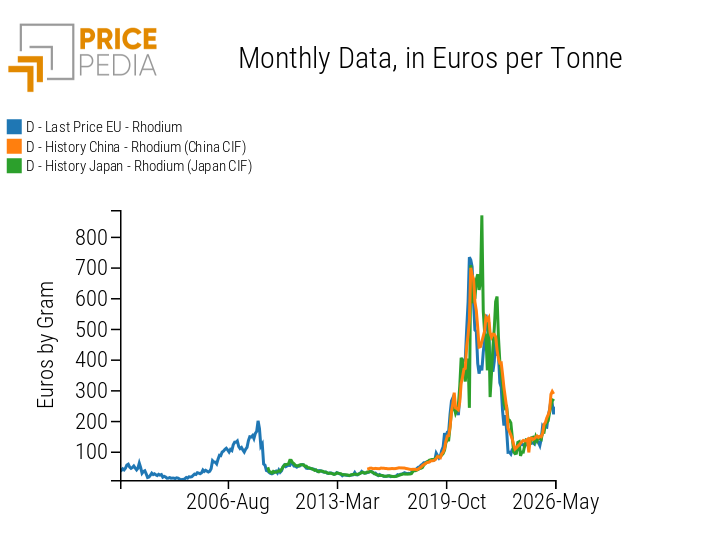
The chart analysis shows that international rhodium prices tend to follow a common trend, maintaining broadly similar levels across the different geographic areas considered.
The main price shock occurred in 2021, when rhodium reached record levels (approximately €700/g in Europe and China and more than €800/g in Japan) due to increased demand for automotive catalysts driven by stricter emissions regulations and limited supply.
During 2023–2024, prices experienced a sharp correction, falling to around €100 per gram due to the growing adoption of electric vehicles, which reduced demand expectations for catalysts used in internal combustion engines.
However, in 2025 and 2026, prices showed a partial recovery, supported by renewed demand for catalysts and reduced supply, bringing international rhodium prices back to levels close to €250 per gram.
Summary
Rhodium is a critical metal essential for catalysts in the automotive and chemical industries and can only be partially substituted by platinum and palladium, compared with which it demonstrates superior catalytic performance in reducing nitrogen oxides.
Its production and supply are highly concentrated in South Africa: any disruption in supplies from this country would be sufficient to generate strong price fluctuations.
Rhodium price dynamics and levels tend to be similar across the geographic areas analyzed, with a peak recorded in 2021. Over the last year and a half, prices have shown a renewed upward trend, although they remain below half of the historical peak reached in 2021.
[1] Source: U.S. Geological Survey (USGS): PLATINUM-GROUP METALS 2026
You may be interested in:
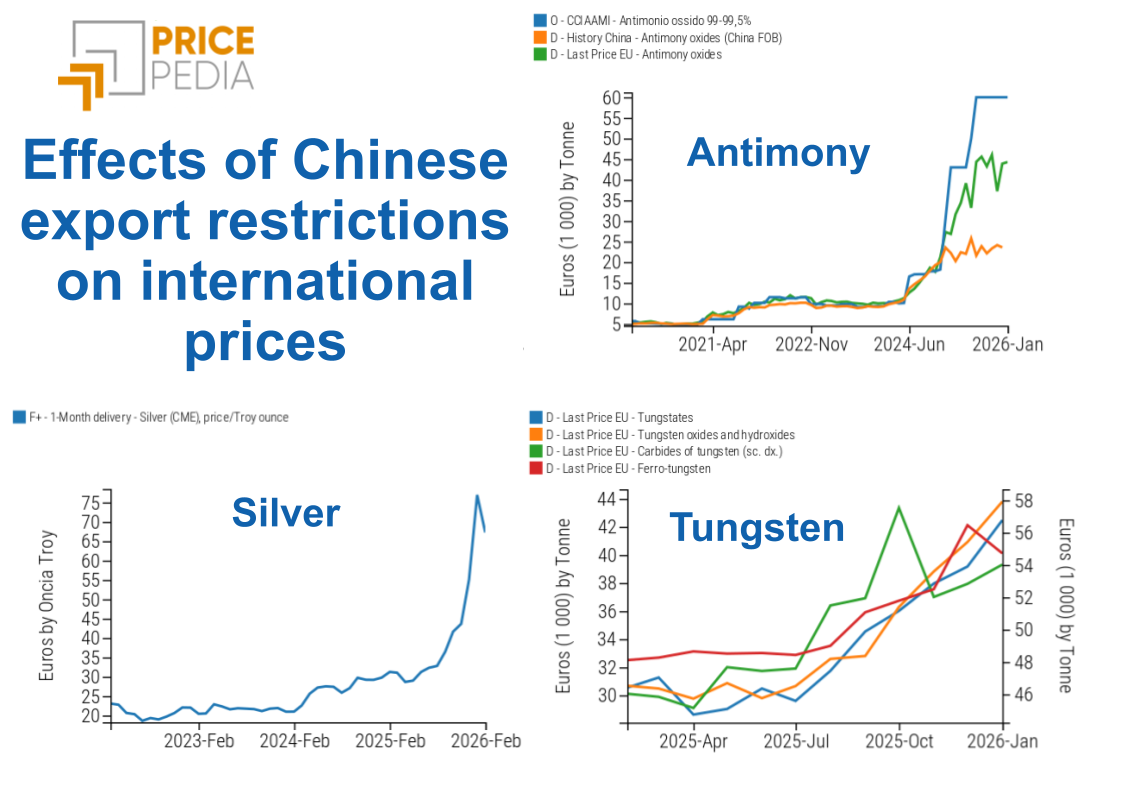
Tungsten, antimony and silver: what do they have in common?
Published by Luigi Bidoia. .
Precious Metals Antimony Tungsten Critical raw materialsLa limitazione delle esportazioni cinesi porta i prezzi mondiali alle stelle [ Read all ]

History repeats itself: uncertainty pushes up gold and silver prices
Published by Luca Sazzini. .
Precious Metals Price DriversHistorically silver has been more subject to speculation than gold [ Read all ]
Criticality analysis of platinum group metals
Published by Luca Sazzini. .
Precious Metals Critical raw materialsImportance of PGM metals for European industry [ Read all ]