Analysis of the effects of trade barriers on tinplate prices
Tinplate prices in Europe: will high levels persist or come down?
Published by Luca Sazzini. .
Ferrous Metals EU customs duties USA customs duties Import tariffs
In the italian article “Il prezzo europeo della latta si mantiene su livelli superiori alla media storica” it is highlighted how the energy crisis led to a structural change in tinplate price levels in Europe. In the period 2005–2021, the average price of tinplate stood at 838 euros/ton, while in the period between 2022 and April 2026 it reached an average of 1400 euros/ton.
The most pronounced increase was recorded in January 2022, when the price of tinplate posted a monthly change of 60%, rising from 1079 to 1726 euros/ton. In that period, as discussed in the italian article: “Le speculazioni che hanno stravolto il mercato del gas europeo”, speculative dynamics contributed to intensifying the energy crisis, pushing the European TTF natural gas price above daily peaks of 180 euros/MWh. These dynamics mainly affected the most energy-intensive industrial sectors, including, precisely, the steel industry.
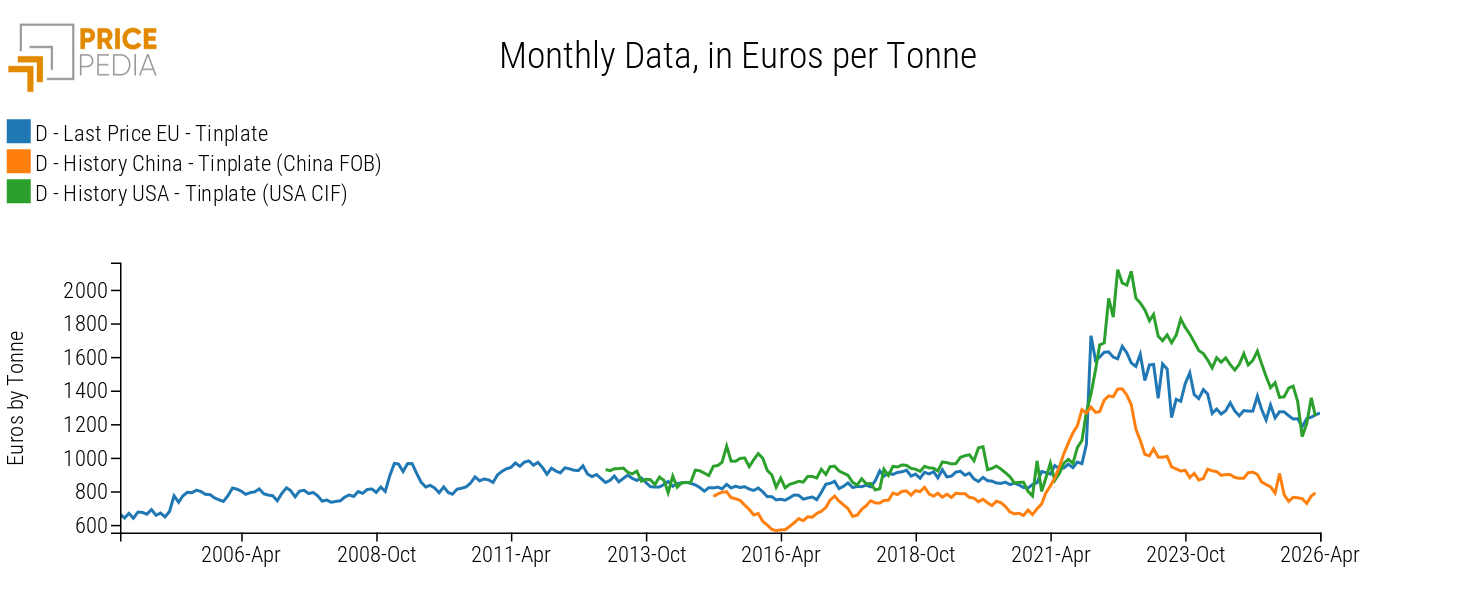
With the subsequent easing of the energy crisis, European tinplate prices recorded only a partial decline, remaining at significantly higher levels than pre-pandemic ones. This persistence of high levels also occurred in the US market, which is strongly influenced by the European one, as Europe is one of the main suppliers of this product to the United States.
Tinplate price dynamics instead followed a different path in the Chinese market. After the sharp increase linked to the 2021–2022 energy crisis, Chinese tinplate price levels subsequently returned to previous values, showing a much more pronounced correction compared to what was observed in the European and US markets.
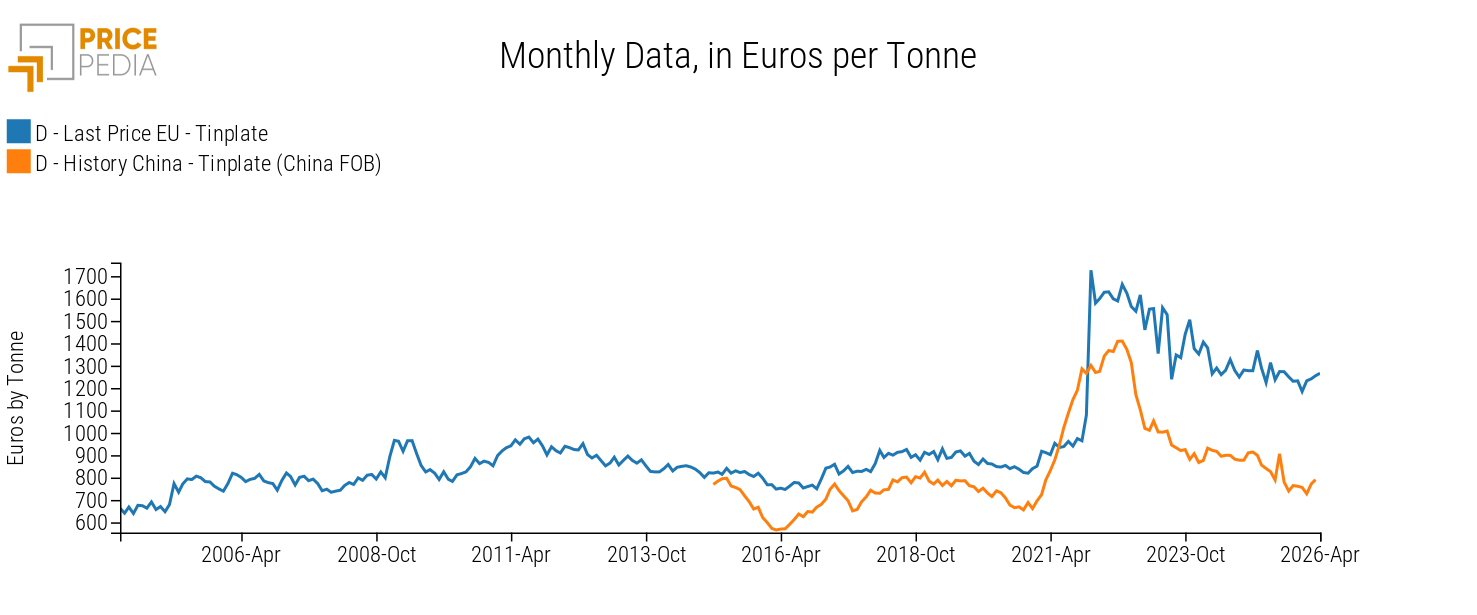
Below are two graphical comparisons of tinplate and coated tinplate prices, recorded at the customs of the European Union, the United States, and China, expressed in euros per ton.
| Comparison of customs prices of tinplate | Comparison of customs prices of coated tinplate |
|
|
In March 2026, FOB prices of Chinese tinplate exports stood at 790 euros/ton, essentially unchanged compared to March 2021 levels of 789 euros/ton. Conversely, in March 2026, intra-European trade prices and CIF import prices into the United States stood at 1254 and 1247 euros/ton respectively, marking increases of 38% and 42% compared to March 2021.
A similar pattern was also observed in regional coated tinplate markets. In China, FOB export prices were actually down by -14% compared to March 2021, while in Europe they increased by 22% over the same period. In March 2026, European coated tinplate prices stood at 1446 euros/ton, a value almost three times higher than Chinese FOB export prices, which were 549 euros/ton.
What is this gap due to?
The gap between Chinese tinplate export prices and those observed in the United States and Europe in recent years is attributable to the introduction of new protectionist measures aimed at defending domestic steel industries from low-cost Chinese competition. In the United States, the Trump administration introduced tariffs of up to 50% on tinplate imports, while the European Union adopted anti-dumping measures on Chinese exports, with rates ranging between 13.1% and 62.3%, depending on the exporting company and its level of cooperation in EU anti-dumping investigations. These measures were officially formalized through the Implementing Regulation (EU) 2025/1042.
The introduction of these new trade barriers reduced the transmission of declining Chinese export prices to domestic markets in the European Union and the United States. In the European context, this dynamic is evident by comparing, in the following chart, intra-European tinplate trade prices — which reflect the effect of tariffs, as they can be considered producer prices — with CIF extra-EU import prices, which are instead recorded net of tariffs.
Comparison between intra-European trade prices and EU import prices from third countries
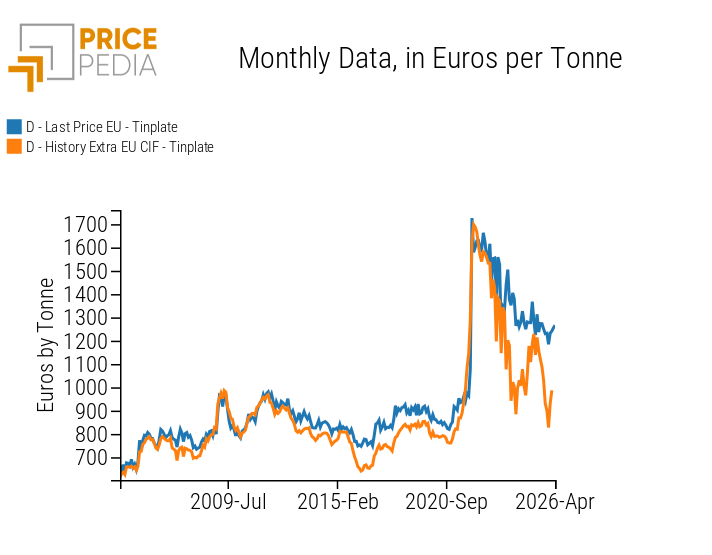
The first divergence between intra-European trade prices and CIF import prices occurred between late 2023 and early 2024, a period in which, according to the European Union anti-dumping investigation on tinplate imports from China, the onset of dumping practices by China was recorded. After a phase of gradual convergence between the two price series, the gap widened again starting at the end of May 2025, following the entry into force of the new European regulation.
Currently, with extra-EU CIF import prices slightly below 1000 euros/ton, intra-European trade prices stand at around 1250 euros/ton, highlighting a price gap of approximately 25%.
Do you want to stay up-to-date on commodity market trends?
Sign up for PricePedia newsletter: it's free!
PricePedia forecast for tinplate prices
Given the currently relatively high levels of tinplate prices in Europe, it may be useful to consider their future evolution.
The chart below shows the PricePedia forecast scenario for tinplate prices, with information updated as of May 1, 2026.
PricePedia forecast scenario for tinplate prices
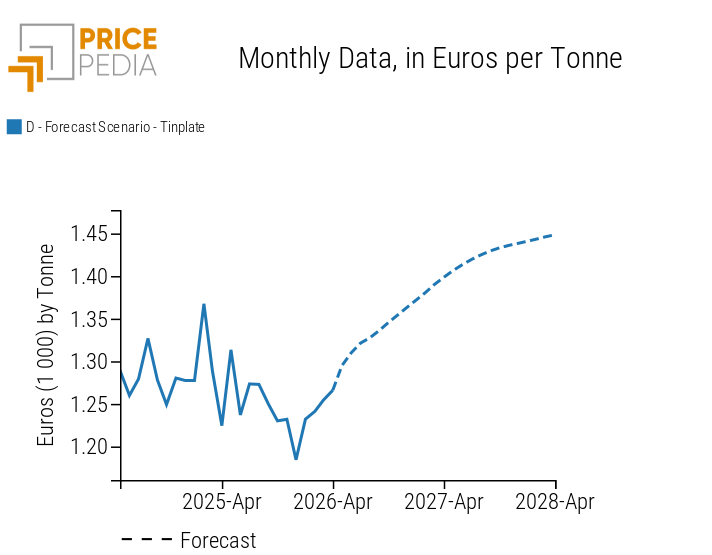
The PricePedia forecast scenario expects a continued increase in European tinplate prices over the next two years, reaching 1450 euros/ton by April 2028, the last forecast date in the scenario.
This dynamic appears consistent with expectations of rising cold-rolled coil prices, which, as highlighted in the italian article: “Il prezzo europeo della latta si mantiene su livelli superiori alla media storica”, are the main driver of tinplate price trends.
Among the main structural factors underlying these dynamics are: the progressive increase in energy costs in Europe, the recovery of prices in the Chinese market, and the gradual tightening of the CBAM (Carbon Border Adjustment Mechanism), which will contribute to increasing the supply costs of imported steel products.
Conclusions
The new trade barriers introduced by the United States and the European Union have supported domestic tinplate prices, protecting local markets from low-cost Chinese exports. This has resulted in a divergence between regional prices: in China, prices have already returned to pre-2022 levels, while in Europe and the United States they remain significantly higher.
Despite European tinplate prices already being at historically high levels, they are likely to increase further over the next two years, driven by several factors: rising input production costs, the recovery of prices in China, and the gradual tightening of the CBAM mechanism.
The PricePedia forecast scenario therefore expects tinplate prices to grow by almost 15% over the next two years, reaching 1450 euros/ton.
You may be interested in:
Crude steel production on the decline: how are forecasts for ferrous metals changing?
Published by Luca Sazzini. .
Ferrous Metals Forecast ForecastThe decline in crude steel production and the escalation in the Middle East are affecting the PricePedia outlook for ferrous metal prices [ Read all ]
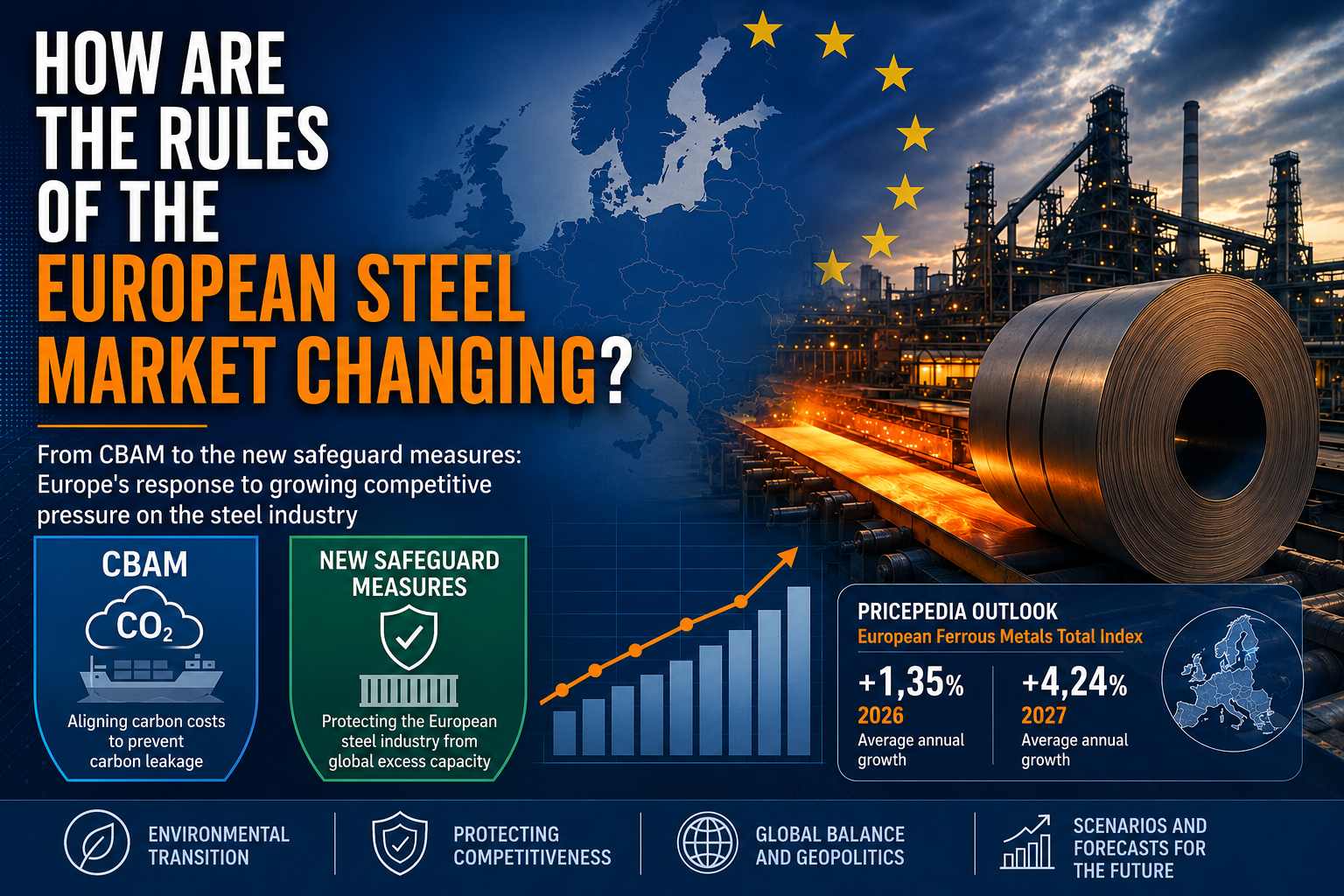
How are the rules governing the European steel market changing?
Published by Luca Sazzini. .
Ferrous Metals Forecast Energy Transition Import tariffsFrom the CBAM to new safeguard measures: the European response to growing competitive pressure on the steel industry [ Read all ]

Iron ore price forecast for 2026 - 2027
Published by Luca Sazzini. .
Ferrous Metals Forecast ForecastWhat are analysts' forecasts for iron ore prices? [ Read all ]