How Much Do European Companies Pay for Electricity?
Price differences depend not only on national markets, but also on consumption levels
Published by Luigi Bidoia. .
Electricity's National Single Price Electric Power Price DriversThe recent increase in wholesale electricity prices has once again drawn attention to the structural price gap that characterizes the Italian electricity market compared with other European countries. In Italy, electricity prices tend to be systematically higher than those recorded in the main competing economies.
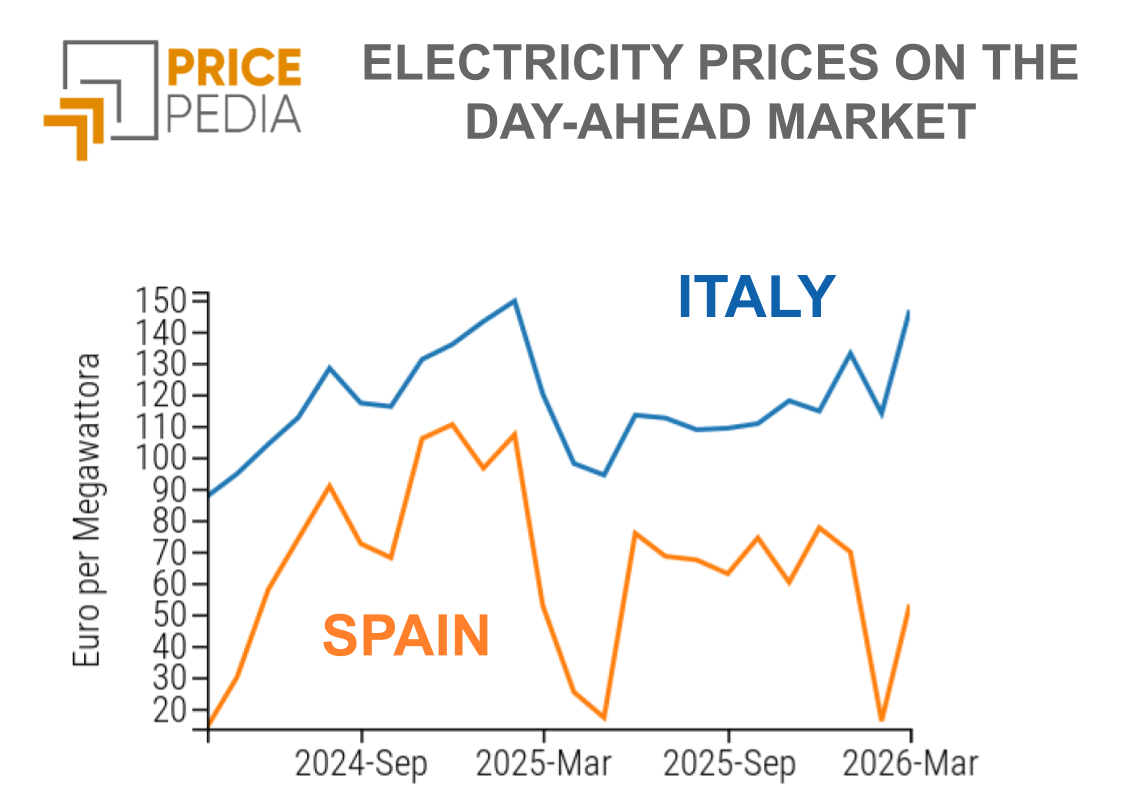
The analysis is usually focused on Day-Ahead Market (DAM) quotations, which represent the benchmark wholesale electricity price paid by market operators in the different national markets. While this indicator is useful for comparing price dynamics across countries, it does not fully reflect the actual costs borne by industrial companies.
The table below shows the average annual wholesale electricity prices in the main European countries competing with Italy.
Electricity Prices on the Day-Ahead Market (Euro/MWh)
| 2019 | 2022 | 2023 | 2026 (*) | |
|---|---|---|---|---|
| Italy | 52 | 304 | 127 | 127 |
| Germany | 43 | 235 | 95 | 97 |
| France | 39 | 276 | 97 | 62 |
| Spain | 48 | 168 | 88 | 45 |
| Poland | 56 | 167 | 112 | 111 |
| (*) First five months of the year | ||||
Since 2022, Italy has recorded the highest wholesale electricity prices among the countries considered. During this period, Italian prices have remained slightly above those observed in Poland. The gap with Germany has been wider, while the difference compared with France — and, from 2026 onward, especially Spain — has become particularly significant.
In the first five months of 2026, thanks to the growing share of renewable energy generation and a nuclear contribution of around 20%, Spain became the European country with the lowest electricity prices, even below those recorded in France. During the same period, the Italian wholesale electricity price was approximately three times higher than the Spanish one.
However, wholesale prices represent only part of the energy component included in the final electricity price paid by companies in different countries. They do not take into account distributors’ margins on the energy component, transmission and system charges, or taxes and levies.
A valuable source for measuring the actual prices paid by companies is the survey that EU member states conduct every six months on industrial electricity prices across the European Union[1].
This database makes it possible to analyze the prices effectively paid by companies:
- both excluding and including taxes;
- broken down by electricity consumption bands.
Do you want to stay up-to-date on commodity market trends?
Sign up for PricePedia newsletter: it's free!
Components of Electricity Prices Paid by Italian Companies
The table below shows the main cost components of electricity prices for three different categories of companies:
- micro enterprises with annual electricity consumption below 20 MWh;
- small enterprises with annual consumption between 20 and 500 MWh;
- energy-intensive companies with annual consumption between 70 and 150 GWh.
Electricity Prices Paid by Italian Companies by Consumption Band (Euro/MWh)
| 2019 | 2022 | 2023 | 2025 | Var 2019-2025 | |
|---|---|---|---|---|---|
| Consumption below 20 MWh | |||||
| ----- Commercial margins and transport | 130 | 45 | 158 | 183 | 54 |
| ----- System charges and taxes | 129 | 12 | 57 | 89 | -40 |
| ----- Total price (excluding VAT) | 311 | 361 | 342 | 388 | 77 |
| Consumption between 20 and 500 MWh | |||||
| ----- Commercial margins and transport | 57 | -14 | 97 | 81 | 24 |
| ----- System charges and taxes | 79 | 16 | 53 | 52 | -27 |
| ----- Total price (excluding VAT) | 188 | 306 | 277 | 249 | 61 |
| Consumption between 70 and 150 GWh | |||||
| ----- Commercial margins and transport | 26 | -13 | 50 | 22 | -5 |
| ----- System charges and taxes | 14 | 1 | 6 | 6 | -7 |
| ----- Total price (excluding VAT) | 92 | 292 | 183 | 144 | 52 |
| Memo item: | |||||
| ----- PUN (National Single Price) | 52 | 304 | 127 | 116 | 64 |
The analysis of these data highlights several particularly relevant aspects.
- In Italy, the differences in electricity prices paid by companies according to company size are extremely significant. Micro enterprises pay a total electricity price almost 3 times higher than that paid by energy-intensive companies, while the price paid by small enterprises is nearly double that paid by large energy-intensive firms.
- All cost components contribute to these price differentials. Particularly important — especially for micro enterprises and, to a lesser extent, for small companies — is the component related to commercial margins and transport costs. For micro enterprises, this item represents the single largest cost component, clearly exceeding even the PUN wholesale electricity price itself.
-
Moreover, the commercial margin component has increased significantly in the years following the 2022 energy shock. The main reason lies in the profound change in the commercial strategies adopted by Italian electricity suppliers, which have substantially increased the margins applied to fixed-price contracts.
Unlike the period before the 2021-2022 energy shock, suppliers are no longer willing to bear the risk associated with PUN price fluctuations unless compensated by sufficiently high margins.
Effects of Price Differentiation by Company Size
The significant differences in the components of electricity prices paid by different categories of companies have important effects on the competitiveness of national production systems, as shown in the table below.
Electricity Prices Paid by European Companies by Consumption Band (€/MWh)
| Italy | Germany | France | Spain | Poland | |
|---|---|---|---|---|---|
| Prices excluding VAT paid by European companies by consumption band (€/MWh) | |||||
| <20 MWh | 388 | 327 | 260 | 247 | 345 |
| 20-500 MWh | 249 | 263 | 209 | 168 | 264 |
| 500-2000 MWh | 227 | 227 | 160 | 137 | 196 |
| 2-20 GWh | 199 | 193 | 125 | 122 | 172 |
| 20-70 GWh | 165 | 159 | 92 | 110 | 162 |
| 70-150 GWh | 144 | 144 | 77 | 99 | 144 |
| Memo item: | |||||
| ---- Wholesale price | 116 | 91 | 65 | 65 | 104 |
The analysis of the data highlights several particularly significant characteristics of the different European national markets:
- For all consumption bands, companies in France and Spain pay electricity prices that are significantly lower on average than those paid by companies in Italy, Germany, and Poland, reflecting the price differentials observed in the respective wholesale markets.
- Spain is the country with the lowest electricity prices for micro enterprises as well as for small and medium-sized enterprises.
- For energy-intensive companies, France is the country with the most competitive electricity prices.
- Italian micro enterprises are the companies paying the highest electricity prices, not only compared with Spanish and French firms, but also relative to German and Polish companies.
- If micro enterprises are excluded, the prices paid by Italian companies in the other consumption bands are not substantially different from those paid by German and Polish firms, effectively offsetting much of the wholesale price differentials existing among the three countries.
Conclusions
The integration of the European electricity market is still far from complete. Companies across the European Union continue to pay significantly different electricity prices, not only because of the different wholesale price levels observed in national electricity markets, but also due to the diverse commercial strategies adopted by electricity suppliers and the different systems of network charges and taxation.
From the perspective of electricity costs, Spain is currently the most favorable country for non-energy-intensive companies, with a moderate advantage over France and a much wider advantage compared with Germany, Poland, and Italy. For energy-intensive industries, however, France remains the most competitive country.
Italian micro enterprises, which tend to sign fixed-price contracts, are the companies paying the highest electricity prices compared with any other category of firms in Europe. The main reason lies in the growing unwillingness of electricity suppliers to bear the risk associated with PUN price fluctuations unless compensated by particularly high commercial margins.
If micro enterprises are excluded, the price differential between Italian companies and their German and Polish counterparts becomes relatively limited; in some cases, Italian firms even pay lower prices. By contrast, the gap between Italian companies and French or Spanish firms remains consistently very large.
[1] Source: Electricity prices for non-household consumers - bi-annual data (from 2007 onwards)
You may be interested in:
How the Hourly PUN Is Formed: The Role of Residual Demand and Intraday Dynamics
Published by Martina Gallus. .
Electricity's National Single Price Price DriversUn modello econometrico mostra come rinnovabili, domanda residuale e profili orari influenzino il prezzo dell’energia elettrica in Italia [ Read all ]
How Renewables Reduce the PUN’s Dependence on Gas Prices
Published by Luigi Bidoia. .
Electricity's National Single Price Electric Power Price DriversUna stima econometrica delle determinanti del PUN consente di misurare il contributo dei diversi fattori [ Read all ]
The impact of renewables on the PUN remains limited in the long run
Published by Luigi Bidoia. .
Electricity's National Single Price Electric Power Price DriversSono ancora poche le ore in cui le fonti rinnovabili determinano il prezzo [ Read all ]