800 Euros per Ton of Sulphur? It Is Not a Sustainable Price
Beyond 500 €/t, substitution mechanisms between sulphuric acid and hydrochloric acid begin to emerge
Published by Luigi Bidoia. .
Sulphuric acid industry Strait of Hormuz
The rise in sulfur prices has deep-rooted origins, although only recently has this commodity entered the focus of mainstream media, mainly because of the large share of globally traded sulfur that, before the disruption, passed through the Strait of Hormuz[1].
Beyond the short-term dynamics primarily linked to geopolitical factors, several elements suggest that sulfur has entered a new structural phase within the global industrial cycle[2].
For years, the market considered sulfur:
- a refining by-product;
- a secondary commodity;
- an almost marginal variable within industrial chemistry.
The commodity risk landscape is changing rapidly today. The issue is no longer only energy-related or metallurgical: it is increasingly becoming chemical. In particular, sulfuric acid is progressively shifting from a simple industrial by-product to a strategic resource within the global supply chain. This profoundly changes the economic meaning of sulfur prices.
The Strategic Role of Sulphuric Acid
Sulphuric acid is one of the most important industrial reagents in the world. It is used:
- in phosphate fertilizers;
- in copper leaching;
- in metallurgical refining;
- in nickel produced using the High Pressure Acid Leach (HPAL) process;
- in batteries;
- in industrial chemical processing.
Its price is currently experiencing a phase of intense growth that has pushed quotations, in some markets, to levels never reached before. The chart below reports sulphuric acid prices collected from three different sources:
- intra-EU customs prices;
- FOB customs prices of Chinese exports;
- wholesale prices defined by the Chemical Products Price Commission of the Milan Chamber of Commerce (CCIAA Milano).
Regional prices of sulphuric acid
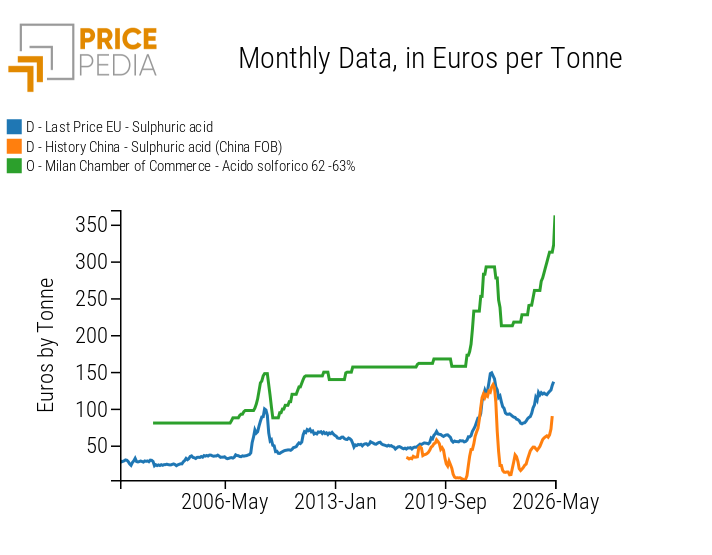
All three sources show a significant increase, although with very different price levels. These differences reflect:
- the existence of regionalized global markets;
- the high logistics costs associated with sulphuric acid;
- the different positions along the production and distribution chain.
Customs prices can in fact be considered close to producer or export prices, while the prices reported by the Milan Chamber of Commerce are more representative of distribution prices in the final market.
The strong upward phase is visible across all three series. However, while customs prices — both intra-EU and China FOB — still remain below the highs reached in 2022, the prices reported by the Milan Chamber of Commerce on May 5 moved well above the peak recorded during the 2022 price cycle.
The Relationship Between Sulphuric Acid Prices and Sulphur Prices
There are two main industrial processes used to produce sulphuric acid:
- Sulfur burner: this process uses elemental sulphur as feedstock. Sulphur is burned to produce sulphur dioxide, which is then converted into sulphuric acid;
- Sulfur smelter: in this process sulphur dioxide is generated as a by-product of metal smelting operations. Many metal ores contain limited amounts of sulphur in addition to the metal itself, and this sulphur is released during processing.
The production costs of sulphuric acid generated through the first process are largely determined by the price of sulphur, while the production costs associated with the second process can be considered close to zero, since sulphur dioxide is effectively a waste by-product of metal production.
Because the amount of sulphuric acid generated through the smelter route is normally insufficient to satisfy total market demand, the market price of sulphuric acid is ultimately determined by the sulfur burner process and, in particular, by the price of sulphur itself.
From the chemical reaction that transforms sulphur into sulphuric acid it is possible to derive a fundamental technical coefficient:
1 ton of H2SO4 → 0.33 tons of sulphur
In other words, approximately 330 kg of sulphur are required to produce one ton of sulphuric acid.
This coefficient represents the key starting point for understanding the possible upper limit of sulphur prices.
The Role of Hydrochloric Acid
In several industrial applications, sulphuric acid can be partially substituted by hydrochloric acid, particularly:
- in water treatment;
- in pH regulation required by certain industrial processes;
- in pickling operations;
- in some general chemical processes.
In these applications, hydrochloric acid can therefore represent an economically viable substitute.
Since hydrochloric acid is normally marketed at concentrations of 31–33%, while sulphuric acid is typically sold at concentrations of 93–98%, it follows that, on average, one ton of commercial sulphuric acid contains approximately twice the usable acidity of one ton of commercial hydrochloric acid.
Given that the current price of hydrochloric acid (intra-EU customs price) is approximately 90 €/t, a theoretical competitive price threshold for sulphuric acid can be estimated at around 180 €/t.
Beyond this threshold:
- hydrochloric acid begins to become competitive in substitutable applications;
- demand for sulphuric acid becomes progressively more price elastic;
- further price increases in sulphuric acid encounter growing economic resistance.
In other words, sulphuric acid prices can certainly rise significantly, but once they move beyond the 180–200 €/t range, substitution mechanisms involving hydrochloric acid begin to emerge.
This Is Where the Upper Limit of Sulphur Prices Emerges
If sulphuric acid prices encounter increasing competitive resistance beyond the 180–200 €/t range, then sulphur prices also implicitly face an economic ceiling.
The cost of sulphur embedded in sulphuric acid alone represents approximately 33% of the sulphur price itself. If sulphur rises, for example, to: 500 €/t, then the raw material cost embedded in sulphuric acid becomes:
500 × 0.33 = 165 €/t
To this value must still be added:
- energy costs;
- plant depreciation and maintenance costs;
- logistics costs;
- industrial margins.
As a consequence, a sulfur burner would struggle to produce sulphuric acid below 180–200 €/t with sulphur priced at 500 €/t.
And it is precisely at that level that substitution mechanisms between sulphuric acid and hydrochloric acid begin to emerge, progressively weakening sulphuric acid demand and, indirectly, sulphur demand itself.
At present, the global sulphur market appears to be approaching this limit. The chart below reports sulphur prices collected from three different sources:
- intra-EU customs prices;
- FOB customs prices of Chinese exports;
- domestic Chinese prices reported by Sunsirs for high-purity industrial granular sulphur (sulphur content ≥99%), mainly used in fireworks production and pesticide formulations.
Global price of sulphur
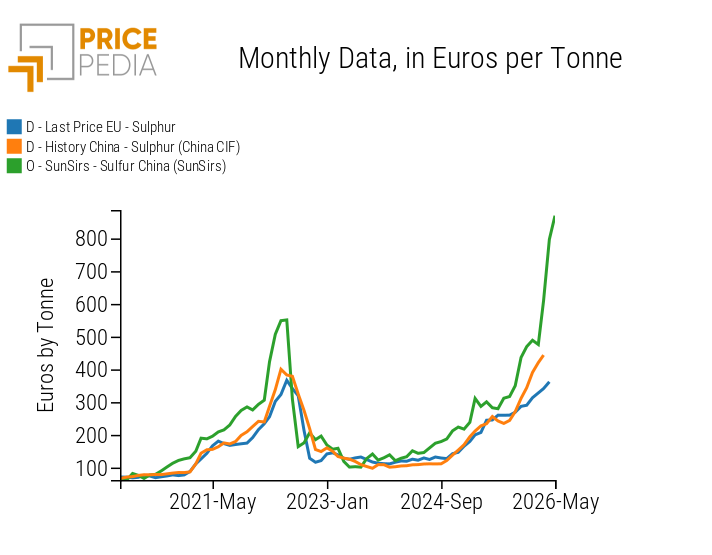
Until a few months ago, the three price series remained broadly aligned. In recent months, the two customs price series have continued to move closely together, while the price of sulphur destined for the Chinese fireworks and pesticide market has accelerated sharply, surpassing — once converted into euros — the threshold of 800 €/t[3].
It is evident that this sharp increase must be interpreted within the context of the effects that the Strait of Hormuz is currently exerting on short-term global sulphur availability, particularly in light of the ongoing substitution between sulphur supply originating from Asian producers and supply coming from Gulf countries[4].
Why 800 €/t Sulphur Prices Are Difficult to Sustain
With sulphur priced at 800 €/t, the sulphur content embedded in sulphuric acid alone would amount to:
800 × 0.33 = 264 €/t
Once the remaining production costs are added, the price of sulphuric acid could hardly remain below 300 €/t, a level incompatible with many industrial applications where substitution remains technically possible, therefore leading to a progressive reduction in demand.
For this reason, 800 €/t may be possible in the short term during extreme market shocks, but such levels appear difficult to sustain as a long-term structural equilibrium.
So far, this abnormal price level has been recorded only within a specific market niche,
whose pricing is nevertheless considered a useful benchmark for the global sulphur market.
Over the coming months,
tensions in broader sulphur prices
(represented by customs prices)
are likely to persist,
potentially leading to further increases.
However, it is plausible that prices will not move significantly beyond the
500 €/t
threshold.
As a consequence, sulphuric acid prices should also avoid moving significantly above 200 €/t, at least in terms of producer prices.
A different — and partly less predictable — dynamic may instead emerge in downstream markets, where prices also incorporate:
- distribution and commercial margins;
- local logistics costs;
- regional supply constraints;
- market dynamics often focused almost exclusively on supply-side shortages.
In these downstream markets, factors related to demand elasticity and product substitutability tend to receive far less attention than immediate concerns regarding physical product availability.
[1] For further analysis of the commodities most exposed to a potential disruption of the Strait of Hormuz, see the article Supply Risk in the Event of a Closure of the Strait of Hormuz .
[2] For an analysis of the factors behind the new price cycle in sulphur and sulphuric acid, see the article Sulphuric Acid: Product Scarcity and Rising Costs Behind Current High Prices .
[3] High-purity industrial granular sulphur (sulphur content ≥99%), mainly used in fireworks production and pesticide formulations, represents a reasonable proxy for the elemental sulphur market used in sulfur burners for sulphuric acid production, although it may include premiums related to purity, packaging, or specialized applications.
[4] For a description of the ongoing changes in global trade flows, see Sulphur Prices: A New Global Upcycle? .
You may be interested in:
The Price of Sulfur: How to Measure It in a Market Without a Public Benchmark
Published by Luigi Bidoia. .
Sulphuric acid industry Analysis tools and methodologiesGeopolitical tensions bring sulfur back into focus as a critical commodity [ Read all ]
Sulphuric acid: product scarcity and cost increases drive current high prices
Published by Luigi Bidoia. .
Sulphuric acid industry Price DriversAumenti dei prezzi molto differenziati per area geografica e fase della distribuzione [ Read all ]
Sulfur prices: a new global uptrend cycle?
Published by Luigi Bidoia. .
Fertilizers Sulphuric acid industry Price DriversAfter the peaks of 2008 and 2022, international quotations exceed €250/ton, signaling the start of an intense phase driven by rigid supply and volatile demand [ Read all ]