Tensions in International HDPE prices
Comparing different sources to capture current developments
Published by Pasquale Marzano. .
Plastics and Elastomers basic thermoplastics Price Drivers
In the article The importance of comparisons in situations of high uncertainty: the case of urea, the need to integrate different data sources into corporate decision-making processes was reaffirmed. Applied to Procurement, this approach makes it possible to conduct negotiations in the best possible way, especially in periods of high uncertainty such as the current one, driven by the evolving geopolitical context.
In addition to helping assess the direction in which prices are moving, this approach also provides a quantitative measure of price changes based on objective data.
The case of HDPE
This article focuses on High-Density Polyethylene (HDPE). Polyethylene is one of the most important basic thermoplastics and is produced through the polymerization of ethylene. Besides being affected by rising production costs—since it is obtained through oil refining (in particular from the steam cracking of virgin naphtha)—ethylene is highly vulnerable to a closure or severe restriction of traffic through the Strait of Hormuz (see the article Supply risk in the event of the closure of the Strait of Hormuz).
Oil price shocks therefore tend to be transmitted to HDPE prices through changes in the prices of virgin naphtha and ethylene.
In addition to the direct and indirect cost factors linked to the recent sharp increases in energy commodity prices, another reason why HDPE deserves closer analysis is the increasingly central role of Gulf countries—currently affected by the ongoing conflict—in global production and international trade.
The chart below shows the evolution of global HDPE exports by main geographical areas, expressed in million tonnes (based on ExportPlanning data).
World HDPE exports by area, in million tonnes
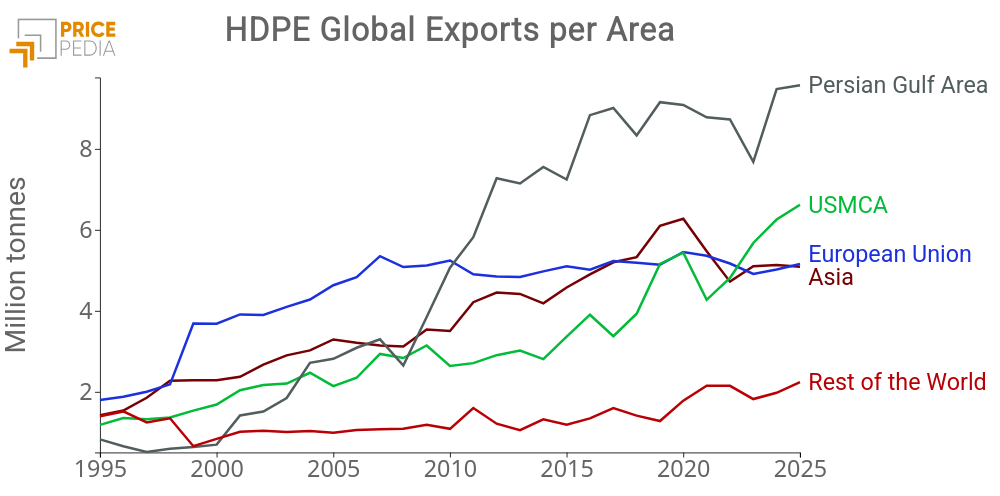
The competitive advantage provided by direct access to energy feedstocks such as oil and natural gas has enabled Gulf countries (led by Saudi Arabia) to establish themselves among the world’s leading HDPE production areas.
While Gulf countries are among the main global suppliers of HDPE, their share in European imports is more limited: in 2025, less than 12% of European HDPE imports originated from the Persian Gulf. In Asia, by contrast, dependence is much higher, exceeding 48%, well above the global average of 33%.
Given the different degree of exposure to imports from the conflict-affected region, Asian prices can be expected to react more strongly to the energy shock than their European counterparts.
As in the case of urea, it is therefore useful to compare the following data sources for HDPE:
- PricePedia forecasts, developed using structural models capable of estimating future price changes assuming historically observed relationships between costs, demand, supply, and selling prices remain stable;
- Customs prices, calculated as the average of millions of trade transactions. In this context, Chinese customs prices are particularly relevant, as they are available very quickly, generally within about 20 days after the end of the month;
- Financial prices, especially on longer maturities, which tend to reflect structural market fundamentals more than short-term speculative dynamics;
- Milan Chamber of Commerce prices, collected by a panel of experts and representative of distribution prices.
The table below reports HDPE prices in January 2026 and at the latest available date for three different sources. It also includes the LLDPE benchmark traded on the Dalian Commodity Exchange (DCE), which historically shows a price dynamic very similar to other polyethylene grades.
HDPE prices: a comparison across different sources
| 2026-01 | 2026-03 | 2026-05 | 2026-09 | |
|---|---|---|---|---|
| Price levels, euro/tonne | ||||
| China imports CIF | 744 | 793 | ||
| China DCE financials, 6-month delivery (LLDPE) | 829 | 1009 | 1017 | |
| Intra-EU customs: PricePedia forecast | 1128 | 1147 | 1253 | 1410 |
| Milan Chamber of Commerce (HDPE injection moulding) | 931 | 1215 | 1830 | |
| Percentage changes (%) vs January 2026 | ||||
| China imports CIF | 6.5 | |||
| China DCE financials, 6-month delivery (LLDPE) | 21.4 | 22.7 | ||
| Intra-EU customs: PricePedia forecast | 1.7 | 11.1 | 25.0 | |
| Milan Chamber of Commerce (HDPE injection moulding) | 30.7 | 96.6 | ||
The comparison highlights the price increases that have affected international HDPE markets, both in Europe and Asia, following the outbreak of the conflict.
In China, CIF import prices had already risen by +6.5% in March compared with January 2026 levels. The increase is even more pronounced when considering 6-month DCE futures, which rose by +21.4%. In the first week of May, the overall increase versus January 2026 reached slightly higher levels at +22.7%.
In Europe, the gap between the overall increases recorded by May appears much wider. Intra-EU customs prices show an increase of +11% compared with January 2026, with further increases expected in the coming months, reaching a total rise of +25% by September 2026.
The Milan Chamber of Commerce series highlights a particularly strong dynamic: by May 2026, prices were +96.6% higher than in January 2026. Moreover, this is the only series that in May 2026 exceeded the previous peaks recorded during the 2021–2022 upswing, signalling a possible stronger reaction at the distribution level driven by precautionary stockpiling demand.
Conclusions
The comparison across different sources confirms that the current HDPE market phase is characterised by particularly high uncertainty, in which geopolitical tensions rapidly transmit along the value chain through increases in feedstock prices.
The analysis also shows that the overall increase in international prices since the start of the conflict is around +25%, assuming the conflict is resolved by the summer. Chinese prices appear to have already priced in most of the increases, while European prices are expected to continue rising over the summer.
In this context, distribution prices are reflecting increased precautionary demand and tighter availability of the product in the short term.
Do you want to stay up-to-date on commodity market trends?
Sign up for PricePedia newsletter: it's free!
You may be interested in:

Can recycling thermoplastics help mitigate the impact of the energy crisis?
Published by Luca Sazzini. .
Plastics and Elastomers Cost pass-throughImpact of fluctuations in oil prices on the thermoplastics supply chain [ Read all ]
Polymer Value Chain: China’s Growing Role
Published by Luigi Bidoia. .
Organic Chemicals Petrolchimica bioplastics basic thermoplastics technopolymers Bio-Based Chemicals China in global commodity marketsIl caso della trasformazione green dell'epicloridrina [ Read all ]

Plastics and Elastomers: China's Market Plays an Increasingly Key Role
Published by Luigi Bidoia. .
Plastics and Elastomers Price DriversLa pressione competitiva della Cina contribuisce a influenzare i prezzi in Europa [ Read all ]