Cement prices at an all-time high: what factors have driven this rise?
Is the rise in cement prices expected to continue over the next two years?
Published by Luca Sazzini. .
Construction Raw Materials Price DriversIn recent years, the European cement market has been characterized by profound changes, driven by a combination of multiple and interconnected factors. In 2022, an exceptional increase in cement prices was recorded, driven by the recovery in demand in the post-pandemic period and supply bottlenecks due to rising energy costs, further exacerbated following Russia’s invasion of Ukraine. Cement production is in fact highly energy-intensive and requires large quantities of fuel to power kilns at high temperatures. The increase in energy costs therefore had a significant impact on production costs, leading to a structural rise in producer prices in Europe, which have not returned to pre-pandemic levels.
The following table shows the dynamics of the annual average percentage change in cement producer prices in Europe, Germany, Spain, France, and Italy, in order to highlight their evolution over the period 2021–2026. For 2026, only data up to February have been considered, the latest available data from Eurostat.
Table of annual percentage changes in cement producer prices (EUR)
| 2021 | 2022 | 2023 | 2024 | 2025 | 2026 | |
|---|---|---|---|---|---|---|
| Euro Area Producer Prices - AT2351 Cement production | +2.38 | +21.88 | +21.59 | +1.26 | +0.16 | +1.58 |
| Germany Producer Prices - AT2351 Cement production | +2.23 | +18.49 | +31.74 | +0.97 | +0.04 | +0.14 |
| Spain Producer Prices - AT2351 Cement production | +0.46 | +13.02 | +17.00 | +3.37 | +1.52 | +3.19 |
| France Producer Prices - AT2351 Cement production | +2.26 | +15.50 | +15.68 | +2.47 | +1.17 | +2.72 |
| Italy Producer Prices - AT2351 Cement production | +4.52 | +45.07 | +14.51 | −0.94 | −1.75 | +1.76 |
If between 2005 and 2020 average European cement prices grew overall by 30%, between 2021 and February 2026 they increased by more than 50%. In particular, the strongest increases were concentrated in the 2022–2023 period, during which average cement producer prices in Europe rose by about 22% in both years. Among the countries considered, Italy shows the sharpest increase in 2022, with prices rising by 45%.
It is interesting to note how the reduction in energy prices in the 2023–2025 period did not lead to a corresponding decrease in cement producer prices. The tightening of European environmental regulations, increasingly focused on reducing CO₂ emissions and based on strict limits and emission trading systems (ETS), contributed to the continued increase in cement production prices, which in turn was transmitted to customs prices and distribution prices, currently at historic highs.
The following table shows the average annual levels of European cement customs prices and distribution prices recorded by the Milan Chamber of Commerce, expressed in euros per ton.
Table of average annual cement prices (EUR/ton)
| 2021 | 2022 | 2023 | 2024 | 2025 | 2026 | ||
|---|---|---|---|---|---|---|---|
| EU customs prices | |||||||
| EU Last Price – Portland Cement | 65 | 81 | 101 | 103 | 107 | 112 | |
| EU Last Price – White Portland Cement | 108 | 133 | 156 | 169 | 167 | 171 | |
| Milan Chamber of Commerce prices | |||||||
| High-strength cement in 25 kg bags | |||||||
| Class 32.5 R | 154 | 205 | 243 | 243 | 243 | 251 | |
| Class 42.5 R | 158 | 213 | 260 | 260 | 260 | 268 | |
| Class 52.5 R | 177 | 240 | 293 | 293 | 293 | 303 | |
| White high-strength cement in 25 kg bags | |||||||
| Class 32.5 R | 280 | 382 | 469 | 469 | 469 | 496 | |
| Class 42.5 R | 295 | 402 | 491 | 491 | 491 | 515 | |
| Class 52.5 R | 340 | 463 | 565 | 565 | 565 | 594 | |
Cement distribution prices, recorded by the Milan Chamber of Commerce, are more than twice as high as those observed in European customs trade, due to the strong impact of logistics costs.
However, all prices analyzed tend to follow the same dynamics, consistent also with the producer price trend shown in the first table. Currently, cement prices are at new historic highs, with the most significant increases occurring in the 2022–2023 period. In particular, between 2021 and 2026, customs prices for Portland cement and white Portland cement increased by about 70% and 60% respectively.
In the same period, among distribution prices recorded by the Chamber of Commerce, the strongest increase concerns white cement of class 32.5, which grew by 77%, rising from 280 euros/ton in 2021 to 500 euros/ton at the beginning of 2026. The smallest increase concerns standard cement, also class 32.5, which at the beginning of 2026 is on average 63% higher than 2021 levels.
Do you want to stay up-to-date on commodity market trends?
Sign up for PricePedia newsletter: it's free!
PricePedia Forecast
Given the marked increase in cement prices recorded over the last five years, it is interesting to assess whether this trend is expected to continue in the next two years or whether stabilization or price declines are more likely.
The following chart shows the PricePedia forecast scenario for Portland cement customs prices, updated with information available up to May 1. To highlight the current price level, the historical series starting from 2000 is also shown.
PricePedia forecast of European cement customs prices (EUR/ton)
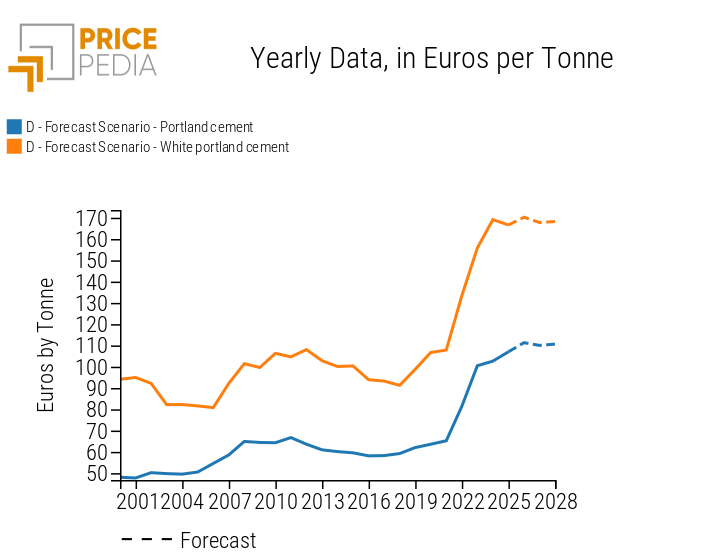
The scenario currently published by PricePedia forecasts an increase in annual cement prices in 2026. The main drivers behind this forecast include: the entry into force of the CBAM, rising energy costs, and increasing supply risk of triethanolamine.[1]
In 2027, a slight decline is expected instead, consistent with expectations of an end to the war in the Persian Gulf and the reopening of the Strait of Hormuz.
Summary
This analysis highlights the increase in cement prices starting in 2021, initially driven by the sharp rise in energy costs and subsequently by persistent production cost pressures linked to increasingly stringent European environmental policies.
Cement prices have thus reached new historic highs and are expected to remain in 2026 at average annual levels above those of 2025, supported by the entry into force of the CBAM, rising energy costs, and supply chain criticalities for triethanolamine. However, a slight decline is expected in 2027, in line with expectations of an end to the conflict in Iran and the reopening of the Strait of Hormuz.
[1] For further insights on the supply risk of triethanolamine, see the article: “ Supply Risk in the Event of a Closure of the Strait of Hormuz”