PricePedia Scenario for May 2026
Purchased material price outlook for 2026-2027 shaped by geopolitical dynamics
Published by Pasquale Marzano. .
Forecast Forecast
The PricePedia commodity price Scenario based on information available as of May 1, 2026 is heavily shaped by the outcome of the ongoing conflict involving the United States, Israel, and Iran. At present, the most likely assumption remains that hostilities will end by the summer, although the way this could occur remains highly uncertain.
Under this assumption, a sharp decline in oil prices is expected over the coming months. In particular, financial market expectations incorporate a Brent crude oil price path falling below the 100-dollar-per-barrel threshold as early as September this year, with the annual average closing slightly above 90 dollars. This level nevertheless remains almost +40% higher than the pre-conflict scenario published in February 2026.
The chart below compares the currently published scenario with the February 2026 scenario for Brent crude oil prices, expressed in dollars per barrel.
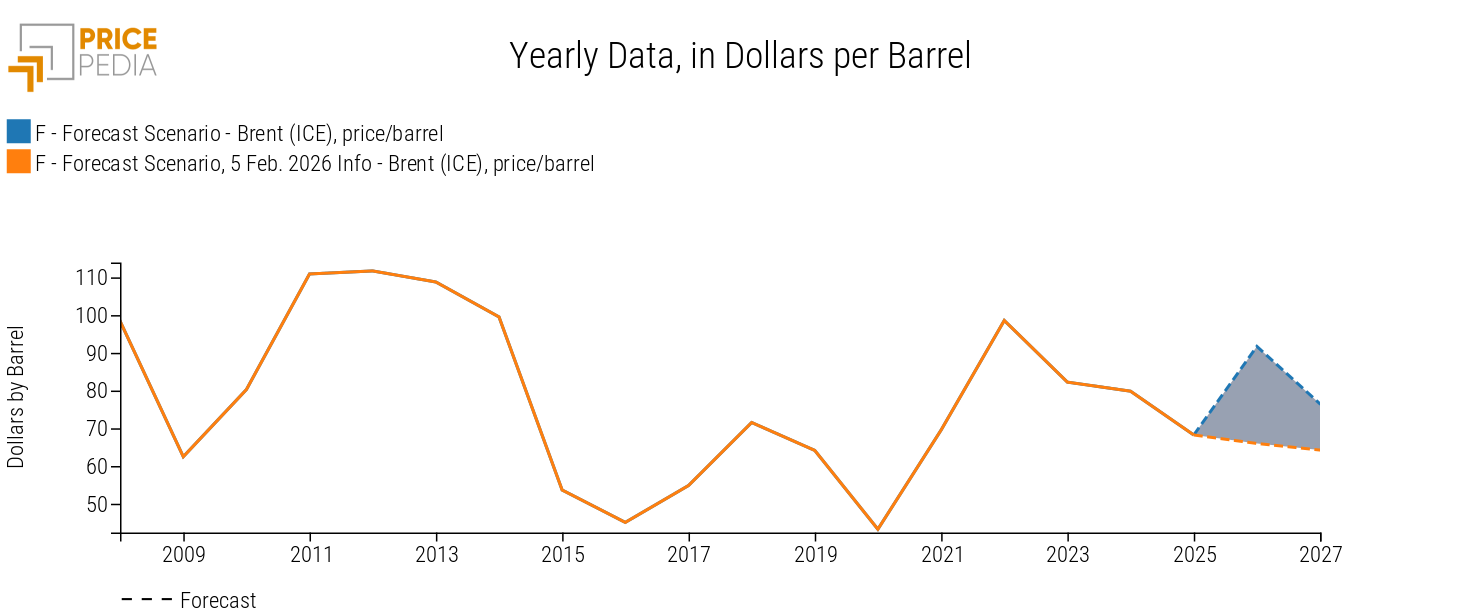
As shown in the chart, the conflict has led to a significant revision of the expected oil price trajectory, which in the current scenario for 2026 still remains below the 2022 average of 98.6 dollars per barrel.
Since the beginning of the conflict, the expected trajectory of natural gas prices has also been revised upward. Unlike oil, however, gas quotations are not expected to decline before next year. The need to refill EU storage facilities during the summer period is set to support demand, offsetting the seasonal drop in consumption resulting from the greater contribution of renewable sources in power generation.
Persistently high energy quotations for much of 2026 are expected to feed through to consumer prices. In this context, euro area inflation in 2026 is projected to deviate from the European Central Bank's 2% target, settling slightly above 3%. In 2027, as energy tensions gradually ease, inflation is expected to move back toward target levels, reaching around 2.5%.
Under the assumption of a summer resolution, the slowdown in the global economy is also expected to remain limited and confined to 2026. This shapes the outlook for global industrial production, a proxy for worldwide commodity demand: after growing by +2.5% in 2025, it is expected to slow to +1.3% on average this year before accelerating again in 2027 (+1.8%).
The May 2026 PricePedia Scenario
In this context—characterized by a relatively limited weakening of global industrial growth and energy prices in euros expected to rise by more than +22% on average in 2026—the overall PricePedia commodity price index is forecast to increase by +10.3% this year.
The table below reports the annual changes in euros for the main commodity aggregates included in the PricePedia Scenario: Industrial[1], Commodity[2], Energy, and Food.
Table 1: Annual growth rates (%) of PricePedia Aggregate Indices, in euros
| 2024 | 2025 | 2026f | 2027f | |
|---|---|---|---|---|
| I-Forecast Scenario, 1 May 2026-Commodity Index (Europe) | −4.10 | −4.91 | +10.34 | −6.83 |
| I-Forecast Scenario, 1 May 2026-Energy Total Index (Europe) | −6.17 | −11.67 | +22.86 | −14.49 |
| I-Forecast Scenario, 1 May 2026-Industrials Index (Europe) | −4.62 | −3.14 | +6.34 | +4.05 |
| I-Forecast Scenario, 1 May 2026-Food Total Index (Europe) | +8.83 | +17.03 | −14.43 | −10.90 |
Within the outlined context, industrial commodity prices are expected to rise by more than +6% in 2026 and by +4% in 2027. Alongside products more closely linked to the petrochemical and natural gas value chains (as described in the April scenario article), industrial metal prices are also expected to remain elevated, supported by demand linked to the dual transition (energy and digital).
This is especially true for copper prices, which are expected to continue fluctuating around 13 000 dollars per tonne, supported by structural demand tied to electrical infrastructure and energy transition technologies.
As for other non-ferrous metals, aluminium prices incorporate the effects of energy tensions and logistical disruptions linked to the Strait of Hormuz blockage, with an average level in 2026 close to 3 500 dollars per tonne. Once the most acute phase of the crisis has passed, quotations are expected to gradually weaken in the following years.
Alongside aluminium, tin prices are also expected to record a moderate decline over the medium term, following current elevated levels supported by persistent supply constraints in key producing countries, particularly Indonesia and Myanmar.
Finally, European steel prices are expected to continue their upward trend, exceeding 750 euros per tonne by 2027, supported by both higher energy costs and European trade protection policies that limit international competition.
1. The PricePedia Industrials index results from the aggregation of the indices relating to the following product categories: Ferrous, Non-Ferrous, Wood and Paper, Chemicals: Specialty, Organic Chemicals, Inorganic Chemicals, Plastics and Elastomers and Textile Fibres.
2. The PricePedia Commodity index results from the aggregation of the indices relating to industrial, food and energy commodities.
You may be interested in:

Energy shock and the furniture industry
Published by Pasquale Marzano. .
Forecast Analysis tools and methodologiesHow ongoing geopolitical tensions are reshaping cost dynamics in the sector over the next two years [ Read all ]
PricePedia scenario for non-ferrous metals 2026-2027
Published by Luca Sazzini. .
Forecast Non Ferrous Metals ForecastWhat impact did the Persian Gulf war have on PricePedia’s forecasts for non-ferrous metals? [ Read all ]

PricePedia Scenario for April 2026
Published by Pasquale Marzano. .
Forecast ForecastHow the energy shock is shaping procurement material prices over the next two years [ Read all ]