Monthly commodity prices update for April 2026
How the energy shock is being transmitted to procurement material prices two months after the start of the conflict
Published by Pasquale Marzano. .
EU Customs Global Economic TrendsIn April 2026, European PricePedia commodity prices in euros continued to rise, posting a +1.1% month-on-month increase after the surge of more than 15 percentage points recorded in the previous month, driven by the energy shock triggered by the conflict in the Persian Gulf. Price dynamics remain strongly influenced by the evolution of the conflict, whose resolution timeline is still uncertain two months after its outbreak.
The chart below shows euro-denominated raw material price trends in the European market across the main PricePedia aggregates, with January 2022 set as the base (=100):
- Commodity[1],
- Industrials[2],
- Energy,
- Food.
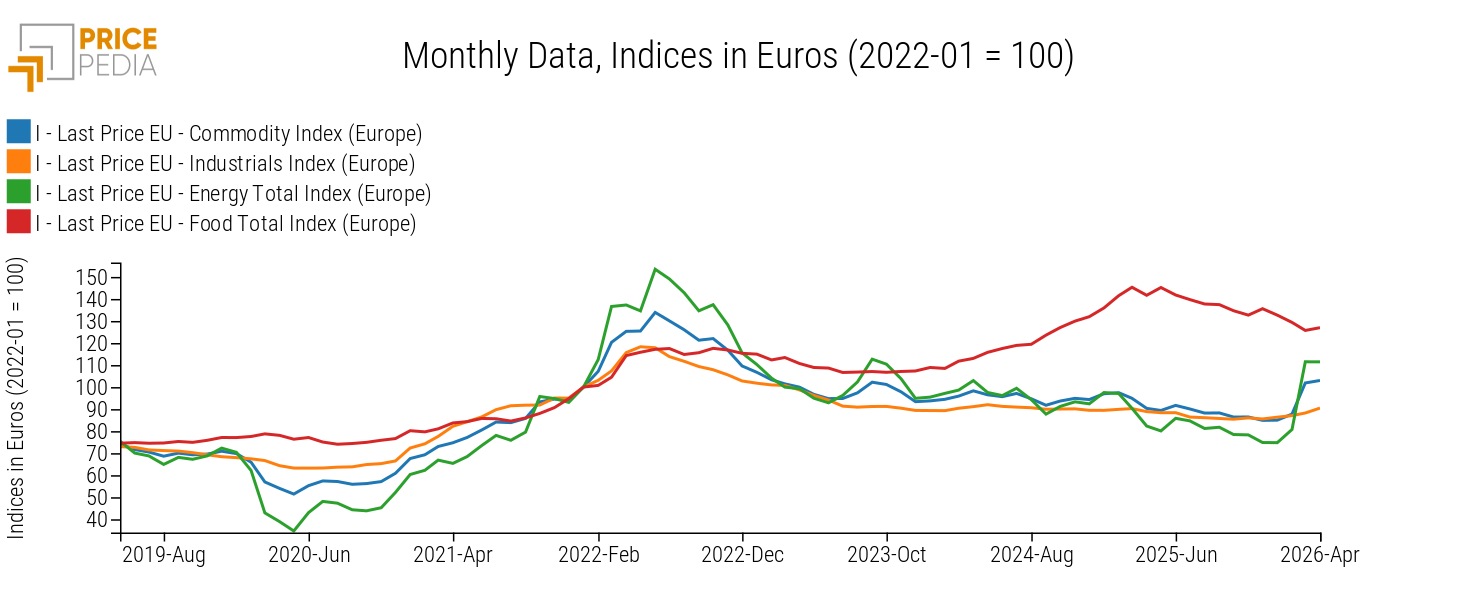
Among the main macro-categories, energy commodities in April remained at the same levels reached in March 2026, when the economic consequences of the conflict had driven a surge of more than 36 percentage points month-on-month.
As reported in the weekly update on financial commodities, oil and natural gas prices remain under pressure, with oil steadily above 100 dollars per barrel and natural gas hovering around 45 euros per MWh.
Looking at non-energy commodities, food commodities rose by +1.1% in April, in line with the overall commodity index. Core industrial commodities, however, show an acceleration in price dynamics, increasing by more than +2.5% after +1.3% in March.
After a relatively limited initial impact, the effects of the energy shock continued to spread along the various industrial supply chains in April.
Price dynamics of industrial raw materials since the start of the conflict
To assess the overall impact recorded in the first two months since the start of the conflict in the Persian Gulf on euro-denominated prices of industrial commodities, the following chart shows the percentage changes observed between February and April 2026.
Chart 2: % changes in April 2026 compared with February 2026
Source: PricePedia
The hierarchy of transmission of the energy shock described in the March update is confirmed: sectors most closely linked to the petrochemical and natural gas value chain—such as fertilizers (Specialty Chemicals), hydrocarbons and polyols (Organic Chemicals), and thermoplastic polymers (Plastics and Elastomers)—show the largest increases since the start of the conflict, in the range of 10–20%.
All other commodities recorded more moderate increases, averaging around +4%. The only exception is Pharmaceutical Chemicals, which declined by -1.4% since the beginning of the conflict.
Do you want to stay up-to-date on commodity market trends?
Sign up for PricePedia newsletter: it's free!
1. The PricePedia Commodity index is the aggregation of Industrials, Food and Energy indices.
2. The PricePedia Industrials index is the aggregation of indices related to the following categories: Ferrous Metals, Non-Ferrous Metals, Wood and Paper, Pharmaceutical Chemicals, Chemicals: Specialty, Organic Chemicals, Inorganic Chemicals, Plastics and Elastomers, and Textile Fibers.
You may be interested in:
Monthly commodity prices update for March 2026
Published by Pasquale Marzano. .
EU Customs Global Economic TrendsEarly impact of the energy shock on European purchasing materials prices [ Read all ]

Monthly commodity prices update for February 2026
Published by Pasquale Marzano. .
EU Customs Global Economic TrendsGeopolitical tensions and differentiated dynamics shape European commodity prices [ Read all ]
Monthly commodity prices update for January 2026
Published by Pasquale Marzano. .
EU Customs Global Economic TrendsEnergy and Non Ferrous Metals attempt to support European commodity prices [ Read all ]