The impact of the Gulf War on steel coil price forecasts
Impact of the war in Iran on financial price expectations for steel coils
Published by Luca Sazzini. .
Hot-Rolled Coils HRC ForecastIn the article: “Drivers of hot rolled coil prices in the 2025-2026 biennium” the risk factors, both upward and downward, that could influence the trend of coil prices over the 2025–2026 period were described.
During 2025, downside risks prevailed, including the weakness of key sectors such as automotive and construction, the increase in Chinese exports to Europe at increasingly competitive prices, and the reduction in energy costs and other production inputs, such as iron ore and coking coal.
In 2026, however, some of the upward risk factors highlighted in the above-mentioned article are re-emerging. In particular, there has been an increase in geopolitical tensions due to the war in Iran, which has significantly affected the trend of energy commodity prices, as well as an evolution of the EU regulatory framework toward more protectionist measures to safeguard the steel sector[1].
In light of the most recent developments in the Persian Gulf, it may be useful to analyze the evolution of financial market expectations since the beginning of the conflict in Iran, in order to understand which factors are having the greatest impact on the dynamics of coil prices. To this end, a comparison is provided between the futures curve[2] of Northern European hot-rolled coils (CME) on February 27, the last trading day before the start of the conflict, and that of April 17.
Comparison of Northern European HRC futures price curves, expressed in euro/ton
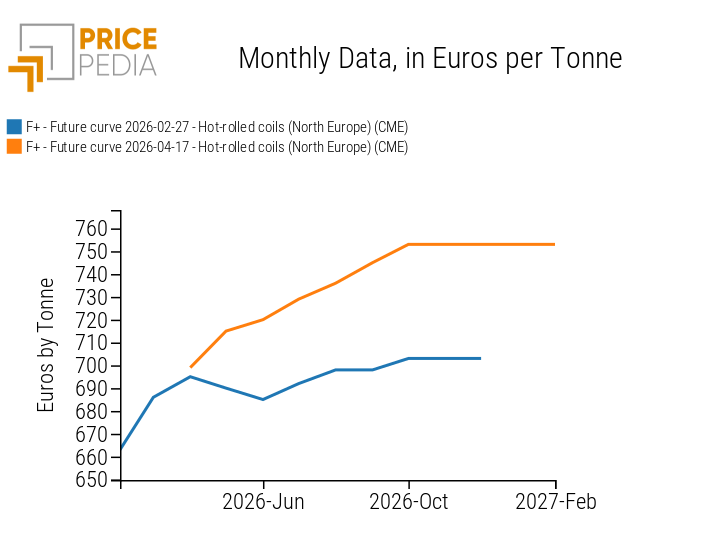
The analysis of the chart highlights a significant change in the dynamics of the coil futures curve over the last two months. Since the beginning of the conflict, the market has started to incorporate expectations of price increases, assigning a higher probability to bullish scenarios. Considering, for example, the contract expiring in October 2026, it emerges that, compared to a pre-conflict level of €703/ton, the current quotation is €50/ton higher.
PricePedia Forecast
The following chart shows the latest forecast scenario (dashed lines) relating to the comparison between the European aggregated price indices in euros for hot-rolled coils and cold-rolled coils.
For both indices, the historical price series starting from 2020 is also shown, in order to highlight how the dynamics of cold-rolled coils tend to follow those of hot-rolled coils, albeit with a slight time lag.
PricePedia forecasts of European aggregated coil indices, expressed in €/ton
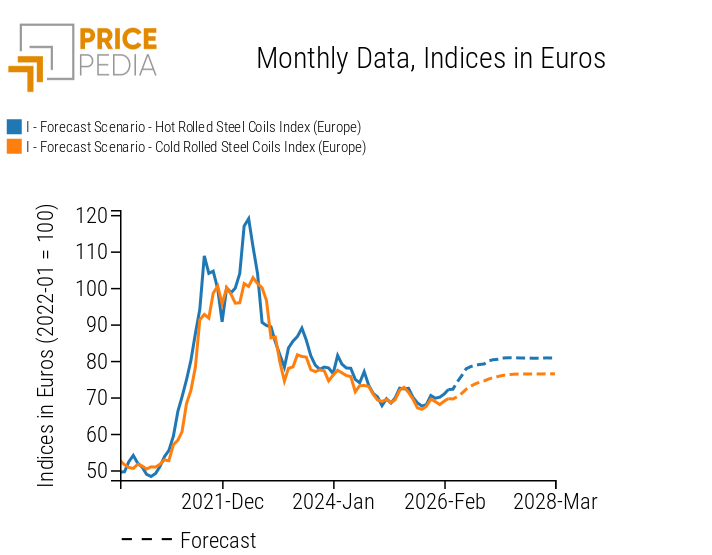
Based on the currently published scenario, in 2026 the prices in euros of hot-rolled coils are expected to increase by +8.2%. Growth is also expected to continue during 2027, at an average annual rate of +6.6%.
As for cold-rolled coils, in 2026 the expected increase is moderate, equal to +3.3% year-on-year, while in 2027 an acceleration in growth is expected, with an annual increase of +6.3%. It is assumed that, in line with what has been observed in previous price cycles, new energy shocks are transmitted more quickly and intensely to hot-rolled coil prices, and then gradually and more moderately reflected in cold-rolled coil prices.
Price forecasts of coil types marketed in the EU
The table below shows the annual percentage changes of the PricePedia forecast scenario for euro-denominated prices of non-alloy coils up to 2027, updated with information available at the beginning of April 2026.
| 2023 | 2024 | 2025 | 2026f | 2027f | |
|---|---|---|---|---|---|
| Hot-rolled coils | |||||
| Hot-rolled (thickness < 3 mm) | −19.73 | −10.15 | −6.46 | +10.73 | +7.69 |
| Hot-rolled (thickness ≥ 3 < 4.75 mm) | −19.77 | −7.60 | −7.49 | +10.65 | +6.05 |
| Hot-rolled (thickness ≥ 4.75 ≤ 10 mm) | −18.37 | −8.09 | −7.15 | +11.19 | +6.48 |
| Hot-rolled, pickled (thickness < 3 mm) | −17.59 | −7.94 | −6.78 | +3.52 | +7.20 |
| Hot-rolled, pickled (thickness ≥ 3 < 4.75 mm) | −16.53 | −6.29 | −5.66 | +4.59 | +3.80 |
| Hot-rolled, pickled (thickness ≥ 4.75 mm) | −17.37 | −8.23 | −6.98 | +5.39 | +6.08 |
| Galvanized coils (width < 600 mm) | −16.75 | −8.57 | −7.24 | +9.12 | +6.77 |
| Cold-rolled coils | |||||
| Cold-rolled (thickness 0.5 - 1 mm) | −19.81 | −7.31 | −5.81 | +3.42 | +6.44 |
| Cold-rolled (thickness 1 - 3 mm) | −19.82 | −4.32 | −4.12 | +2.83 | +6.13 |
| Cold-rolled (thickness ≥ 3 mm) | −19.47 | +10.78 | −6.60 | −3.85 | +5.88 |
| Cold-rolled magnetic (thickness 0.5 - 1 mm) | −41.40 | −20.17 | −10.36 | +7.31 | +17.49 |
After the reductions recorded in 2023–2025, which can be interpreted as a correction following the increases of the 2021–2022 period, coil prices are expected to show a widespread recovery.
Among the products recording the largest increases in 2026 are non-pickled hot-rolled coils, for which all annual changes in euros exceed 10% compared to 2025 levels.
Further significant increases are expected for galvanized hot-rolled coils, while for pickled coils the increases are more moderate, in line with the less pronounced declines recorded in previous years.
As for cold-rolled coils, a strong recovery is observed for magnetic coils, which experienced the largest declines in the 2023–2025 period, and modest increases for cold-rolled coils with thickness between 0.5 and 3 mm.
The only exception is cold-rolled coils with thickness ≥ 3 mm, for which a decline is also expected in 2026. This product continues to reflect still-elevated price levels, as a consequence of the increases recorded in 2024.
[1] For more information on the new safeguard measures, see the article: “Reopening of the Strait of Hormuz: financial markets optimistic about the developments in the conflict in Iran”
[2] For further insights on futures curves, see the article: “HRC futures curve: analysis of the evolution of market expectations”
You may be interested in:

HRC futures curve: analysis of the evolution of market expectations
Published by Luca Sazzini. .
Hot-Rolled Coils HRC Analysis tools and methodologiesWhat is the impact of the EU's proposed safeguards on HRC futures prices? [ Read all ]
HRC: A Partially Globalized and Financialized Market
Published by Luca Sazzini. .
Ferrous Metals HRC Price DriversToward a regional division of the HRC market? [ Read all ]
Drivers of hot rolled coil prices in the 2025-2026 biennium
Published by Luca Sazzini. .
Ferrous Metals HRC ForecastWhy should the HRC price not deviate much from the average prices in 2024? [ Read all ]