PricePedia scenario for non-ferrous metals 2026-2027
What impact did the Persian Gulf war have on PricePedia’s forecasts for non-ferrous metals?
Published by Luca Sazzini. .
Forecast Non Ferrous Metals Forecast
The PricePedia scenario published in April 2026 and analyzed in the article: “PricePedia Scenario for April 2026”, outlines an overall increase in aggregate commodity prices, mainly driven by expectations of rising energy prices due to the closure of the Strait of Hormuz and the permanent damage to energy infrastructure caused by the war. The increase in energy prices is also expected to transmit to industrial commodities, through both direct and indirect channels, for which average annual growth in dollar terms is forecast at +7.5% in 2026 and +4.2% in 2027.
Among the industrial commodities expected to experience particularly significant price increases are non-ferrous metals, with annual changes in dollars estimated at +15.1% in 2026 and +1.6% in 2027.
In light of the strong impact of the war in the Persian Gulf on energy commodity prices, it may be useful to assess how recent geopolitical developments have affected the current forecast scenario for non-ferrous metal prices. The following chart shows the April PricePedia forecast scenario for the aggregate index of European non-ferrous metals, compared with forecasts from the previous two months.
PricePedia forecasts of the total European non-ferrous metals index
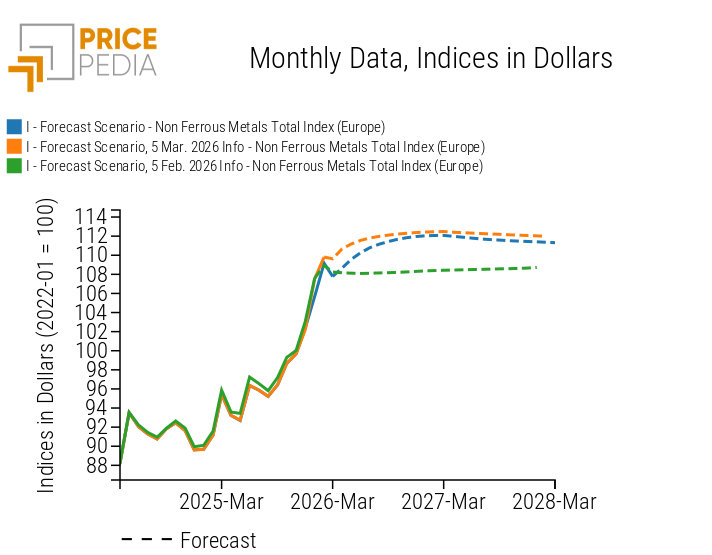
Based on the new information available, PricePedia forecasts an upward revision of non-ferrous metal price expectations compared to the February scenario, while April forecasts remain broadly unchanged compared to March. The main drivers behind this upward revision relative to February are: rising energy costs, increasing concerns about supply for some base metals (especially aluminum), and the acceleration of price recovery in China. Since the beginning of the year, in fact, the recovery in Chinese non-ferrous metal prices has significantly accelerated, with quarter-on-quarter changes exceeding 4%. [1]
However, some downside risks remain that could dampen the expected growth of non-ferrous metals, including a possible weakening of demand linked to the escalation of the conflict in the Persian Gulf and the adoption of more restrictive-than-expected monetary policies aimed at curbing inflation.
Non-ferrous metal forecasts by individual commodity group
To assess future price dynamics of non-ferrous metals, it may also be useful to examine the individual commodity groups included in the aggregate European index of total non-ferrous metals, in order to identify those expected to experience the highest price increases over the next two years.
The table below shows the annual percentage changes of the PricePedia forecast scenario, in dollars, for selected commodity groups included in the European non-ferrous metals aggregate.
Table of annual percentage changes in dollars for non-ferrous metal commodity groups
| 2023 | 2024 | 2025 | 2026f | 2027f | |
|---|---|---|---|---|---|
| I-Forecast Scenario-Index Aluminum (Europe) | −10.97 | +0.76 | +8.50 | +16.21 | −1.88 |
| I-Forecast Scenario-Index Secondary Aluminum (Europe) | −12.55 | +7.21 | +11.50 | +13.09 | −3.84 |
| I-Forecast Scenario-Index Aluminum Alloys (Europe) | −14.72 | −2.30 | +7.36 | +11.48 | +1.07 |
| I-Forecast Scenario-Index Copper (Europe) | −2.22 | +6.63 | +8.68 | +20.36 | +1.74 |
| I-Forecast Scenario-Index Nickel (Europe) | −11.03 | −21.81 | −11.36 | +11.05 | +4.33 |
| I-Forecast Scenario-Index Zinc (Europe) | −15.50 | −0.48 | +0.63 | +11.08 | +3.44 |
| I-Forecast Scenario-Index Lead (Europe) | +2.56 | −4.25 | −6.86 | +0.79 | +2.41 |
| I-Forecast Scenario-Index Bronze (Europe) | −3.30 | +9.47 | +11.28 | +22.20 | +6.96 |
| I-Forecast Scenario-Index Brass (Europe) | −2.80 | +3.45 | +6.69 | +18.33 | +3.94 |
The analysis of the table highlights a bullish forecast scenario for all the commodity groups considered over the next two years.
Prices of primary aluminum and secondary aluminum are both expected to increase sharply in 2026, followed by stabilization in 2027 at slightly lower levels, in line with the in-depth analysis in the article: “Aluminum price forecasts in light of the conflict in Iran”. Consistent with aluminum dynamics, prices of related alloys are also expected to rise significantly in 2026, followed by a slight increase in 2027.
Copper is the base metal expected to experience the largest price increase in 2026, at around +20% compared to average 2025 levels. Despite current levels being close to the historical highs reached in January 2026, PricePedia forecasts a gradual stabilization of prices, which will remain supported by strong demand and recent incidents that have disrupted production in some of the world’s major mines, including Grasberg, El Teniente, Constancia, and Quebrada Blanca.
Other significant increases among base non-ferrous metals are expected for zinc and nickel, the latter supported by concerns over a potential reduction in Indonesian supply.
Lead is the only base metal for which price stability is expected, linked to expectations of increased supply due to improved global recycling rates, which should be sufficient to offset the anticipated growth in demand.
As for bronze and brass, average annual increases of 22.2% and 18.3% respectively are expected in 2026, in line with the strong rise in copper prices.
Overall, this forecast scenario appears consistent with futures price dynamics in financial markets and with expectations of future demand growth for non-ferrous metals, driven by the development of green technologies and the infrastructure required for the energy transition.
[1] For further details on Chinese short-term dynamics in January and February 2026, see the article: “China economic update February 2026”
You may be interested in:

PricePedia Scenario for April 2026
Published by Pasquale Marzano. .
Forecast ForecastHow the energy shock is shaping procurement material prices over the next two years [ Read all ]

PricePedia Scenario for March 2026
Published by Pasquale Marzano. .
Forecast ForecastCommodity Prices: how the 2026-2027 forecast is changing in response to the energy shock [ Read all ]
PricePedia scenario for steel tube prices
Published by Luca Sazzini. .
Ferrous Metals Forecast Steel tubes ForecastWhen will steel tube prices reverse their current downward trend? [ Read all ]