China economic update March 2026
Analysis of the impact of the war in Iran on Chinese commodity prices
Published by Luca Sazzini. .
Conjunctural Indicators Global Economic TrendsThe update of PricePedia monthly prices for Chinese commodities for March 2026 has been published.
In aggregate terms, dollar prices of Chinese commodity exports show a slight increase, with a month-on-month change of +1.4%. In euros, the monthly change is much more pronounced at +3.7%, reflecting the depreciation of the euro against the dollar in March.
The following chart shows the trend of export FOB prices in dollars over the past two years, referring to the aggregate index of total commodities[1].
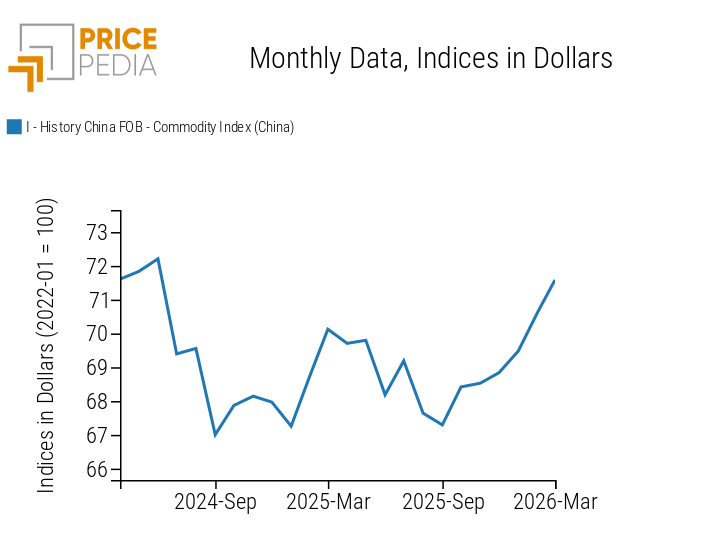
Analysis of the chart highlights the continuation of the recovery trend in Chinese prices, which began in October 2025.
This trend is almost entirely attributable to the growth in FOB prices of industrial products, which account for the majority of commodities exported by China.
The price recovery, initially supported by new stimulus measures targeting the real estate sector and by the halt in steel and aluminum production aimed at containing excess supply, was further intensified in March by the outbreak of the conflict in Iran and the closure of the Strait of Hormuz, events that led to a significant increase in the costs of energy commodities used as production inputs.
These increases were in turn transmitted, through both direct and indirect channels, to the FOB prices of Chinese industrial commodities, also due to the high level of competitiveness already achieved by the latter, which limits the ability to absorb further increases in energy costs without passing them on, at least in part, to export prices.
Export prices of Chinese industrial commodities had in fact recently reached (September 2025) a price floor, with levels much lower than those observed in Europe.
The following chart shows a comparison between the dollar prices of the aggregate FOB index of Chinese Industrials[2] and the European Industrials index, derived from intra-EU customs trade.
Comparison of dollar prices of Total Chinese Industrials and Total European Industrials
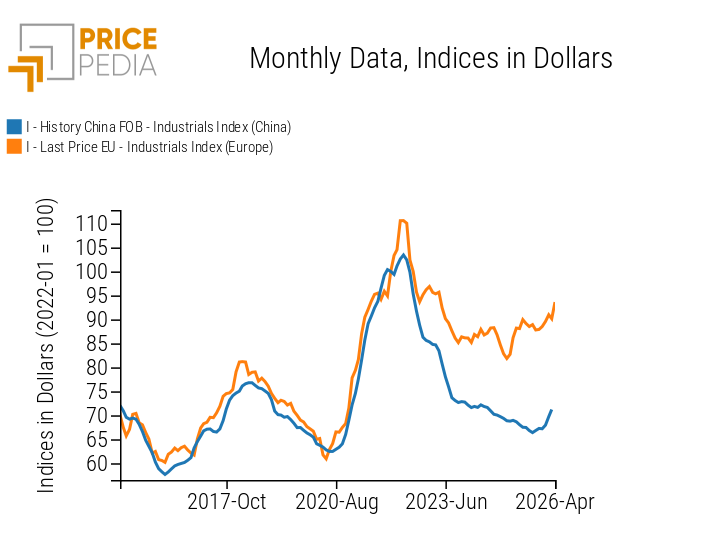
While in the period 2015–2022 the prices of the two industrial indices followed a common trend, in the last three years Chinese prices recorded a much sharper decline than that observed in Europe.
However, in March 2026 a much stronger recovery in aggregate prices of Chinese industrial commodities is observed, which increased by more than 2% in dollars and more than 4.5% in euros compared to the previous month. In the same period, in Europe aggregate prices of industrial commodities recorded a month-on-month change of -0.9% in dollars and +1.4% in euros.
Do you want to stay up-to-date on commodity market trends?
Sign up for PricePedia newsletter: it's free!
Analysis of industrial commodities by individual category
The table below shows the dynamics of month-on-month changes in dollar prices of Chinese exports, for the categories included in the industrial commodities aggregate.
Month-on-month changes of industrial commodities by individual category, expressed in $/ton
| 2025-11 | 2025-12 | 2026-01 | 2026-02 | 2026-03 | |
|---|---|---|---|---|---|
| I-Historical China FOB-Total Ferrous Index (China) | −0.03 | −1.37 | −0.51 | +3.91 | +0.48 |
| I-Historical China FOB-Total Non-Ferrous Index (China) | +2.78 | +1.89 | +4.81 | +4.80 | +2.68 |
| I-Historical China FOB-Total Plastics and Elastomers Index (China) | −0.17 | −0.35 | −1.42 | −0.42 | +2.90 |
| I-Historical China FOB-Total Organic Chemicals Index (China) | −0.86 | −1.42 | +0.02 | +0.65 | +3.16 |
| I-Historical China FOB-Total Inorganic Chemicals Index (China) | −0.23 | −0.15 | +1.89 | +2.59 | +1.37 |
| I-Historical China FOB-Total Specialty Chemicals Index (China) | −0.74 | −2.07 | 0.00 | +1.16 | +1.30 |
| I-Historical China FOB-Total Pharmaceutical Chemicals Index (China) | 0.00 | −1.83 | −3.66 | −0.33 | +1.50 |
| I-Historical China FOB-Total Textile Fibres Index (China) | +0.16 | −0.08 | −0.46 | +0.68 | +3.66 |
In March, all product groups included in the China FOB Industrials aggregate index recorded an increase in dollar prices on a monthly basis. The strongest increase concerns Textile Fibres, mainly driven by the sharp rise in FOB prices of polypropylene (PP) and polyethylene terephthalate (PET), which recorded month-on-month changes of +10.7% and +6.8% respectively. Significant increases are also observed in FOB prices of silk yarns and raw combed wool yarns, with monthly changes of +5.5% and +4.1% respectively.
The other product groups showing the most significant price increases are those most closely linked to the petrochemical supply chain, particularly Organic Chemicals and the Plastics and Elastomers segment. This is followed by the Non-Ferrous group, characterized by particularly strong increases in the aluminum supply chain. Against a monthly increase of +4% in dollar prices of unalloyed unwrought aluminum FOB, export prices in dollars of aluminum profiles and hollow aluminum profiles increased by +14.2% and +8.4% respectively.
The groups with the smallest price increases are Ferrous Metals and Specialty Chemicals, with month-on-month dollar changes of +0.5% and +1.3% respectively. In the case of Specialty Chemicals, however, a strong increase is noted in FOB prices of ammonium sulfate, which recorded a monthly increase in dollars of over 7%.
[1] The PricePedia FOB index for Total Commodity China is derived from the aggregation of FOB indices relating to industrial and energy commodities.
[2] The FOB index of Chinese industrial prices is derived from the aggregation of FOB indices relating to the following product categories: Ferrous, Non-Ferrous, Plastics and Elastomers, Organic Chemicals, Inorganic Chemicals, Specialty Chemicals, Pharmaceutical Chemicals, and Textile Fibres.
You may be interested in:

Tension returns to the energy markets following the renewed closure of the Strait of Hormuz
Published by Luca Sazzini. .
Conjunctural Indicators Commodities Financial WeekThe impact of the war in Iran on EU and US PMI indices [ Read all ]

Reopening of the Strait of Hormuz: financial markets optimistic about the developments in the conflict in Iran
Published by Luca Sazzini. .
Conjunctural Indicators Commodities Financial WeekEU agreement on new safeguard measures for steel [ Read all ]

Impact of de-escalation on financial commodity prices
Published by Luca Sazzini. .
Conjunctural Indicators Commodities Financial WeekHow have shipping costs changed following the closure of the Strait of Hormuz? [ Read all ]