The Fragmented Oleic Acid Market
How Europe, China, Indonesia and Malaysia turned a global commodity into different markets
Published by Luigi Bidoia. .
Fatty acids Bio-Based Chemicals China in global commodity marketsThe Fragmented Oleic Acid Market
How Europe, China, Indonesia and Malaysia turned a global commodity into three different markets
In today’s and tomorrow’s green chemistry landscape, oleic acid is set to play an increasingly important role, emerging as one of the main bio-based chemical feedstocks. Its importance is not limited to the cosmetics and detergents sectors, where it represents an essential base for the production of soaps, detergents, creams and lotions, but is also expanding into biodegradable plastics and, more broadly, into eco-friendly polymers and solvents. Industrial oleic acid[1] is in fact the starting feedstock for the production of azelaic acid and pelargonic acid, two key intermediates for these industries.
Industrial-scale oleic acid production is heavily concentrated in regions with abundant vegetable oil availability, particularly palm oil and soybean oil. Thanks to their large palm oil supply, Indonesia and Malaysia hold a leading position in more standardized production, while the European Union and the United States are distinguished by higher-purity production.
How the Global Oleic Acid Trade Has Changed
For much of the last two decades, the industrial oleic acid market operated according to the standard rules of major commodity markets. For a long time, it was a global product, traded in large volumes and with relatively limited price differences across the main economic regions.
During this period, Indonesia and Malaysia followed a similar supply strategy in the global market. Both were strong in palm oil, both occupied a central role in the oleochemical value chain, and both were naturally export-oriented. Europe represented the premium, high-purchasing-power market, while China was characterized by rapidly growing demand. The differences between the two main demand areas for oleic acid were not yet sufficient to segment the global market, which retained a unified structure with a single global price, with only modest variations mainly linked to purity levels.
This balance began to break down in 2021, when China and the European Union adopted diverging policies toward the two main producers of palm oil, the key feedstock for industrial oleic acid production.
As the world emerged from the pandemic, Europe tightened its approach on sustainability, deforestation and supply-chain traceability. China, by contrast, strengthened a more pragmatic strategy focused on securing volumes, industrial inputs and reliable partnerships.
On one side, in June 2021 China and Indonesia held in Guiyang the inaugural meeting of the High-Level Dialogue and Cooperation Mechanism, launching a new phase of engagement aimed at strengthening mutual strategic trust and deepening cooperation in the political, economic and maritime fields. Within this framework, China reinforced a pragmatic strategy designed to secure volumes, industrial inputs and a dependable long-term partnership.
On the other side, the European Commission hardened its approach on sustainability, deforestation and traceability, requiring suppliers of palm oil and derivatives to guarantee that raw materials originated from plantations not linked to deforestation. This shift triggered different reactions from Indonesia and Malaysia. Malaysia appeared immediately more aligned with the requirements of the European market: stronger certification capacity, large and well-structured industrial groups, better institutional dialogue and lower political friction. In short, for Brussels and for many European importers, Malaysia has in recent years become a far more “compatible” supplier than Indonesia.
This was followed in November 2021 by the launch of an anti-dumping investigation into fatty acid imports from Indonesia. The investigation concluded that Indonesian imports had caused injury to the European industry, leading to the imposition of definitive duties in January 2023.
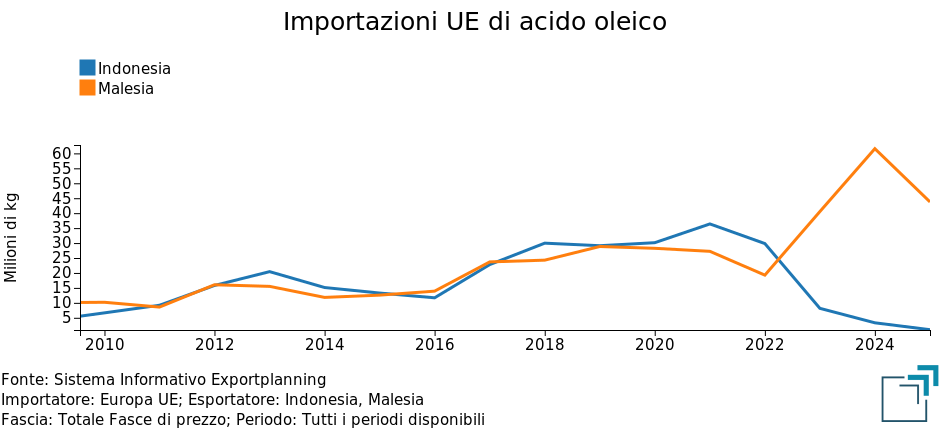
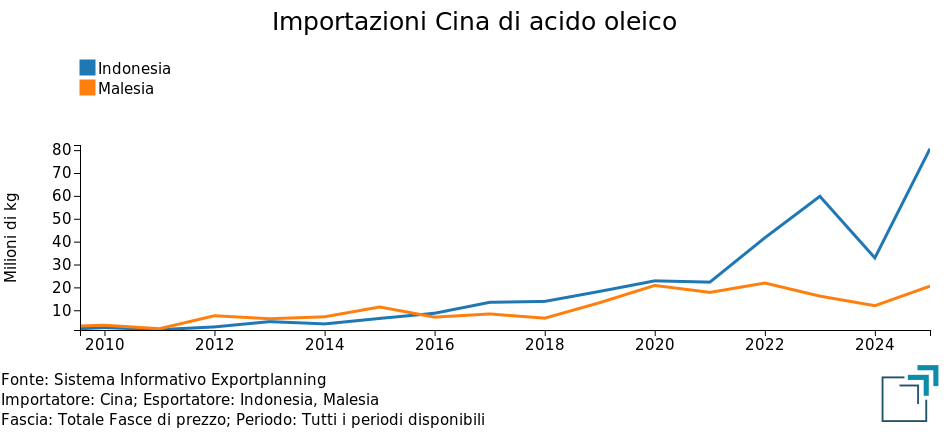
The combined effect of these policies was a radical transformation of the global industrial oleic acid market, documented in the two charts below. They show exports from Indonesia and Malaysia respectively to the EU and Chinese markets.
Imports of oleic acid
| into the EU market | into the Chinese market |
|
|
A comparison of the two charts clearly shows that 2021 marked a turning point in the global oleic acid market. In the following years, EU imports from Indonesia collapsed and were replaced by a strong increase in supplies from Malaysia. In the Chinese market, the opposite occurred, with a sharp rise in Indonesian imports accompanied by a gradual decline in Malaysian shipments.
Regionalization of Oleic Acid Prices
The break-up of the international market that emerged in 2021 becomes even more evident when looking at prices. Before the summer of 2021, the global oleic acid market was still able to generate a single world price, to which values in the various regions broadly adjusted. Since late 2021, however, prices across different markets have increasingly diverged.
The chart below reports oleic acid prices across several markets and for different trade origins:
- Price of intra-EU trade flows (Last Price EU, blue line);
- Price of EU imports, mainly of Malaysian origin (Storico Extra UE CIF, orange line);
- Price of Chinese imports, mainly of Indonesian origin (China CIF, green line);
- Price of Chinese exports (China FOB, red line).
Oleic acid prices in various markets

The analysis of the chart highlights the following dynamics and price levels after the summer of 2021:
- The price of Chinese imports, mainly of Indonesian origin, did not follow the other prices during the 2022 surge, remaining at levels clearly below the average and entering a gradual downward trend from early 2023;
- The other three price series continued to move along a common path until early 2023, when the price of EU imports from Malaysia and the price of Chinese exports recorded a sharper decline than intra-EU transaction prices;
- By early 2026, price dispersion in the global oleic acid market had become very wide: the price of Chinese imports from Indonesia remained below 900 euro/tonne, while the price of intra-EU transactions stayed above 1.600 euro/tonne. In an intermediate position, and at relatively similar levels, stood the prices of Chinese exports and EU imports from Malaysia.
The price dispersion observed in early 2026 reflects a market in which the tightening of EU environmental standards and anti-dumping measures reduced Indonesia’s commercial space in the EU fatty acids market. Jakarta’s response was to seek alternative outlets elsewhere, finding them in China thanks to its industrial demand and commercial pragmatism.
In this context, the country that benefited the most was China, which was able to satisfy its domestic demand for industrial oleic acid through low-cost imports from Indonesia, while simultaneously developing its own higher-purity oleic acid supply capable of competing with Europe’s niche producers.
Do you want to stay up-to-date on commodity market trends?
Sign up for PricePedia newsletter: it's free!
Conclusions
Palm oil and its derivatives are increasingly becoming raw materials through which the different industrial models pursued by the European Union and China are clearly reflected. With the post-pandemic recovery, the EU tightened its approach on sustainability, deforestation and supply-chain traceability, while China consolidated a more pragmatic strategy aimed at securing volumes, industrial inputs and reliable partnerships.
The effects of these choices have been particularly visible in global oleic acid trade flows. The European Union has progressively replaced imports of Indonesian origin with Malaysian supplies, considered more compatible with the new standards required by the European market. At the same time, Chinese imports from Indonesia, supported by highly competitive prices, have more than doubled.
The result has been the fragmentation of the global oleic acid market into two distinct poles. On one side stands the European market, supplied mainly by Malaysia, characterized by greater attention to environmental issues and deforestation, but associated with higher prices. On the other side is the Chinese market, more heavily supplied by Indonesia, based on a more pragmatic and cost-oriented approach, with clear pricing advantages.
The oleic acid case shows how the green transition and supply security can now generate different trade geographies, in which environmental standards, industrial strategies and price competitiveness are increasingly diverging.
[1] Industrial oleic acid (a mixture predominantly composed of oleic acid, but also containing other fatty acids) is classified under Harmonized System customs code HS382312. By contrast, pure oleic acid used as a specific chemical molecule is classified under code HS291615.
You may be interested in:

Why Palm Kernel Oil Prices Reflect the State of the Oleochemical Industry
Published by Luigi Bidoia. .
Palm Oil Vegetable oils Bio-Based Chemicals Price DriversCome la competizione tra usi alimentari, energetici e chimici degli oli vegetali influenza i loro prezzi relativi [ Read all ]
Sorbitol: a Commodity Only in Appearance
Published by Luigi Bidoia. .
Bio-Based Chemicals China in global commodity marketsPrezzi, segmentazione del mercato e nuove dinamiche competitive tra Europa, Cina e Stati Uniti [ Read all ]
Biofuels and the Ecological Transition in Europe
Published by Luigi Bidoia. .
Biofuels Bio-Based Chemicals Price DriversSostenibilità, materie prime e competitività: il dilemma europeo [ Read all ]