Maleic Anhydride and UPR Resins: Why China Is Winning the Global Competition
The energy shock is only marginally reducing China’s competitive advantage in the C4 petrochemical platform
Published by Luigi Bidoia. .
Petrolchimica China in global commodity marketsThe Butane-Derived C4 Petrochemical Platform
Crude oil and natural gas are both mixtures of hydrocarbons, i.e. molecules composed of carbon and hydrogen atoms, characterized by a different number of carbon atoms. Hydrocarbons with a lower number of carbon atoms tend to be gaseous under ambient conditions. Among these is butane, which consists of 4 carbon atoms (C4). Butane is primarily known because, together with propane (C3), it forms the mixture commonly referred to as Liquefied Petroleum Gas (LPG). However, butane also plays a significant role as a feedstock (“building block”) for an important petrochemical production platform, generally referred to as the C4 platform. The main products of this platform include: maleic anhydride, butadiene, butenes, and butanols.
Among these, maleic anhydride is the key strategic intermediate, acting as a critical building block for Unsaturated Polyester Resins (UPR), which are essential for the production of glass fiber-reinforced (GPR) composites widely used in automotive, marine, and construction applications.
In light of the recent energy shock, caused by the attack by Israel and the United States on Iran and the resulting closure of the Strait of Hormuz, it is useful to analyze the structure of the production chain that starts from butane and, through maleic anhydride, leads to UPR resins.
This analysis makes it possible to assess:
- the dynamics of competitive relationships between different regions of the world.
- the potential impact on the prices of these resins of oil prices above 90 dollars;
Competitive Advantages Across Different Regions of the World
Cost Advantages Related to Butane
The main production hubs of the C4 platform are located in Europe (with Germany playing a leading role), China, the United States, and the major oil and gas producing countries.
When considering both the level of technological development and the cost advantages linked to butane prices, the United States holds a clear competitive advantage over other producing countries.From a pricing perspective, this advantage becomes evident when comparing U.S. market quotations, as reported by the Chicago Mercantile Exchange (CME), with the prices of liquefied butane imported by China and the European Union from non-EU countries.
Comparison of butane prices by region
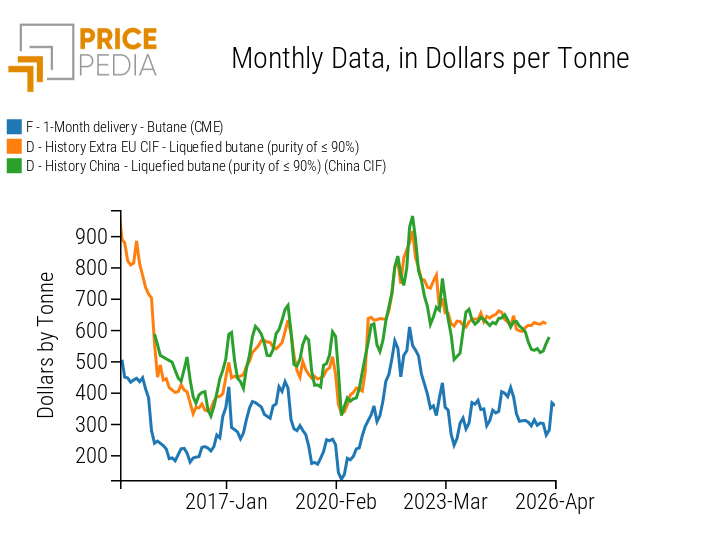
The chart clearly shows a strong relationship among the dynamics of the three prices considered, confirming that in all cases they closely follow global crude oil price trends. At the same time, it highlights the systematically lower price of butane in the U.S. market, partly due to the ability to extract butane from natural gas, whose price in the United States is relatively low. Indeed, the price of butane quoted on the CME shows an elasticity of 0.65 with respect to WTI crude oil prices, along with an elasticity of 0.25 relative to U.S. natural gas prices traded at the Henry Hub. This indicates that a significant share of butane supply in the U.S. market is derived from natural gas processing.
Advantages in Maleic Anhydride Pricing
However, the cost advantage in feedstock does not translate into a corresponding price advantage for maleic anhydride. This is clearly shown in the chart below, which compares FOB prices from U.S. and Chinese exports with EU customs prices observed in intra-EU trade.
Comparison of maleic anhydride prices by region n
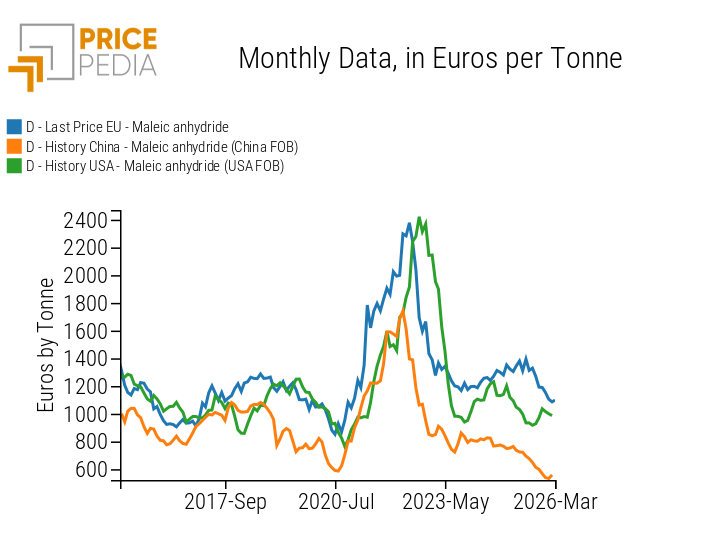
Up to the post-pandemic recovery in 2020, maleic anhydride prices in the United States and Europe were very close, reflecting a high level of market integration, with the United States being the main non-EU exporter to the Union.
By contrast, as early as 2018, Chinese prices had already started to diverge, positioning themselves at significantly lower levels compared to other global regions.
During the post-pandemic recovery phase, Chinese prices were the first to react, followed almost immediately by European prices. U.S. prices reacted more slowly but continued to rise in the following years, eventually creating a wide gap with Chinese prices.
In recent years, U.S. prices have declined again, falling below European levels, but still remaining above Chinese prices, which continue to maintain a clear competitive advantage over the other major producing regions.
Impact on Competition in the EU Maleic Anhydride Market
These differing international price dynamics for maleic anhydride have had a significant impact on the redistribution of market shares within the European Union. The following chart shows exports of maleic anhydride to the EU from the three main competing countries: Germany, the United States, and China.
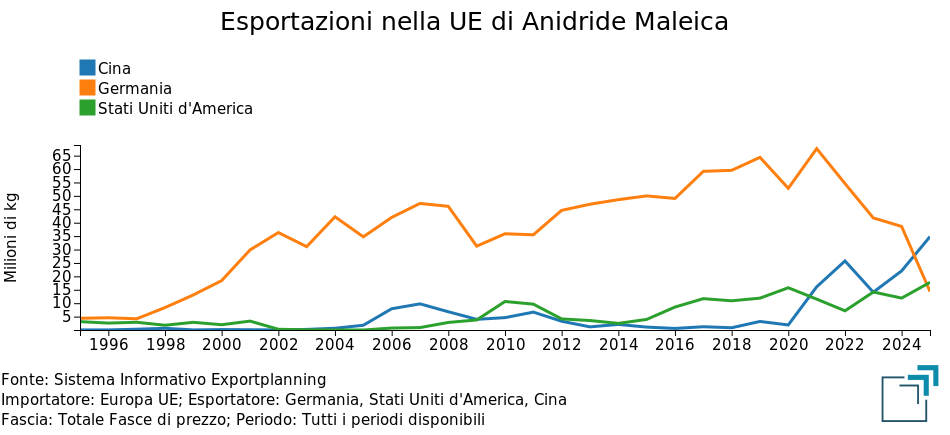
The analysis of the trends shown in the chart highlights three distinct phases. The first phase, up to 2015, is characterized by Germany’s clear leadership in the European market.
This is followed by a second phase, from 2015 to the outbreak of the pandemic, during which German leadership is marginally challenged by imports from the United States.
However, the most significant shift occurs in the most recent period, marked by a sharp decline in German sales, largely replaced not by U.S. imports but by those from China.
The difficulties of the European industry became particularly evident in the last year, when German exports were surpassed by both Chinese and U.S. imports.
Impact on the Global and EU Markets for Unsaturated Polyester Resins
The increased competitiveness of the Chinese industry in the production of maleic anhydride, reflected in its lower prices and strong export performance in the EU market, is generating even more significant effects on the global market for Unsaturated Polyester Resins (UPR), as clearly shown in the chart below.
The chart compares global UPR exports of the three main producing countries over a period of more than 30 years.
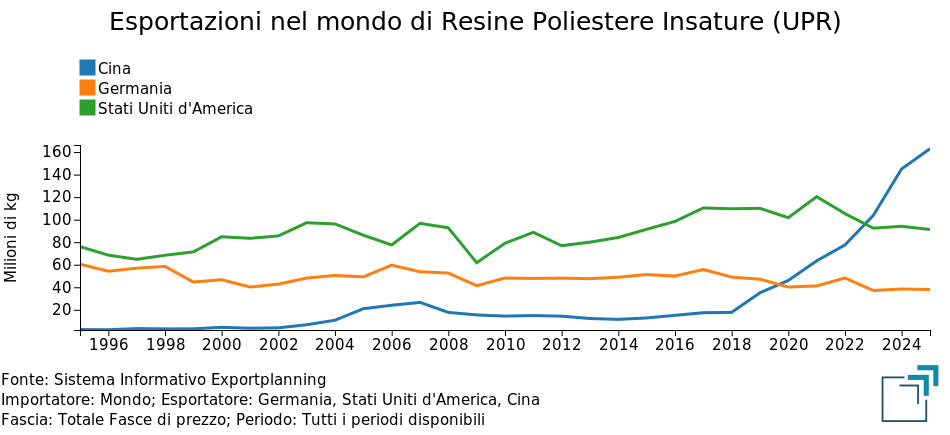
Until 2018, the year in which China established a clear and significant price advantage in the global maleic anhydride market, competition in the global UPR market was characterized by the solid leadership of the German industry, supported by a strong competitive position of the United States.
During this phase, China played only a marginal role, with very limited shares in global trade.
Following the cost advantage in maleic anhydride achieved by China starting in 2018, the global market experienced a sharp acceleration in Chinese UPR exports.
By 2025, this led China’s exports to surpass the combined total of Germany and the United States.
Effects of the Latest Energy Shock on C4 Platform Prices
In light of the developments observed over the past decade — particularly China’s price advantage in maleic anhydride production and the resulting gains in competitiveness for downstream resins — it is likely that the recent energy shock will lead to an increase in C4 platform prices, but to a relatively limited extent.
The price decline recorded between the end of 2025 and the beginning of 2026 is helping to contain cost pressures: on average, maleic anhydride prices in 2026 are expected to be in line with the 2025 average, thereby limiting price increases along the entire value chain.
You may be interested in:
Polymer Value Chain: China’s Growing Role
Published by Luigi Bidoia. .
Organic Chemicals Petrolchimica bioplastics basic thermoplastics technopolymers Bio-Based Chemicals China in global commodity marketsIl caso della trasformazione green dell'epicloridrina [ Read all ]

Virgin naphtha: price, cost and substitutability among regions
Published by Luigi Bidoia. .
Petrolchimica Price DriversCome quotazioni del Brent e gli scambi internazionali influenzano il prezzo della virgin nafta [ Read all ]
From raw materials to markets: how prices are formed in basic petrochemicals
Published by Luigi Bidoia. .
Organic Chemicals Petrolchimica Price DriversNafta, gas naturale e catrame: tre percorsi che convergono nei grandi mercati degli idrocarburi alcheni e aromatici [ Read all ]