Aluminum price forecasts in light of the conflict in Iran
What are the main factors driving aluminum price trends?
Published by Luca Sazzini. .
Aluminium ForecastIn the article: “Monthly commodity prices update for March 2026”, the strong growth in European monthly PricePedia commodity prices during March was highlighted, driven by developments in the conflict in the Persian Gulf. The commodity group most affected by the escalation of the conflict in Iran was energy, followed by industrial sectors most closely dependent on energy commodities, particularly chemical commodities, plastics, and elastomers supply chains.
The dynamics of industrial metals were more contained, with average prices remaining overall stable compared to February levels, recording only moderate increases. The only industrial metal that showed particularly significant growth was aluminum, due to its strong exposure to developments in the Middle East conflict. Approximately 8% of global aluminum production is concentrated in the Persian Gulf; damage to regional producers and the recent blockade of the Strait of Hormuz have exerted significant upward pressure on prices. This geopolitical shock is expected to affect aluminum price dynamics in the coming months as well, significantly altering the forecast scenarios previously developed by analysts.
In light of the most recent information available, a new analysis of the aluminum price forecast scenario is therefore appropriate.
Aluminum Price Forecast Scenario
The following table shows the annual percentage changes in the PricePedia aluminum price forecast scenario through 2027, updated with information available as of April 7, 2026.
Table of Annual Percentage Changes in Aluminum Prices
| 2023 | 2024 | 2025 | 2026 | 2027 | |
|---|---|---|---|---|---|
| F-Forecast Scenario – Aluminum (LME) | −18.59 | +7.42 | +4.25 | +25.59 | −5.79 |
| D-Forecast Scenario – Unalloyed Unwrought Aluminum | −21.18 | +2.97 | +3.23 | +21.32 | −4.50 |
| D-Forecast Scenario – Unalloyed Aluminum Wire | −10.77 | +1.03 | +5.21 | +13.13 | −4.28 |
| D-Forecast Scenario – Aluminum Waste | −14.73 | +7.19 | +7.01 | +10.23 | −6.12 |
| D-Forecast Scenario – Aluminum Scrap | −15.53 | +6.68 | +6.35 | +10.66 | −2.48 |
| D-Forecast Scenario – Aluminum Shavings | −5.23 | +11.55 | +10.20 | +6.72 | −3.80 |
Analysis of the new PricePedia forecast scenario shows strong growth in average annual prices for unalloyed aluminum in 2026, with an expected increase of more than 20% compared to average 2025 levels.
For 2027, a slight decline is expected compared to the estimated 2026 values; however, prices should remain significantly higher than those recorded in 2025, with an expected annual average of $3,600 per ton. Even assuming a resolution of the Persian Gulf conflict by the end of 2026, prices forecast for 2027 will remain elevated due to permanent damage suffered by aluminum production facilities currently forced to suspend operations. Additional upward factors will also support prices, particularly increased aluminum demand linked to the energy transition, Chinese supply constrained by the annual production cap of 45 million tons, and tightening of the new CO₂ quota allocation method within the Chinese ETS system, with the introduction of the first absolute emissions caps starting in 2027.
The strong growth expected for aluminum prices will also be reflected in the dynamics of related downstream products, such as unalloyed aluminum wire, whose average prices for 2026 are expected to increase by 13% compared to 2025 levels.
Furthermore, given the partial substitutability between primary and secondary aluminum, a significant increase in primary aluminum prices is expected to drive higher demand for aluminum scrap and residues used in secondary metal production. Consequently, prices for wastes, scraps, and shavings are all expected to increase significantly in 2026.
The scenario described above appears the most likely based on currently available information; however, uncertainty remains, particularly regarding the magnitude of expected price growth next year. Several risk factors could influence aluminum price dynamics.
Do you want to stay up-to-date on commodity market trends?
Sign up for PricePedia newsletter: it's free!
Analysis of Main Forecast Risks
Among the main risk factors affecting aluminum price forecasts are:
- the duration of the Middle East conflict: developments in the conflict may influence the speed of recovery of aluminum production in the Persian Gulf and related exports through the Strait of Hormuz;
- monetary policies of Western central banks: although a tightening of monetary policies by the FED and ECB is considered likely, the extent of interest rate increases will depend closely on inflation dynamics, themselves influenced by the evolution of the conflict;
- the pace of recovery in Chinese export prices: since October 2025, Chinese aluminum export FOB prices have resumed growth; however, their increase remains significantly more moderate than international prices due to weak domestic demand in China.
Focusing on the latter point, it is interesting to note that Chinese prices have already begun to slow the recent recovery in international aluminum prices.
The following chart shows the dynamics of Chinese aluminum export prices compared with European prices and LME financial prices.
Comparison of International Prices of Unalloyed Unwrought Aluminum
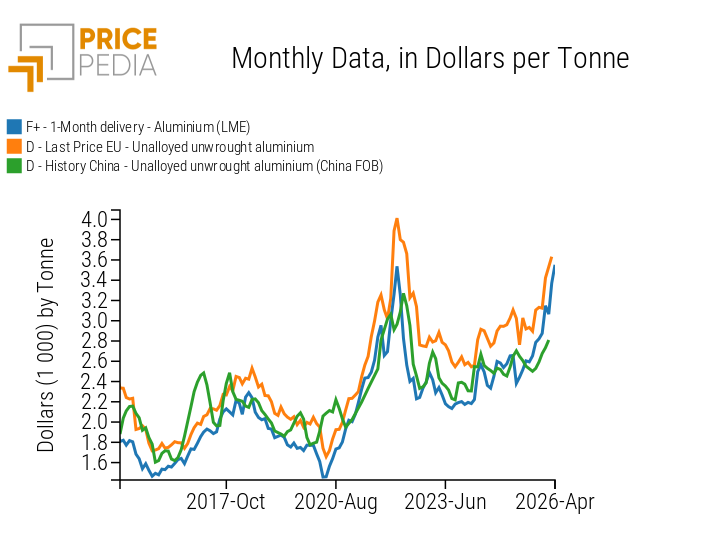
Analysis of the chart shows that physical aluminum prices, both in Europe and China, are almost always higher than LME financial prices. However, starting from July 2025, Chinese export prices have consistently remained below LME levels, thereby limiting growth in other international prices.
In Summary
In the article “LME aluminium price forecast 2026–2027”, the outlook for aluminum price growth was already highlighted, supported by the energy transition, production limits imposed by China, and the progressive strengthening of the Chinese ETS system. In light of the latest developments related to the war in the Persian Gulf, even stronger increases can reasonably be expected. In particular, PricePedia estimates that the average annual price of unwrought aluminum in 2026 could increase by more than 20% compared to 2025 levels.
However, risks remain that could influence the magnitude of this growth in either direction, including the duration of the conflict, Western central bank monetary policies, and the speed of recovery in Chinese export prices.
You may be interested in:

Recycling Markets and Commodity Markets
Published by Luigi Bidoia. .
Polypropylene Aluminium Polyethylene terephthalate (PET) Circular economyInteractions between scrap prices, recycled commodity prices, and virgin raw material prices [ Read all ]
LME aluminium price forecast 2026–2027
Published by Luca Sazzini. .
Non Ferrous Metals Aluminium ForecastIs the rise in aluminium prices expected to continue over the next two years? [ Read all ]

Analysis of Aluminum Market Fundamentals Through 2050
Published by Luca Sazzini. .
Forecast Non Ferrous Metals Aluminium Analysis tools and methodologiesAluminium supply and demand: what are the long-term growth prospects? [ Read all ]