Monthly commodity prices update for March 2026
Early impact of the energy shock on European purchasing materials prices
Published by Pasquale Marzano. .
EU Customs Global Economic TrendsIn March 2026, European monthly prices of PricePedia commodities recorded an increase of over +15% compared with the previous month. The main contribution to this strong price growth came from Energy commodities, increasingly influenced by the evolution of the conflict in the Persian Gulf.
The chart below shows the price trends, in euros, of raw materials in the European market for the main PricePedia aggregates: Commodity[1], Industrials[2], Energy, and Food, with January 2022 = 100 as the base for each index.
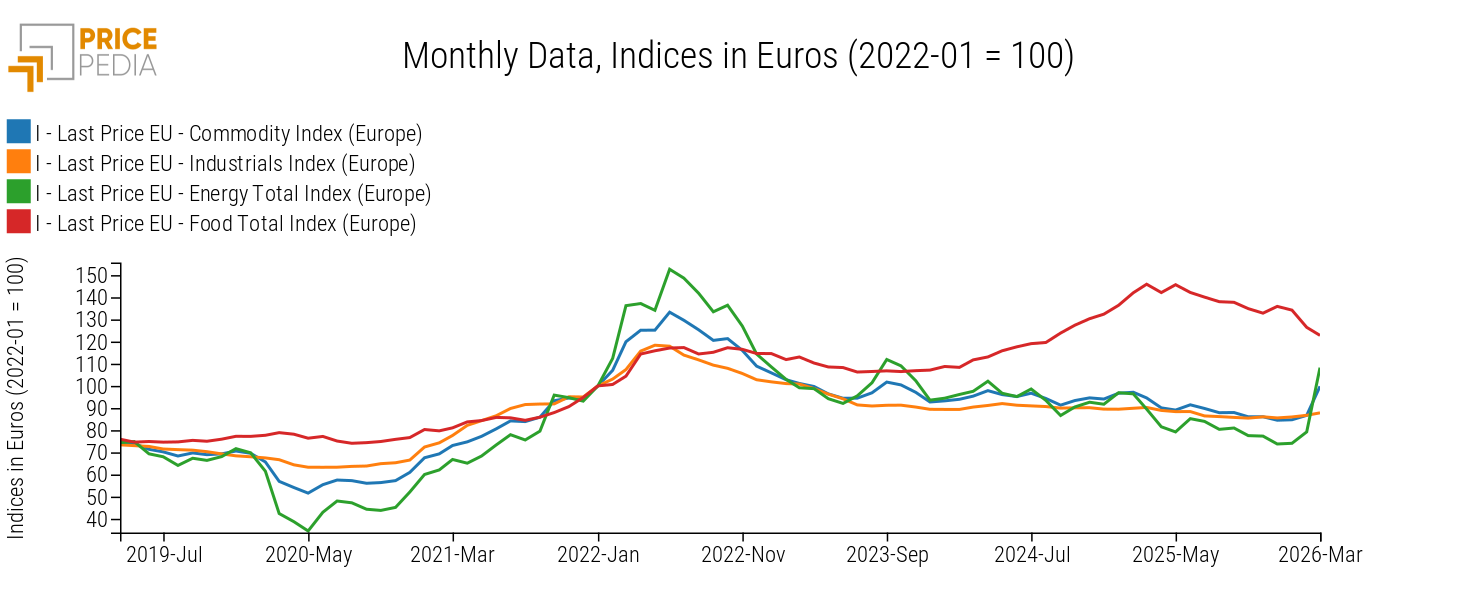
Due to the United States and Israel’s attack on Iran and the closure of the Strait of Hormuz by Iran, energy prices recorded a very sharp increase in March 2026. On a monthly basis, the euro-denominated price index for energy commodities rose by +36.6%, far exceeding all monthly increases recorded during the post-pandemic energy crisis.
So far, non-energy commodities prices have remained relatively immune to the effects of rising energy prices, although with some significant exceptions.
The most relevant concerns the chemical industry, particularly petrochemicals, with double-digit percentage increases for fertilizers, hydrocarbons, and polyols. The impact has already begun to spread along the value chain, leading to a +2.2% increase in the price index of Plastics and Elastomers.
Another important exception is the European “physical” price of primary aluminium, which increased by more than +5%, compared with an average increase of only +1% for non-ferrous metals. Among metals, hot-rolled steel coils also reacted to rising energy costs, with a +2% monthly increase in European physical market prices.
Industrial Raw Materials Prices in March 2026
The monthly dynamics of core industrial categories in March 2026 confirm the hierarchy of transmission of the energy shock.
The chart below shows the month-on-month price changes in euros for the categories belonging to the industrial sector in March 2026.
Chart 2: March 2026, % changes in euros compared with February 2026
Source: PricePedia
At the level of individual categories, in March 2026 Organic Chemicals recorded the strongest monthly increase at +3.3%, as they are more strongly correlated with upstream energy feedstocks. They were followed by Plastics and Elastomers (+2.2%) and Specialty Chemicals (+2.1%).
Inorganic Chemicals also showed a relatively strong monthly increase of +1.7%.
Summary
The first effects of the energy shock on industrial supply chain prices emerged in March 2026, with differentiated impacts depending on the degree of dependence on energy raw materials.
For commodities less affected so far, more significant price increases can reasonably be expected in the coming weeks, especially if the conflict persists and keeps energy prices at elevated levels.
Do you want to stay up-to-date on commodity market trends?
Sign up for PricePedia newsletter: it's free!
1. The PricePedia Commodity index is the aggregation of Industrials, Food and Energy indices.
2. The PricePedia Industrials index is the aggregation of indices related to the following categories: Ferrous Metals, Non-Ferrous Metals, Wood and Paper, Pharmaceutical Chemicals, Chemicals: Specialty, Organic Chemicals, Inorganic Chemicals, Plastics and Elastomers, and Textile Fibers.
You may be interested in:

Monthly commodity prices update for February 2026
Published by Pasquale Marzano. .
EU Customs Global Economic TrendsGeopolitical tensions and differentiated dynamics shape European commodity prices [ Read all ]
Monthly commodity prices update for January 2026
Published by Pasquale Marzano. .
EU Customs Global Economic TrendsEnergy and Non Ferrous Metals attempt to support European commodity prices [ Read all ]
Monthly commodity prices update for December 2025
Published by Pasquale Marzano. .
EU Customs Global Economic TrendsThe 2025 Commodity Market: toward price normalization and diverging trends across sectors [ Read all ]