China economic update February 2026
What price trends can we expect in light of the conflict in the Persian Gulf?
Published by Luca Sazzini. .
Conjunctural Indicators Global Economic TrendsPricePedia has published the update of the monthly prices of Chinese commodities for the months of January and February 2026.
Between December 2025 and February 2026, in aggregate terms, prices in US dollars of Chinese commodity exports reversed the recovery recorded in previous months, showing a decline of -2.9%.
Over the same period, the reduction in euro-denominated prices was even more pronounced, equal to -3.7%, reflecting the appreciation of the euro during January and February 2026.
The following chart shows the dynamics, in US dollars, of FOB export prices over the last two years for the three main aggregated indices of Chinese commodities available on PricePedia: Total Commodities[1], Industrial Commodities[2], and Total Energy.
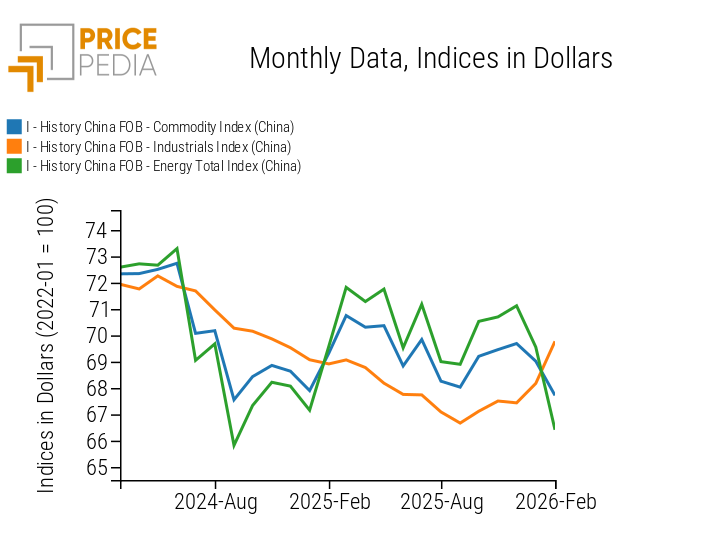
Analysis of the chart shows that the decline in the Total Commodities China aggregate index is attributable to the contraction in Chinese energy commodity export prices, which in February 2026 recorded, in US dollars, a decrease of -6.61% compared with December 2025 levels.
Conversely, the upward phase in Chinese industrial commodity FOB prices continues, which in aggregate terms show growth of 3.6% compared with December 2025.
In light of recent developments in the Middle East, it is reasonable to expect that the dynamics of Chinese FOB price aggregates for Total Energy will record significant growth in March 2026, in line with developments observed in international financial markets. Since the beginning of March, the monthly average financial prices of Brent (the international oil benchmark) and JKM (the Asian natural gas benchmark) have increased by more than 40% and 65% respectively compared with February 2026, due to the attack by the United States and Israel on Iran, the subsequent closure of the Strait of Hormuz, and attacks in the Persian Gulf that have compromised the region’s energy infrastructure.
Given the strong dependence of Chinese industry on foreign energy supplies, rising energy prices are expected to also affect industrial commodity costs, accelerating the growth of their FOB prices in the coming months.
Do you want to stay up-to-date on commodity market trends?
Sign up for PricePedia newsletter: it's free!
Analysis of Industrial Commodities by Individual Product Category
The table below shows the dynamics of month-on-month changes in US dollar prices of Chinese exports for the product categories included in the industrial commodities aggregate.
Month-on-month changes in industrial commodities by product category, expressed in $/ton
| 2025-10 | 2025-11 | 2025-12 | 2026-01 | 2026-02 | |
|---|---|---|---|---|---|
| I-Historical China FOB – Total Ferrous Index (China) | +1.43 | +0.03 | −1.29 | −0.51 | +3.68 |
| I-Historical China FOB – Total Non-Ferrous Index (China) | +2.21 | +2.78 | +1.89 | +4.81 | +4.25 |
| I-Historical China FOB – Total Plastics and Elastomers Index (China) | −0.70 | −0.40 | −0.18 | −1.35 | −0.19 |
| I-Historical China FOB – Total Organic Chemicals Index (China) | −1.51 | −0.87 | −1.52 | +0.03 | +0.77 |
| I-Historical China FOB – Total Inorganic Chemicals Index (China) | +0.46 | −0.39 | −0.64 | +1.17 | +1.33 |
| I-Historical China FOB – Total Specialty Chemicals Index (China) | −0.29 | −1.07 | −2.10 | +0.07 | +0.96 |
| I-Historical China FOB – Total Pharmaceutical Chemicals Index (China) | −0.20 | 0.00 | −1.83 | −3.66 | −0.33 |
| I-Historical China FOB – Total Textile Fibres Index (China) | +0.10 | +0.16 | −0.08 | −0.46 | +0.68 |
Analysis of the table highlights the strong increase in non-ferrous metal prices, which in January and February recorded month-on-month changes above 4%, driven by concerns over potential reductions in the supply of several base metals. In particular, among Chinese FOB prices for non-ferrous metals showing the largest increases since the beginning of the year are raw manganese and copper cathodes, with increases of 23% and 15% respectively. A third non-ferrous metal that recorded significant growth is unalloyed nickel, which in the last month alone increased by more than 10%, due to concerns regarding future supply from Indonesia. For 2026, the Indonesian government has drastically reduced production at PT Weda Bay Nickel, the world’s largest nickel mine, with the aim of rebalancing global supply and supporting prices.
Focusing on February 2026, the only other product family characterized by a significant price increase is ferrous metals, which recorded a month-on-month change of +3.68%, mainly driven by rising coil prices. In the same month, a stabilization of thermoplastic and pharmaceutical chemical prices was also observed, alongside moderate increases in the other product families.
For March 2026, an increase in Chinese FOB prices for thermoplastics and chemical commodities is expected, supported by the anticipated rise in energy input prices. The price dynamics of industrial metals appear more uncertain, influenced by opposing factors: on the one hand, higher energy costs support prices; on the other, expectations of interest rate hikes could limit their growth.
[1] The PricePedia FOB Total Commodities China index results from the aggregation of FOB indices relating to industrial and energy commodities.
[2] The China Industrial FOB price index results from the aggregation of FOB indices relating to the following product categories: Ferrous, Non-Ferrous, Plastics and Elastomers, Organic Chemicals, Inorganic Chemicals, Specialty Chemicals, Pharmaceutical Chemicals, and Textile Fibres.
You may be interested in:

Commodity volatility accentuated by uncertainty over the outcome of negotiations with Iran
Published by Luca Sazzini. .
Conjunctural Indicators Commodities Financial WeekEU-Australia Trade Agreement: A New Chapter in Free Trade [ Read all ]

The impact of tensions in the Middle East on energy and metal prices
Published by Luca Sazzini. .
Conjunctural Indicators Commodities Financial WeekExpectations of less accommodative monetary policy are holding back the rise in metal prices [ Read all ]

Commodity prices at the mercy of the conflict in the Middle East
Published by Luca Sazzini. .
Conjunctural Indicators Commodities Financial WeekThe announcement of the IEA's additional supply is not enough to curb oil prices [ Read all ]