How Renewables Reduce the PUN’s Dependence on Gas Prices
An econometric estimate of PUN drivers makes it possible to measure the contribution of different factors
Published by Luigi Bidoia. .
Electricity's National Single Price Electric Power Price DriversEnergy Shock and Electricity Prices
The ongoing disruption in the Strait of Hormuz has led to an increase in gas prices, alongside oil prices, bringing back into focus the significant supply risk associated with hydrocarbon-based energy for the Italian economy and, more broadly, for Europe.
From international markets, attention in Italy quickly shifted to the electricity market and to the mechanisms linking the Italian Single National Price (PUN) to European gas prices. The PUN is determined by the marginal producer, namely the one with the highest production cost, which is typically a gas-fired power plant.
When a gas-fired plant is the last unit dispatched to meet demand, the PUN is directly influenced by production costs, primarily the price of gas and CO2 emission allowances.
This link tends to weaken when electricity generation from lower-cost sources is sufficient to meet demand, at least in one or more of the zones into which the Italian electricity grid is divided. The likelihood of this condition increases as renewable energy production rises.
The Spanish Case
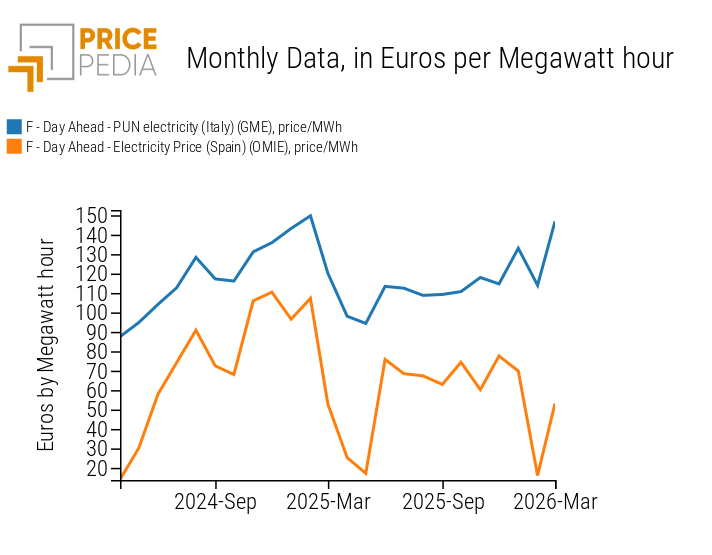
Spain provides a particularly illustrative example in this context. According to data from the transmission system operator Red Eléctrica de España (REE), Spain closed 2025 with a renewable energy share of 56.6%. Thanks to this high penetration, the average annual electricity price on the Day-Ahead market was 65.2 euro/MWh, with a low of just 17.5 euro/MWh recorded in May.
The role of renewables becomes even clearer when comparing Spain with Italy, where the average price of the Single National Price (PUN) on the Day-Ahead market (MGP) in 2025 was 115 euro/MWh, with a renewable share of 43%.
This gap highlights how a higher penetration of renewables contributes to lowering average electricity prices and, at the same time, reducing their dependence on gas costs.
The chart below compares Day-Ahead electricity prices in Italy and Spain.
A comparison of electricity prices in Italy and Spain
The analysis presented here focuses on the impact of renewables on electricity prices and does not address the issue of the technical feasibility of their increasing integration into the electricity system. The challenges that emerged during the recent blackout in Spain highlight how an increase in the share of renewables requires the parallel development of flexibility, storage and grid management systems.
The Effect of Renewables in Italy
The impact of renewable energy in reducing electricity prices is also evident in the Italian market. This effect can be quantified by estimating a function that links the PUN to its main determinants, including the variable costs of gas-fired power plants and the share of electricity generation from renewable sources.
Building on a first specification of the hourly electricity price equation (described in Hourly PUN price: is there a specific “hour” effect?), we extended the model to better capture the dynamics of the PUN in Italy through its key drivers.
Do you want to stay up-to-date on commodity market trends?
Sign up for PricePedia newsletter: it's free!
The main improvements introduced are the following:
- A variable representing the “standard variable production costs” of a gas-fired power plant was constructed, using the technical parameters adopted by ARERA to calculate the Clean Spark Spread. The average efficiency of gas in a power station has been set at 0.54, while CO₂ emissions have been estimated at 0.39 tonnes per MWh generated
- The share of electricity generation from renewable sources was split into three separate regressors, depending on its level, in order to test how the strength of the effect increases as the share rises, particularly as it approaches 100%.
- The regressors also include the shares of solar and wind generation as a percentage of total renewable production, in order to capture potential differences across technologies.
The table below reports the estimated coefficients.
Estimated Coefficients of the Hourly PUN Equation
| Coefficient | Estimated value | Standard error | t-statistic |
|---|---|---|---|
| Constant | -11.04 | 0.94 | -11.70 |
| Standard variable cost (euro/MWh) | 1.03 | 0.006 | 159.54 |
| Electricity demand (GWh) | 1.68 | 0.014 | 116.65 |
| Share (%) of electricity generation from renewable sources | |||
| below 70% | -0.44 | 0.010 | -43.51 |
| between 70% and 80% | -0.70 | 0.010 | -68.60 |
| above 80% | -1.02 | 0.020 | -51.30 |
| Solar share in renewables (%) | -0.44 | 0.006 | -73.81 |
| Wind share in renewables (%) | -0.28 | 0.007 | -40.85 |
| Dummy variables | |||
| non-working days | 8.22 | 0.258 | 31.89 |
| winter days | -2.22 | 0.273 | -8.11 |
| summer days | -2.37 | 0.265 | -8.94 |
The analysis of the results highlights several key findings:
- The pass-through of changes in the standard variable production costs of a gas-fired power station to the PUN price is complete. The estimated coefficient for standard costs, which is close to 1, indicates an almost full pass-through of cost variations to the final price and provides indirect confirmation of the robustness of the model.
-
Electricity demand and the share of generation from renewable sources have opposite effects on the PUN. As electricity demand increases, the PUN tends to rise, since progressively less efficient plants must be brought online, with higher unit costs.
Conversely, as the share of renewable generation increases, the PUN decreases, because demand can be met by relying on the most efficient gas-fired plants. The strength of this effect increases as the renewable share rises, as the likelihood grows that, in some zones, renewable generation fully satisfies demand, causing local prices to align with the marginal cost of renewables. - The price-reducing effect of renewables becomes even stronger as the share of wind and, especially, solar generation increases.
Impact of Renewables in the Coming Months
Using the results of this equation, it is possible to estimate the expected benefit in terms of PUN reduction over the next months of April and May, when the combined effect of the increase in the share of renewable generation and the rising contribution of solar within renewables will be at its peak.
Assuming that 2026 follows the same trends in renewable energy production as those observed in 2025,
the PUN is expected to decrease compared to March levels by approximately 17 euro/MWh in April and 23 euro/MWh in May.
Conclusions
The experience of the Spanish electricity market and the econometric estimation of the hourly PUN for Italy both highlight the strong price-reducing effect associated with an increasing share of renewable energy generation, particularly when driven by solar power.
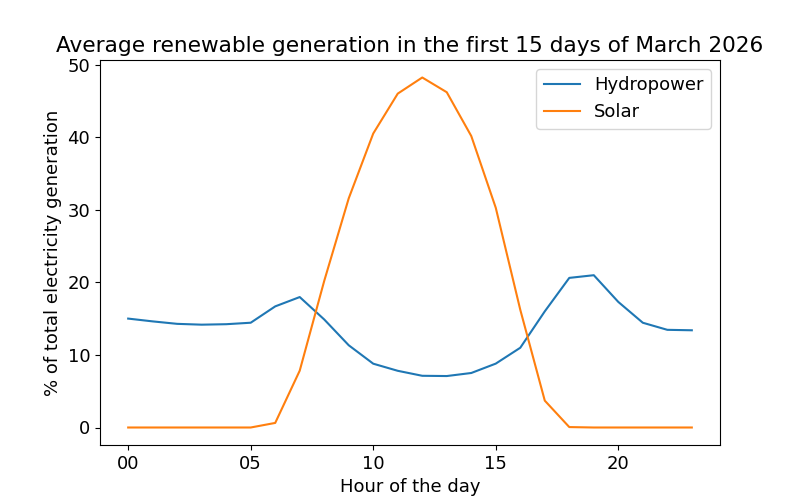
This is mainly due to the fact that solar generation is concentrated in specific hours of the day, increasing the likelihood that, during those hours, renewable generation is sufficient to fully meet demand in one or more market zones. However, it is the combined effect of all renewable sources that leads to a significant reduction in the PUN.
This effect is especially evident in the spring months, when higher solar generation is complemented by increased hydroelectric production.
Finally, it is worth noting that hydroelectric generation, also thanks to intraday price variations, is increasingly playing a storage role—accumulating energy during hours of high solar output and releasing it when prices are higher and solar production is lower.
You may be interested in:

The impact of renewables on the PUN remains limited in the long run
Published by Luigi Bidoia. .
Electricity's National Single Price Electric Power Price DriversSono ancora poche le ore in cui le fonti rinnovabili determinano il prezzo [ Read all ]

How the Italian electricity market has changed over the last 6 years
Published by Luigi Bidoia. .
Energy cost Electricity's National Single Price Electric Power Energy Transition Price DriversConsumi e mix produttivo: le basi per comprendere l’evoluzione dei prezzi [ Read all ]
PUN price: neither inverse decoupling nor a CO2 effect
Published by Luigi Bidoia. .
Electricity's National Single Price Electric Power Analysis tools and methodologiesLa quota di produzione da fonti rinnovabili spiega in larga misura il recente aumento del prezzo dell’energia elettrica. [ Read all ]